 Auckland, New Zealand
You’re ignoring this member’s posts.
Just released study finds no clear 3-month advantage for REM-based fitting in unilateral hearing aid users
74 replies715 viewsLast reply
In reply to @Hearing_Potential
The majority of doctors didn't wash their hands between dealing with dead bodies and delivering babies.
oh come on. Now you're just irrationally venting.
You’re ignoring this member’s posts.

Hearing_PotentialProvider
oh come on. Now you're just irrationally venting.
I'm pointing out that professionals don't always get things right. We're dealing with human beings and we're prone to error. It was well known that midwives had much lower infant mortality rates, but the doctors still ridiculed Semelweiss and helped send him to an early grave for suggesting that they wash their hands. There is a parallel between this and clinicians who have never adopted real-ear measurement.
Azah and Moore 2007 found that only 36% of initial fittings were within 10 tolerance of NAL-NL1 target from 0.5 to 4 kHz. A decade later, the proportion had increased to 63% (Munro et al 2016) which means 1/3 of clients weren't getting optimal results. More recent studies have reported further improvements in the manufacturer's initial fits. The availability of have helped to drive these improvements.
The sole purpose of real ear measurement is to reduce error. Would you trust a builder to build a house without taking any measurements? Why should you expect anything less from someone shaping your perception of sound when you have hearing loss. Is your ability to communicate with others not equally if not more important as the quality of the home you live in?
People wrongly think that poorly fitted hearing aids don't have consequences. This isn't true. I've seen children fail at school and life, adults lose their jobs and their careers and marriages fail because of poor audiological practice. There are serious safety concerns that arise for moderately-severe or greater hearing losses and poor fittings. This is an area where REM is essential because small errors can have massive consequences when you're dealing with a dynamic range of 10 - 12dB. Audiologists need to take their duty of care seriously.
You’re ignoring this member’s posts.

 Texas Hill Country
You’re ignoring this member’s posts.
In reply to @Hearing_Potential
In Australia and New Zealand everyone uses real-ear measurement because it has been emphasized by training programs and has been required by professional standards.
That's not what I've heard:
You’re ignoring this member’s posts.
Hearing_PotentialProvider
Tenkan is misinformed. He isn't based in Australia so can be excused for not understanding the local market. If funding is being applied for through the Australia Hearing Services program, then printous must be submitted along with the funding application. This funding is used by almost everyone who gets hearing aids in Australia.
You’re ignoring this member’s posts.

And something new from the HearAdvisor lab:
You’re ignoring this member’s posts.
Hearing_PotentialProvider
This is a worthwhile study. Well done Abram and HearAdvisor Team 
"The present findings suggest that advances in hearing aid technology do not inherently improve prescriptive target matching under Initial Fit conditions. Instead, they highlight that verification and clinician-driven tuning remain integral components of best-practice hearing aid fitting, including for the most recently released devices."
The graph below shows the mean error from target for first fit algorithms for soft, average and loud inputs for flagship hearing aids from 2021 - 2021 (older), 2023 (mid) and 2024 - 2025 (newest). As you can see prior to verification there is still a significant amount of error. For individuals with moderate or greater hearing losses these errors can be the difference between good and poor performance.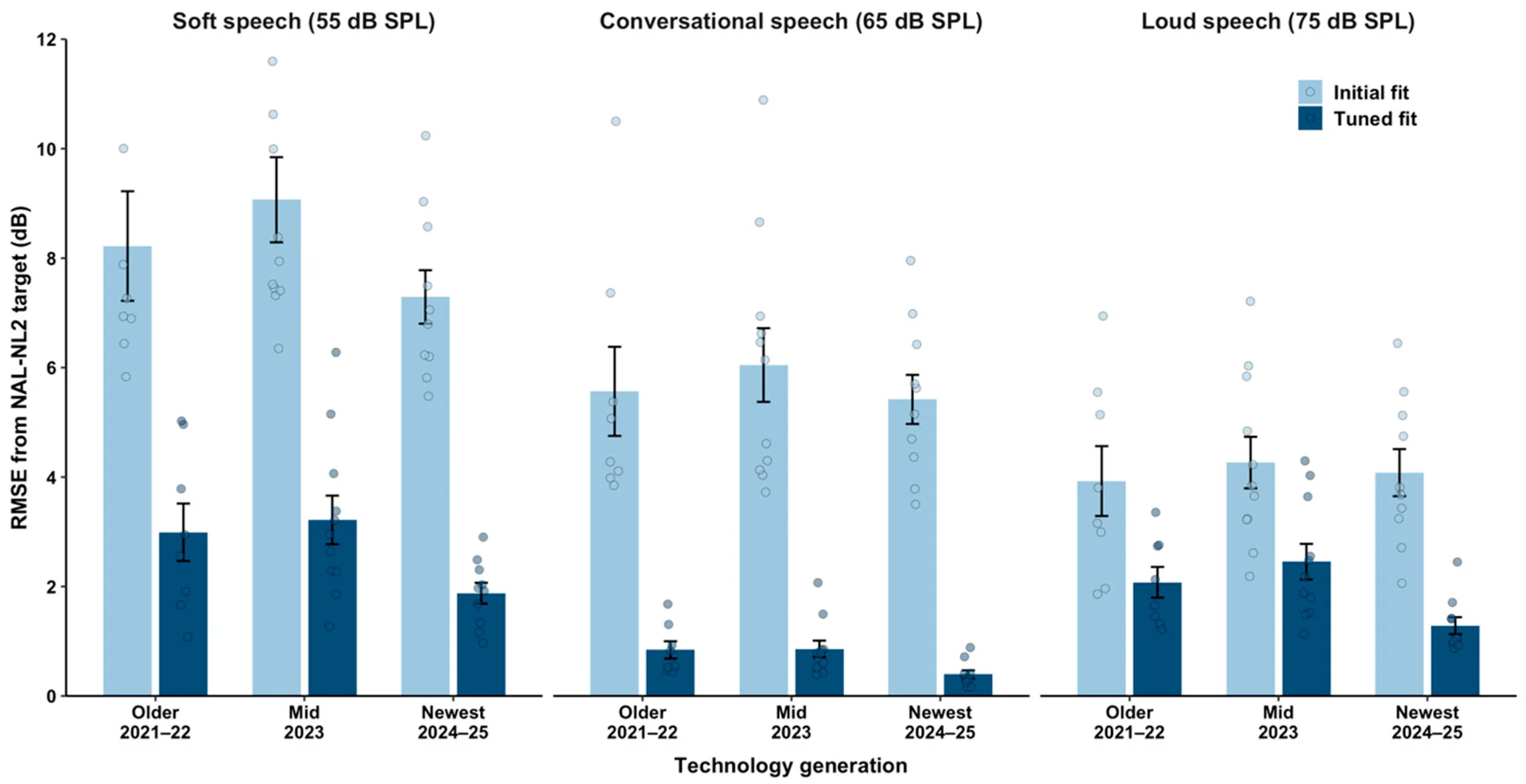
You’re ignoring this member’s posts.
well, yeah: "first fit".
But who here ever stopped getting adjustments--or for the folks, making them--and never went back after their initial settings from a new pair of aids?
"first fit" isn't the gold standard for people who've worn over some many years. Of course not. "third or fourth fit" is where things come into focus, one way or another.
For those of us who want to optimize our new hearing aids, going back to our providers to make initial adjustments is standard. Of course!! so the question is, does provide a better outcome to those who take the trouble to dial in their aids to their particular hearing loss, preferences, environments and needs? Or, does REM result in no need to go back and have the "first fit" adjusted because, you know, the REM protocols have been met?
No one accepts this last.
Getting the optimum out of ones' new hearing aids requires paying attention to how they function in various environments FOR YOU; and then describing that to your tech and making a series of adjustments. I'd guess that studies would find the end result for those who take the time to do this--and it's not much time!--have better outcomes than those who don't--initial REM or not.
REM doesn't eliminate the need for tweaks. I suppose those who want a 'one and done' result--"first fitting"--may be happier with REM, and that may in fact give better results.
You’re ignoring this member’s posts.
Hearing_PotentialProvider
The point is, if you haven't measured the actual output of a device is in the individual's ear i.e. the environment in which it is being used, then all fine tuning is just guess work.
Using at the initial fitting applies the best science to the fitting. When done correctly, speech intelligibility can be optimized from the beginning and it is easier to then take care of user preferences. The average number of follow-up appointments with this approach is on average less because we reach the end point that optimizes speech understanding and meets users preferences faster.
It is near impossible to predict individual user preferences, but we've taken into account everything we can predict and measure when REM is done correctly.
It's like the difference between shoes custom made for your feet individual feet using carefully crafted materials and off the rack discount vegan leather (plastic) shoes that only come in an average size. When you're paying as much as you do for hearing aids, you should expect the best fitting practices that give you the highest chance of success with the least amount of guesswork.
There would be very few clinicians who use REM like you suggest. There is always fine tuning for individual preferences. You're the only person I've met who has ever suggested otherwise.
You’re ignoring this member’s posts.
I suspect one of the reasons that there is a relatively low rate of use of among U.S. audiologists can be found in the very final sentence of the conclusion to the study provided by Abram Bailey , " Whether these modest improvements in target matching translate into clinically meaningful benefits for hearing aid users remains to be seen."
You’re ignoring this member’s posts.
Hearing_PotentialProvider
Whether these modest improvements in target matching translate into clinically meaningful benefits for hearing aid users remains to be seen."
The word "seen" is not in this paper. If you're going to cite a source in quotation marks please don't paraphrase, especially when no context is provided. I think what you're referring to is this sentence:
"Whether the modest improvements observed in more recently released hearing aid generations translate into meaningful benefits in speech understanding, listening experiences, or patient-reported outcomes remains to be established."
This isn't a finding of the study. It is a limitation of this specific study from the paragraph in the conclusion discussing study limitations. It is definitely not a comment on the utility or clinical relevance of .
You’re ignoring this member’s posts.
Please disregard my post above, I misunderstood that the " modest improvements in target matching" is referring to newer prescriptive target matching technology employed by manufacturers, not .
You’re ignoring this member’s posts.
You’re ignoring this member’s posts.
You’re ignoring this member’s posts.
 England, UK
I will add my further two cents, as I appreciate that my earlier post has been unintentionally slightly misleading. I did say that could offer you a single fit and you didn't have to come back for further adjustments. I will clarify that statement as it's not entirely accurate.
Without REM, I have to go for repeated appointments just to address issues with new hearing aids. Issues such as right ear, uncomfortably louder, right ear much louder than left, typing on the keyboard is unpleasant and sound cuts out, voices sound thin, cold and flat, vowels are not properly rounded etc and many other "issues".
With REM, I basically have none of that, or these issues are considerably reduced. So REM in one fitting gets me there a lot quicker than having to go to multiple appointments just to get to the point where the hearing aids don't have all these niggles and issues.
Having said that, I have been for a couple of appointments with my audio, since REM largely to address a very challenging audibility issue and to tweak the volume balance between my ears further.
So, technically, REM does not solve everything on first fit, but it does in one fitting achieve a lot more than an audio who does not use REM can do, where I have to go for at least a dozen appointments to reach the same point that I reached with my new audio and REM in one fitting.
I am not a fanboy of REM because I like new toys. I am a fan, because with two completely separate audios and hearing aids, I saw a considerable difference between no REM and with REM! REM just gets me to the end destination quicker, with less guesswork.
You’re ignoring this member’s posts.
"first fit" isn't the gold standard for people who've worn HAs over some many years. Of course not. "third or fourth fit" is where things come into focus, one way or another.
For those of us who want to optimize our new hearing aids, going back to our providers to make initial adjustments is standard. Of course!! so the question is, does REM provide a better outcome to those who take the trouble to dial in their aids to their particular hearing loss, preferences, environments and needs? Or, does REM result in no need to go back and have the "first fit" adjusted because, you know, the REM protocols have been met?
My Costco experience so far tells me that their business model is, in some part anyway, hoping that there's no need to go back. They don't seem to want follow-up visits. For some people the "good enough" that you get from + 1 follow-up adjustment is what they'll accept. Guess it's following the idea of not letting perfect get in the way of good. OK, sometimes that's a valid approach... Not sure if I like it for this case, but there probably is a wise balance in there somewhere...
Anyway, I wonder about this idea of REM being some sort of gold standard....
Now I understand that are considered to be scientific, repeatable, accurate, or whatever. I'm a mechanical engineer and I tend to think about things critically with some attention to detail. I really don't know much about this whole field of science, but I do have some exposure. I've taken annual hearing tests required for my industrial work for pretty much my whole adult life, since long before I had a meaningful hearing loss. I have ALWAYS felt that they are an approximation at best. They are loose and sloppy. I reckon that they are a nearly perfect example of not letting perfect get in the way of good enough.
Isolation booths still let a lot of outside noise in. There are errors in positioning of the headphones, I can hear myself breathing, I get nose form the wires and cords rubbing, etc... all sorts of interference keeping me from hearing every beep. But even if you accept that the test methods clear out most of that error, we're still only testing a finite number of frequencies. Seems like the human hear can discern many more different frequencies than what is tested...approaching infentity I suppose...so that means that there's some interpolation and extrapolation going on a long with some assumption...
And then there's the REM test. Now I've only had it done the one time so I'm no expert on it for sure, but seems to me that there's a ton of noise in that test too. There's the audiogram test stuff + placement errors for the mic, for the receiver, for the speaker, probably tolerance errors and all sorts of stuff.
Add in all the subjective psychological, neurological and brain stuff??? I don't know, that might complicate things more or it might actually simplify back down to the point of explaining why it's good enough as we're doing it...maybe???
Anyway, my thought is that it's just an imperfect tool. One of many.
And it seems to me the fine tuning comes from the long term experience of life+ further adjustments. So, for long time hearing aid wearers, why didn't Costco pull up the settings in my old hearing aids and use that as a basis? Seems to me that as long as it's in the same brand family the changes are incremental at most from one model to the next. In my case I know my Marvels weren't set up perfectly, but they were pretty good. After a little more than 1-1/2 months with these Sennheisers I would guess that they are only incrementally different from the Marvels but not monumentally different. Wouldn't something like that also help to land closer to the end Target right out of the gate at the first visit?
You’re ignoring this member’s posts.
Hearing_PotentialProvider
It's clearly listed as from @ronshere. If you don't understand how automatically-generated summary emails from user forums work, consider unsubscribing from them to avoid the distress and visit the forums manually. I do.
You’re ignoring this member’s posts.
So, technically, REM does not solve everything on first fit, but it does in one fitting achieve a lot more than an audio who does not use REM can do, where I have to go for at least a dozen appointments to reach the same point that I reached with my new audio and REM in one fitting.
I think that this is probably true. This statement has me thinking about the audiologist variable + the patient variable. Seven years ago when I was getting set up for my first hearing aids, I had the feeling that these two variables were very significant. I could be all wrong about it, but I had the feeling that the audiologist was using her experience (I think she'd been at it a long time, she wasn't inexperienced). She probably knew that it's going to take a while for my brain to adapt...so MAYBE she did things purposely taking my fit "off target" such as turning down some stuff that she knew would be too 'hot' and shocking to me...knowing that in a few weeks or a month's time that I'd be ready to turn it back up. There were quite a few follow-up visits over the next couple of months, and I remember going to her with different scenarios of things being to loud or not loud enough and she'd make little changes. Eventually that slowed and things got balanced into place.
Anyway, my point is that I wonder if it had been an inexperienced audiologist and had she done and just blindly set the program based on my , would we have really landed on Target faster? Or would I have rejected the hearing aids?
You’re ignoring this member’s posts.
Hearing_PotentialProvider
Costco is a low cost provider. Clinician time is the most valuable resource after clinician expertise. Costco limits your time with clinicians as part of their business model. There are trade-offs in life. If this is a deal breaker for you, don't use Costco in the future.
You’re ignoring this member’s posts.
Log in to reply to this topic.
Active discussions
What the forum has been talking about this week.
Fitting Software Requests1.1k replies
Uncategorized451 replies
Hearing Aids168 replies
Fitting Software Requests511 replies
Hearing Aids72 replies