
I’m not sure what they’re doing in this paper either. It almost sounds like they’re seeing how close the
First Fit comes to taget. If so, seems pretty meaningless.
You’re ignoring this member’s posts.
This topic is closed.
40 replies4.5k viewsLast reply
I’m not sure what they’re doing in this paper either. It almost sounds like they’re seeing how close the
First Fit comes to taget. If so, seems pretty meaningless.
You’re ignoring this member’s posts.
I too, had never heard of the terms until last May. I have Phonak Naida V90up since Dec 17 long time phonak ha wearer. Have worn Phanak Naida since 2014 was not fitted right. Word recognition was terrible. My audi added a manual speech in noise program in April of 2019 because the phonak auto sense programming was terrible which helped to stabilize my ha in different listening environments. But I still had terrible word recognition. Read about the different ha fitting formulas on this forum. Tried did not help but one poster said the v5a really helped him so I switched and my word recognition really went up. This forum has proven invaluable to me and countless others who want to improve their hearing health.
You’re ignoring this member’s posts.

I’m not sure what they’re doing in this paper either. It almost sounds like they’re seeing how close the First Fit comes to taget. If so, seems pretty meaningless.
Yes, that seemed like a strange thing to do. The real issue is how does that target sound? Does it improve speech recognition? They did do some of that, but it seemed to be lost in all the reporting of fit accuracy. The paper certainly has a worthy objective, but the report was poorly written. It seemed that the report got sidetracked into trying show the value in , when the objective should have been to determine the value of the specific formulas.
You’re ignoring this member’s posts.

Hi folks
Tis very interesting and for me tis likely I will keep on trying different setups… I do enjoy tinkering with my aids, but unfortunately I lost all my settings on my Laptop last week, when it died on me! I had to buy a new Window’s laptop as everything else I have is Apple! Yesterday I did a fresh installation of Target, did all the updates and decided to try my again instead of the direct version, seemed fine but definitely it was not perfect, so today I changed to “” and that made a big difference in overall clarity, so I will try this for a while hopefully and see how it goes… With my inquisitive nature I will probably try every setting at some point or other? Meanwhile, I have still to face my audiologist next week, and I am likely to get my knuckles rapped for their settings no longer appearing in these marvels! Cheers Kev
You’re ignoring this member’s posts.

Be sure to warn your audiologist. The default for Target is to always load the settings from the Marvels. The audiologist will want to load the settings on their Target software “to” your Marvels. That way the audiologist’s settings won’t be lost too.
You’re ignoring this member’s posts.
Sierra said “What I find interesting is that hearing aid users don’t blink about trying 2, 3, or more different brands of hearing aids, but do not even consider simply switching the prescription formula.”
That is a reasonable observation, but I suspect that most folks, like me, were totally unaware of those various fitting programs. I’ve been using the same audiologist for at least 20 years and he has never mentioned that to me.
I will ask him at my next visit when the Phonak Marvels with disposable batteries finally come in for me to try.
You’re ignoring this member’s posts.
I’m sure you audiologist will have all the various settings and formulas saved and backed up. No sweat for them to restore them. That said it is a crap shoot just changing formulas with the software and not doing the adjustment to target. You basically don’t know what the levels actually are in your ears.
You’re ignoring this member’s posts.
I’ve been using the same audiologist for at least 20 years and he has never mentioned that to me.
I suspect most audiologists think it is over the head of most clients and don’t want to take the time to explain it to them. And unfortunately some want to get you in and out with the least time expended on their part. And to be fair they also have a lot of experience in what formula may be best for you. That however is their judgement, and can’t hear what you hear. There is always some merit in trial and error.
You’re ignoring this member’s posts.
I suspect most audiologists think it is over the head of most clients and don’t want to take the time to explain it to them.
I don’t think that is the case with my audiologist. He knows I am a retired engineering professor. He once loaned me his Noah interface box over a weekend to let me experiment with my own settings in a classroom. But that was quite a few years ago.
You’re ignoring this member’s posts.
Thank you for that reply Sierra… I think Target warns you if your is way too high, one of the reasons I stop using “ Direct” is that in my left ear it was in certain frequencies as high as 132db and I could’nt for the life of me quite get it back down? Perhaps because AD doesn’t go up too 120db even if you tick the box, Target kept warning me about the high gain… that level was not safe or sustainable, Cheers Kev
You’re ignoring this member’s posts.
I’m not sure what they’re doing in this paper either. It almost sounds like they’re seeing how close the
First Fit comes to taget. If so, seems pretty meaningless.
Yeah, it’s not great. But just to clarify, it looks to me like they measured real-ear-to-coupler differences (basically, a measure of individual ear canal acoustics) and inputed those into the manufacturer software and assumed that this would create a pretty good individualized fit to target without actually fitting to target. However, they seem to indicate that they did at some point confirm a +/- 5 fit-to-target from .25 to 2 kHz if you trust their brief mention of this in the discussion. In any case, all users were in the same hearing aids.
Then they calculated and compared speech intelligibility index, which they spend a lot of time talking about. They also did some speech-in-quiet and speech-in-noise testing; notably, beat out NAL in both of these tests, although it’s hard to confirm because they spend zero time discussing how the is typically scored or what the numbers they show in that table actually represent.
You’re ignoring this member’s posts.
Annnnnd… Target’s “Feedback and real ear test” (FARET) seems to have a repeatability problem, at least for me.
For your viewing convenience, here’s a copy of the gain prescription I posted above in this thread, based on the FARET from a few days ago:
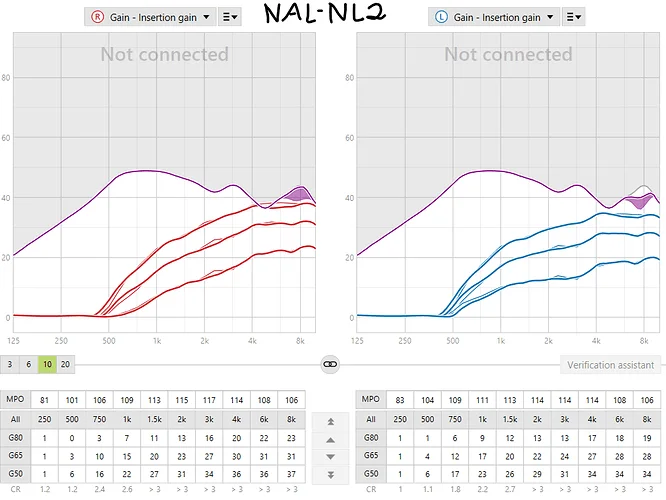
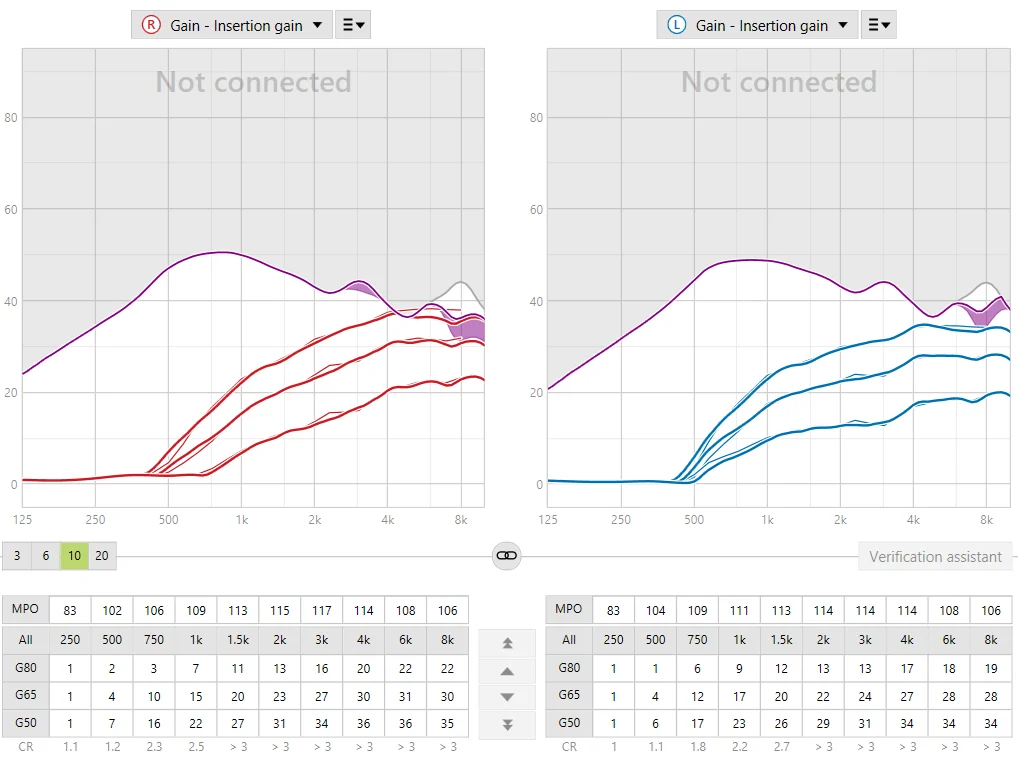
I’m unaware of any ambient noise or physical insertion differences between the original and new test results.
You’re ignoring this member’s posts.
The fitter at Costco that does my KS8 aids uses the Critical Gain test to determine feedback potential, but does not allow it to limit the gain. She limits the gain manually based on my input on when I have feedback. She knows pretty much where it will be based on what the Critical Gain tells her.
You’re ignoring this member’s posts.
Target allows the fitter to tune gain beyond the feedback threshold.
I mentioned in my original “four fitting formulas” post that there was an unexplained difference in feedback threshold between and . I’m guessing that there’s some factor in the feedback test that is as yet unknown to me.
You’re ignoring this member’s posts.

I found this post to be very interesting, as I’ve been experimenting with v5.0a. I’ve been wearing hearing aids since 2019, now using Lumity 90-RT with Phonak ear molds. I have also been using Adaptive Phonak Digital. I tried ADP Contrast, but speech and streaming audio were not clear. No Real Ear Measurement () involved. I had that performed several years ago on my Marvel 70s and hated it. FWIW for every audi that swears by it, I can find 4-5 that laugh at it. I had on audi look at my and said REM would not improve my ability to hear speech in high background noise. I looked at your audiogram @focusandearnit and above 500 Hz we have similar losses. I wonder if the differences in our losses between 250 Hz and 500 Hz is what makes ADP work for you.
This past July, I woke up with further decreased hearing in my left ear. I was examined by Otolaryngology Department of Northwestern Memorial in Chicago. I was given two rounds of intratympanic steroid injection with minimal improvement. I was told it might be time to consider a C.I., to which I am opposed.
I decided I wanted to try and get the best out of my Lumitys. While researching DSL v5.0a vs NAL NL-2 (there isn’t a lot written about ADP) I read the following:
DSL v5.0a provided better speech perception in silence
DSL v5.0a performed better than in certain areas, including:
evaluation in medium frequencies for medium input sounds
Low and medium frequencies for soft input sounds
calculation for medium and loud input sound
test in silent and noisy situations
I’ve been using DSL v5.0a for a month and I find:
My only complaint is that sound in my left ear at times sounds too strong, over driving. I’m not sure how to adjust the left without effecting the right so I will live with it for now.
This is going to sound strange. In my bedroom, I have a hand held radio scanner on, low volume, 24/7. When I change from DSL v5.0a to NAL NL-2, the scanner audio is a bit louder, and a bit clearer.
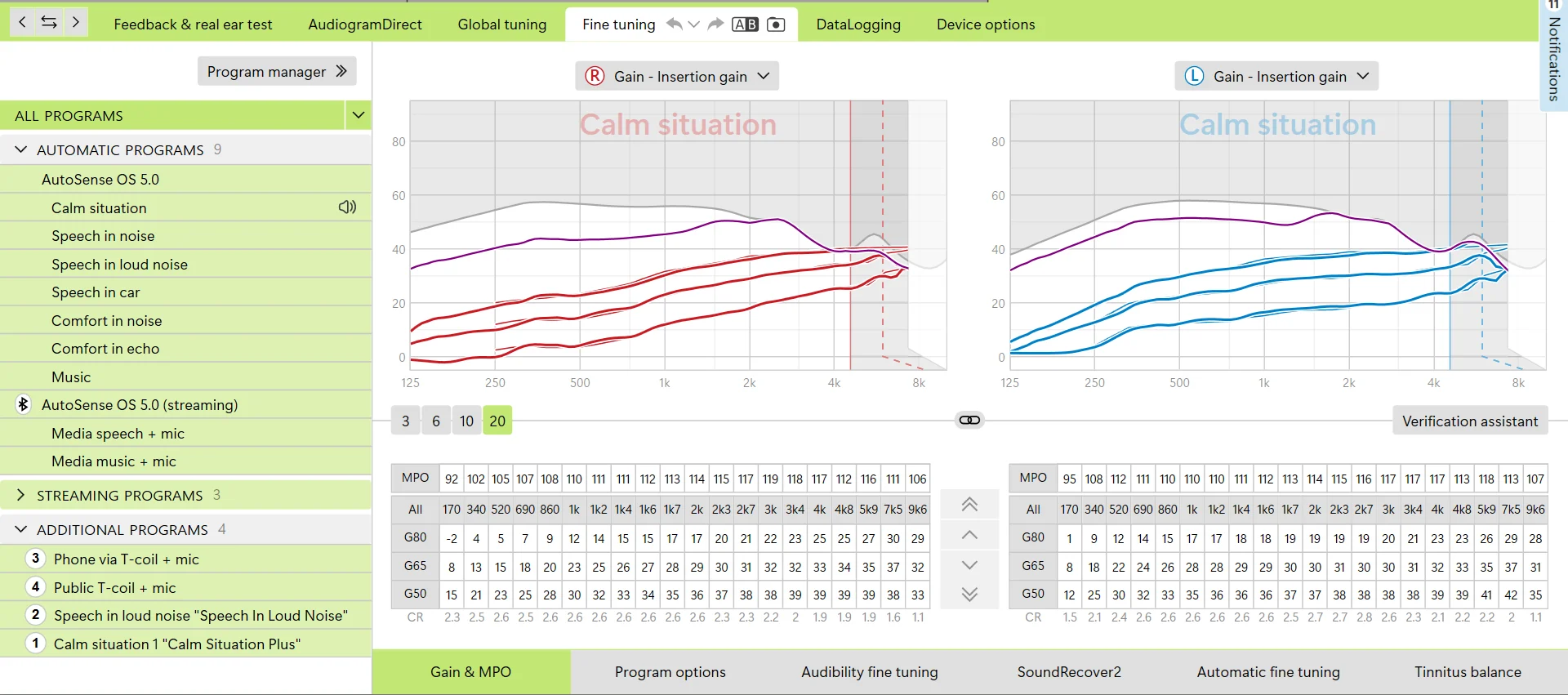
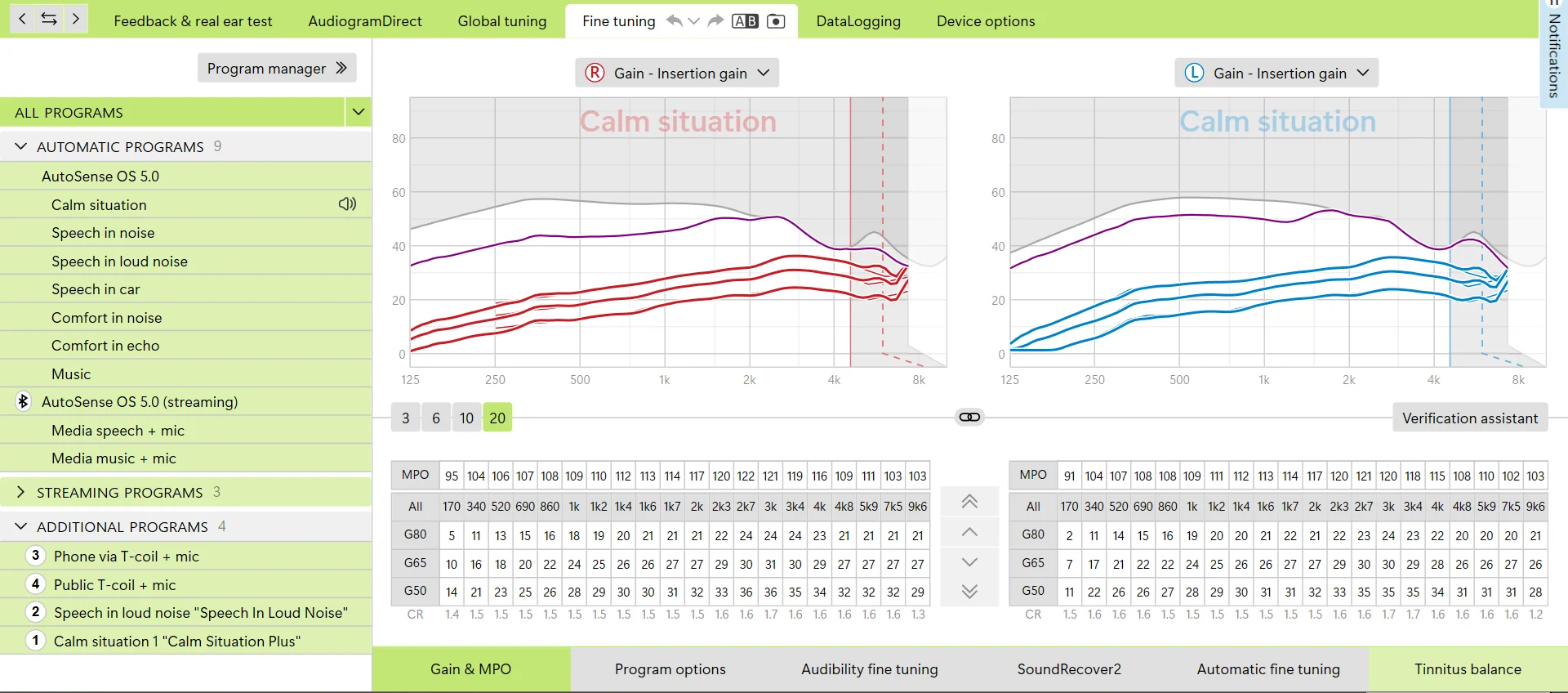
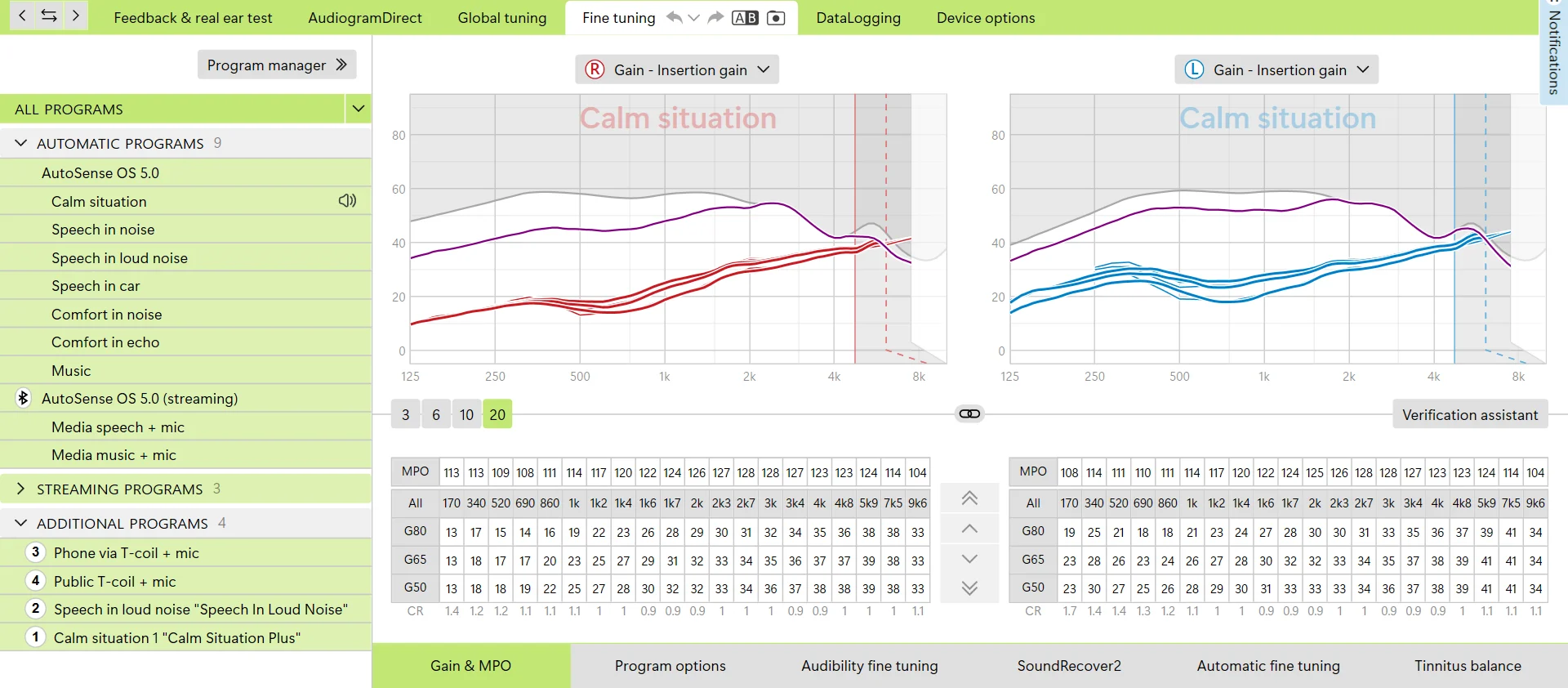
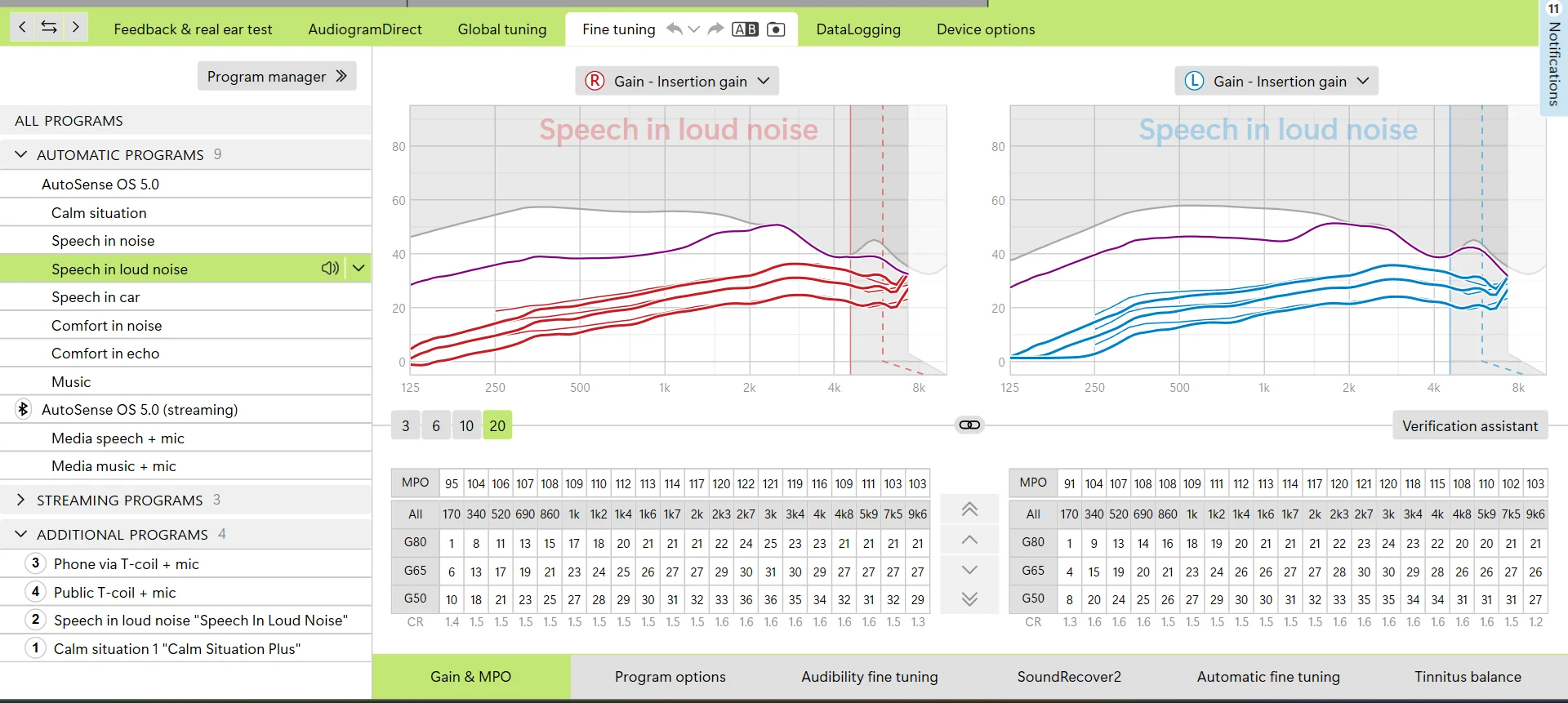
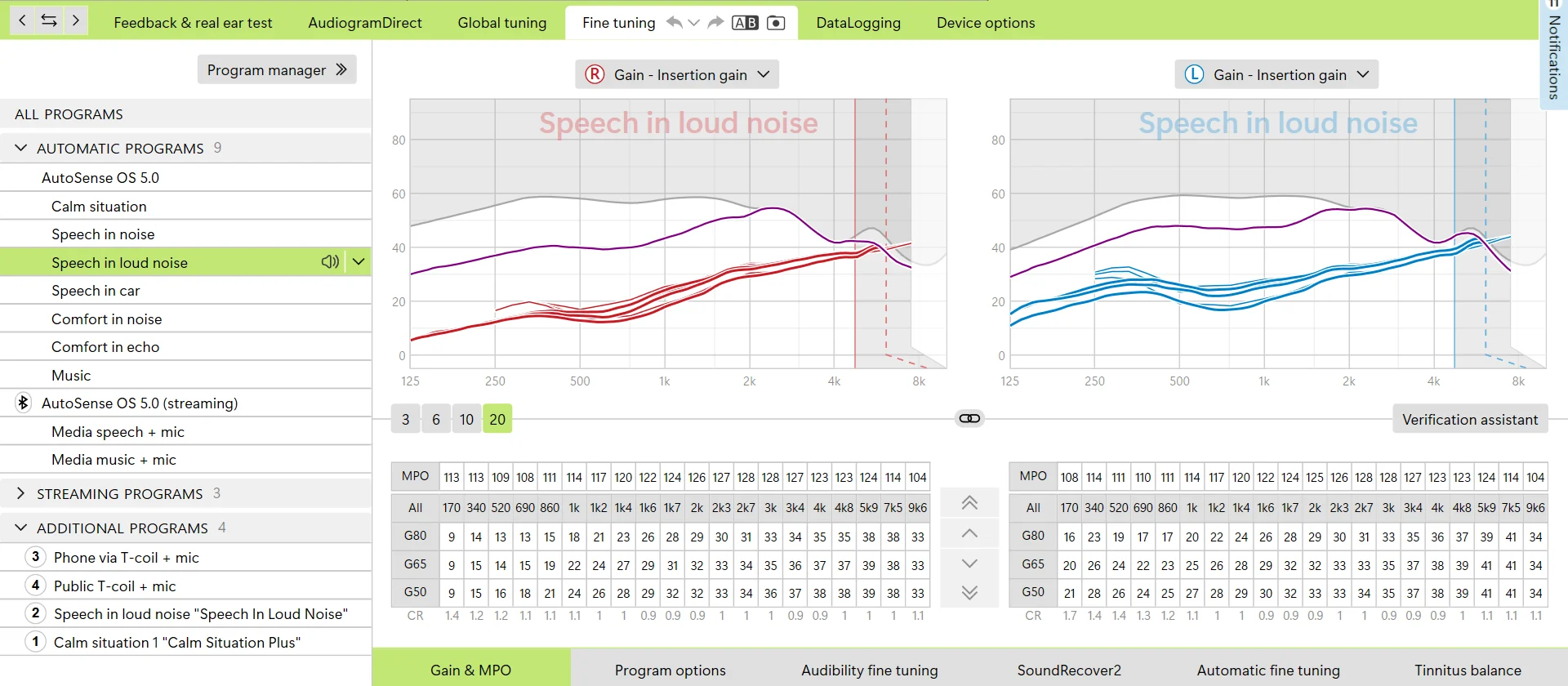
I struggle in noisy venues, as does probably 90% of hearing aid users. The last two images were screenshot of the Speech in Loud Noise mode. I wanted to see the differences between ADP and DSL v5.0a. Clearly DSL v5.0a gives more amplification. I do use a Roger On microphone when needed.
The screenshots top to bottom:
NAL NL-2 - Calm Situation
ADP Calm - Situation
DSL v5.0a - Calm Situation
ADP Speech in Loud Noise
DSL v5.0a - Speech in Loud Noise
Thoughts?
You’re ignoring this member’s posts.

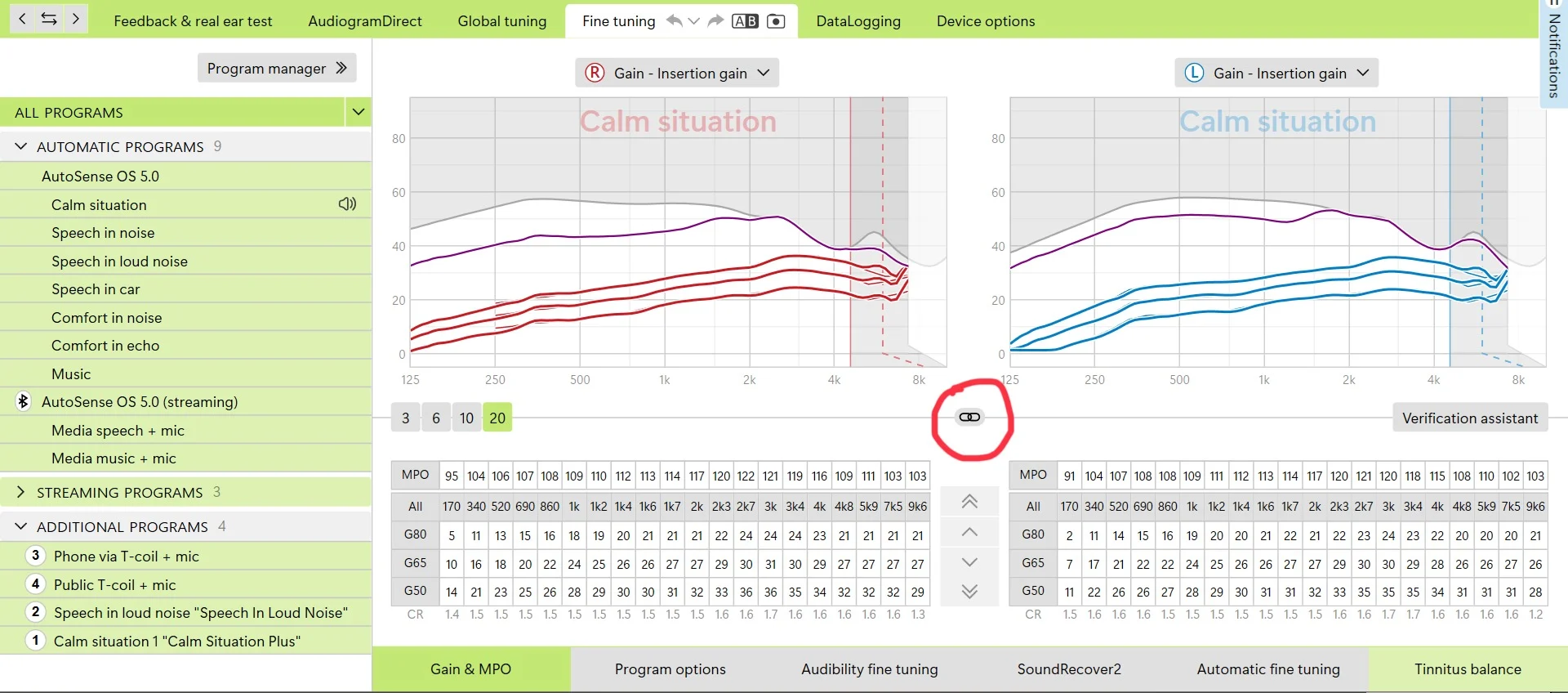
I’m not sure how to adjust the left without effecting the right so I will live with it for now.
Where I’ve circled in red, if you click that icon, you can adjust left OR right.
You’re ignoring this member’s posts.
You’re ignoring this member’s posts.
FWIW for every audi that swears by it, I can find 4-5 that laugh at it.
I mean, it does take some skill. As a clinician if you suck at it, you may struggle to see the benefit.
I was told it might be time to consider a C.I., to which I am opposed.
Why, out of curiosity?
You’re ignoring this member’s posts.
The M.D. was quite frank, which I appreciate.
You’re ignoring this member’s posts.
Okay, but. . . all that being said, if you’re going from 10% to 80% speech clarity is it worth it?
Sometimes I think people are a bit unclear on what it means to “re-learn” how to hear. It’s less like learning a new language and more like strengthening a muscle. You have to work at it, but once your brain figures it out things sound pretty normal again.
You’re ignoring this member’s posts.
Hearing Aid Self-Fitting (DIY)2 replies
Hearing Aid Self-Fitting (DIY)3 replies
Hearing Aids32 replies
Hearing Aids169 replies
Hearing Aids19 replies

 Scottish Highlands
 Atlanta, Georgia, USA