 SoCal
@cvkemp Maybe your present Audi can fine tune the gains, and sound controls to better suit your loss.
At least try it.
You’re ignoring this member’s posts.
This topic is closed.
226 replies11.1k viewsLast reply
@cvkemp Maybe your present Audi can fine tune the gains, and sound controls to better suit your loss.
At least try it.
You’re ignoring this member’s posts.

From what I have seen with the Gene2 software there isn’t much that hasn’t be tried. Also I haven’t ever been able to truly be comfortable with music, even when I was a teen and in my 20s. And when I went in Navy boot camp I wasn’t able to understand Morse Code, I wasn’t able to tell the difference between dots and dashes.
You’re ignoring this member’s posts.
I think it shows how are brains are different when processing sound. Some sounds you “picked up” we’ll and others not. I think it’s reflected in how two people can have the same (a pretty objective way for a side by side comparison) but describe and truly experience their hearing loss in utterly different manners. Fortunately we have options we can adjust to try and create an experience we can live with and even enjoy. I guess we all should be grateful for that.
You’re ignoring this member’s posts.
I can live without music, but not without understanding speech the best possible and that Is what I have spend my time relearning and why I have spent so much time pushing myself and my Audi to get me the best fitting possible.
You’re ignoring this member’s posts.

@cvkemp: Well, Chuck - it may well be true that you have a “tin ear”. LOL. In that case, even Oticon “Most1s” won’t save your bacon (if they made such a thing)!
However, if you’re aware that the organ is louder than the choir, and it’s spoiling your enjoyment of the music in church, odds are you don’t have a real “tin ear”.
I realize that you think the world of your audiologist, but perhaps he’s just not aware of the finer points of tuning for music.
It’ll basically open up the frequency response without all the compression, and other “speech” enhancements that ruin music
I agree with the above statement 100%. But if you haven’t heard the difference between the “processed-for-speech” sound and the “flat” sound of a dedicated music program, I’d say that it wasn’t set up correctly.
[And that’s strictly my opinion, Chuck, and the beauty of having a dedicated music program is that it won’t interfere with your speech program at all!]
You’re ignoring this member’s posts.
I have always been, either enjoy instrumentals, or I enjoy someone or some group singing. I haven’t ever enjoyed both in the same music.
You’re ignoring this member’s posts.

For what it’s worth, to me the default program in my OPN 1 is good enough to listen to music. But with the built-in Music program, it sounds even a little more “open” because it changes the Directionality setting to Fixed Omni (from Open Automatic), and it turns off the noise reduction.
While I like to use the Music program for music listening better, I find it very acceptable to listen to music with the Default program as well. If you have an extra program lying around unused, I’d assign it to the built-in Music program. But if all the programs are used up for something else already, then it’s no big deal to listen to music with the Default program.
You’re ignoring this member’s posts.
@Volusiano has alluded to this before: there’s not much difference between More2s and More1s. The gap between More1s and More3s is much greater
To be honest, apart from the cleardynamics feature I doubt this statement. I saw the tech.sheet and i think there are more similarities between 2 and 3 then 2 and 1?
More2 is ordered by the way, for trial. Tested the 1 and 3, so now let’s make the list complete 
You’re ignoring this member’s posts.
I think if you simply go feature by feature count with equal weights for the features where the More 2 is either the same as the More 1 or the More 3, then you’re correct that the More 2 has more similarities with the More 3 than with the More 1, feature by feature.
But if you put different weights on different features, then I would give Clear Dynamics a very heavy weight compared to, say, Virtual Outer Ear options, or Spatial Sound # of estimators, or Fitting Bandwidth, or Processing Channels, where the More 2 is the same as the More 3. But this is only because I value the importance of listening to music. For folks who don’t care about music much, this may not have a heavy weight for them. But for me it’s a deal breaker not to have this and I would pay more for the More 2 just to have this.
Neural Noise Suppression is another heavier weight feature in my opinion. The spec shows 6 for the More 2 and 3, and 10 dB for the More 1 for Difficult Environment Max value. I really wish they would have given 8 dB to the More 2 here to be more fair, but instead they chose to give the More 2 only 6 dB like with the More 3. This 4 dB difference between the More 1 vs More 2/3 is not (10 dB vs 6 dB) may or may not be a deal breaker for you depending on how often you find yourself in very noisy/difficult environment and need to understand speech better. If you’re not in a noisy/difficult environment often enough, then this 4 dB difference may not matter much to you.
In a previous post, not sure on which thread, I said that I thought perhaps Oticon misprinted the Max Neural Noise Suppression for Difficult Environment and it should have been 8 dB instead of 6 dB. Well, I guess I was wrong, because if I chose the More 2 for my option in Genie 2, it would confirm that you only get the 6 dB option and there’s no 8 dB option for the More 2.
The ability to define which is the Easy Environment and which is the Difficult Environment -> Environment Configuration, shows that the More 1 and More 2 have 5 configurations, while the More 3 has only 3 configuration. But I don’t think it’s a heavy weight feature here because the extra 2 environments -> Very Simple and Very Complex seem to be redundant for me because it’s obvious you don’t really want to categorize Very Simple in the Difficult Environment and Very Complex in the Easy Environment in the first place.
So the bottom line to me personally is the existence of Clear Dynamics. In this regards, because it’s a deal breaker to me, it makes the More 2 seem much more “capable” than the More 3 and closer to the More 1. The other stuff I can probably live without, like the 4 dB difference in Max Neural Noise Suppression in Difficult Environment, because I rarely find myself in noisy places in the first place.
But of course other people may have different priorities.
You’re ignoring this member’s posts.
Fair enough, but weighting is always personal.
I am not too familiair with all different terms, but I realise that, though music is very important for me (and yes, not having that cleardynamics thing is a showstopper for More3) I also have a job to be done and a family to listen to  So other features are important as well. And then indeed I see several options on the More2 closer to the 3 then the 1. Hence my remark.
My audi send me this tiny little vid https://www.youtube.com/watch?v=8nPjObrFKzE9 , for those still wondering what that Cleardynamics thing is about.
You’re ignoring this member’s posts.
You’re ignoring this member’s posts.
yes.
I do have a certain sense to want to have the best and most exiting device available here. However, the question is whether the extra posibilities are value for money. With my audi, the price difference between 3 and 2 is 200 euro’s, and the difference between 1 and 2 is another 300. That is quite some money for wanting ‘the best’.
Now, there is 1 odd thing. A huge difference between for example Phonak and Oticon.
You see, I wear devices for over 45 years now, since I was 6. Yes, still from the time we had these refridgerator size things behind our ears. That means I have spend years using analogue devices. And us ‘analog’ guys seem to be the worst customers audi’s have 
As for me, I like to have a steady environment. I frigging hate it when I hear my aids adapt. It makes me feel I miss things. Feels like my batteries may be dying or something.
Now the funny thing is: with most devices this can be kind of imitated by getting to lower techlevels and disabling many features. I was kind of settled on the unitron Moxi 3/phonak P30 before I gave the More a try.
However, with the more, the only way to open up the sound of your environment is to get the higher techlevels. Because in the lower techlevel you simply cannot change the concerned setting.
You’re ignoring this member’s posts.
 Oops! I was basing my groupings on Neural Noise Suppression for More2 being 8dB, and not 6dB! This muddies the waters.
The idea of weighting the features is legitimate, especially for musicians and music lovers who listen “over the air” in real time, because the ClearDynamics feature is so effective at rendering the music without clipping at the input stage.
Having used Oticon More3s as well as More1s, I can vouch for the improvement ClearDynamics and 10dB of Neural Noise Suppression make to the performance of More1s … but not $1,500 worth.
Knowing the premium of More2s over More3s would be helpful. I’ll see what I can dig up.
You’re ignoring this member’s posts.
You’re ignoring this member’s posts.
@akk: Thanks for posting this informative and helpful paper. (Just a heads up that it was written for the Velox platform, not Polaris, which probably makes no difference in the operation of ClearDynamics.)
You’re ignoring this member’s posts.
You’re ignoring this member’s posts.
Agreed, but the principle is the same, I think. I expect that @Volusiano will eventually comment on this.
You’re ignoring this member’s posts.
I am sure the code has been cleaned up and made more efficient also. But yes I am sure the principal concepts are he same
You’re ignoring this member’s posts.
@cvkemp: Chuck, what I found interesting was this “look ahead” approach to limiting .
Although the principle is no doubt similar, I agree with you 100% that the greater speed of Polaris, plus optimization of the code will, in fact, enhance ClearDynamics’ effectiveness.
You’re ignoring this member’s posts.
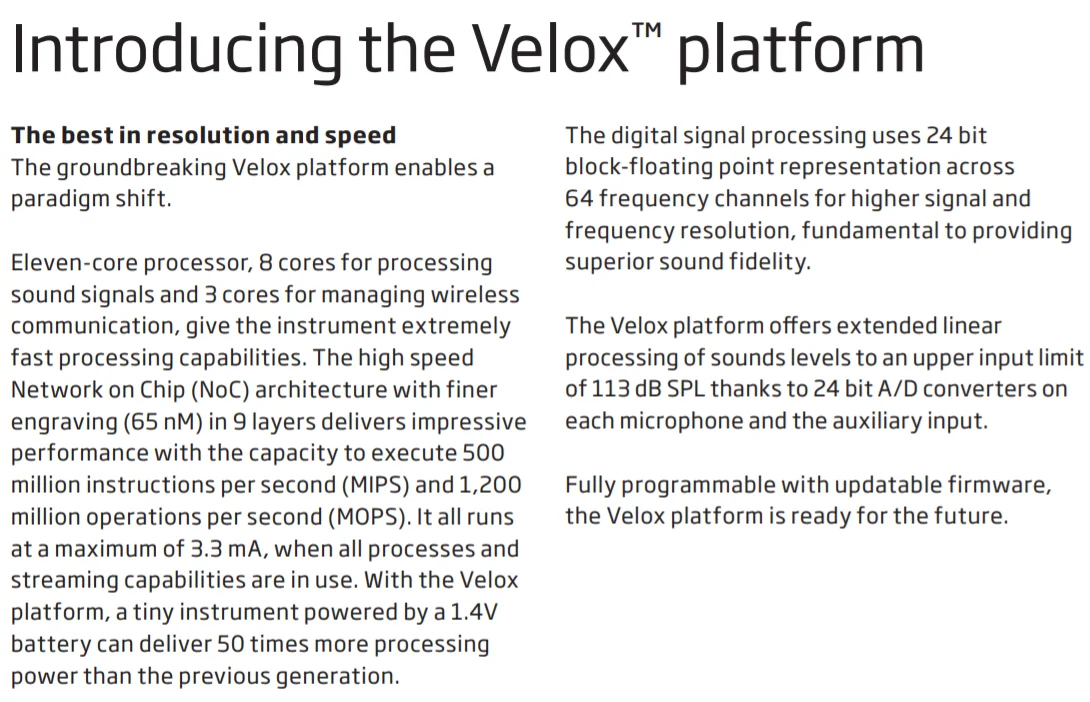
Usually 16-bit A/D converters are used which has a theoretical dynamic range limit of 96 only. In the 2017 OPN product guide, the snippet from it as seen below (second paragraph from last) shows that the Velox platform offers 24 bit A/D converters to enable 113 . I’m sure the Polaris platform for the More also uses 24 bit quantization for its A/D converter to give it the 113 dB SPL for Clear Dynamics, although it doesn’t explicitly say that in its Polaris whitepaper (it just mentions Clear Dynamics).
So it’s not so much the processing speed, but the number of quantization bits used in the A/D converters that enables this wider dynamic range.
You’re ignoring this member’s posts.
What the forum has been talking about this week.
Fitting Software Requests1.1k replies
Fitting Software Requests512 replies
Hearing Aids104 replies
Uncategorized451 replies
Hearing Aids169 replies
 Oticonian/Disposablyte