 Oticonian/Disposablyte
You’re ignoring this member’s posts.
Oticon More3 (vs More1) Might Be Capable Enough For Some
This topic is closed.
226 replies11.1k viewsLast reply

 Hot Springs Village, Arkansas
but the speed of the processor will mean that the audio can be checked and updated more times per second. Which will give even better representation of the audio around you.
You’re ignoring this member’s posts.
@cvkemp Yes, you will likely be able to tell what they are saying. I know that I am now able to discern speech in singing much better. I was also amazed that I could hear the high notes from the cello. I had no idea those sounds where there. (Oticon MORE1 Trial).
I also had an issue with “echoing” at church. That is now also under control.
My first trial was the lowest level of Signia Styletto X3 which was not properly set up. I now have software to make test runs and then provide info to Audi.
You’re ignoring this member’s posts.

For the record, Now have More 2 in my ears. Clear Dynamics clearly does the trick, experience is quite the same as with the More 1. Most of the settings could be copied even because on several settings the 1 has an extra option to choose whereas I already choose a lower setting. The only thing that keeps puzzling me is what is the effect of the virtual outer ear. With the More 1 there are 3 modes, of which the middle 1 is 'balanced, the lower is ‘comfort’ and the higher one is “Aware”. In the More 1 I had this on “Aware”, but the More2 just has this as ‘balanced’. Anyone knows what this does, how it affects sound/hearing?
You’re ignoring this member’s posts.

However, with the more, the only way to open up the sound of your environment is to get the higher techlevels. Because in the lower techlevel you simply cannot change the concerned setting.
I’m not sure what you mean by “open up the sound of your environment” here. I think all 3 More levels do open them up just the same. What the difference here is when you want to balance the sounds in favor of speech. The More 1 would do a better job of rebalancing it by suppressing the non-speech sounds more to let the speech sounds stand out more (via the Max Neural Noise Suppression setting), as compared to the More 2 and 3. But in terms of hearing everything (open up the sounds), I don’t think the More 2 and 3 would let you hear any less sounds than the More 1.
You’re ignoring this member’s posts.
Actually I do. Look at the virtual outer ear for example. More 1 has the setting “Aware”, “balanced” and “Comfort”, whereas 2 and 3 just are set on "balanced, which is the middle setting of the 3.
You’re ignoring this member’s posts.
The only thing that keeps puzzling me is what is the effect of the virtual outer ear. With the More 1 there are 3 modes, of which the middle 1 is 'balanced, the lower is ‘comfort’ and the higher one is “Aware”. In the More 1 I had this on “Aware”, but the More2 just has this as ‘balanced’. Anyone knows what this does, how it affects sound/hearing?
As seen in the flow of the first screenshot below, the Virtual Outer Ear setting is used only in the Easy Environment. It’s a model of the real life pinna, and Focus gives you the pinna model of the ear that gives you the most front focus (I don’t know what kind of ear this is, maybe a bigger ear that sticks out a little more?). Aware gives you the pinna model of the ear that is the least front focus, and therefore the most omni directional of the 3 models. Maybe this models smaller ears that are more flushed to the head and don’t stick out as much??? Balanced is the middle of the 2 pinna ear model above.
The Virtual Outer Ear doesn’t let you hear more sounds with the More 1 (more open) and less sounds with the More 2 or 3 (less open) like you were alluding in “open up the sound of your environment”. You still hear all the sounds, practically all of them, with either the More 1, 2, or 3. The difference is that the More 1 gives you 3 choices of the type of pinna models you want (so you can hear sounds in the front better → Focus, or hear all surrounding sounds more equally → Aware, or in between), while with the More 2 and 3 you don’t get a choice and are stuck with the in-between model.
For Difficult Environment, the Virtual Outer Ear model is not powerful enough to provide the spatial clarity/awareness, so Oticon uses a different beam forming approach to balance out the sounds better. This beam forming approach was actually used in the OPN and the OPN S, as shown in the second screenshot below. The difference is that in the OPN and OPN S, this was done in 16 frequency bands while in the More, it’s now done in 24 channels to make the system even more precise in targeting the sound sources.
The More 1 utilizes 100% of this Spatial Balancer capability, while the More 2 and 3 use only 60% of this capability. I really don’t know what this 60% means though. Is it 60% of the precision? Or of the channels? Or of the attenuation? Nevertheless, the point is that either the VOE or the Spatial Balancer is used to create the spatial awareness of the sounds around you. It’s not used to make the environment more open or less open between the 3 More models.
I don’t know why Oticon doesn’t just use the Spatial Balancer for both the Easy Environment and the Difficult Environment to keep things simple. After all, the OPN and OPN S don’t give you the Virtual Outer Ear option for the Simple Environment setting at all. I’m just guessing that it’s something they’d been working on, and so they’re now throwing it in to create more value for the More maybe. Heck, at least now if you pay the premium for the More 1, you get to choose to have big ears for the front focus even if your real life ears are smaller and can’t give you the front focus you’ve always wanted before. 
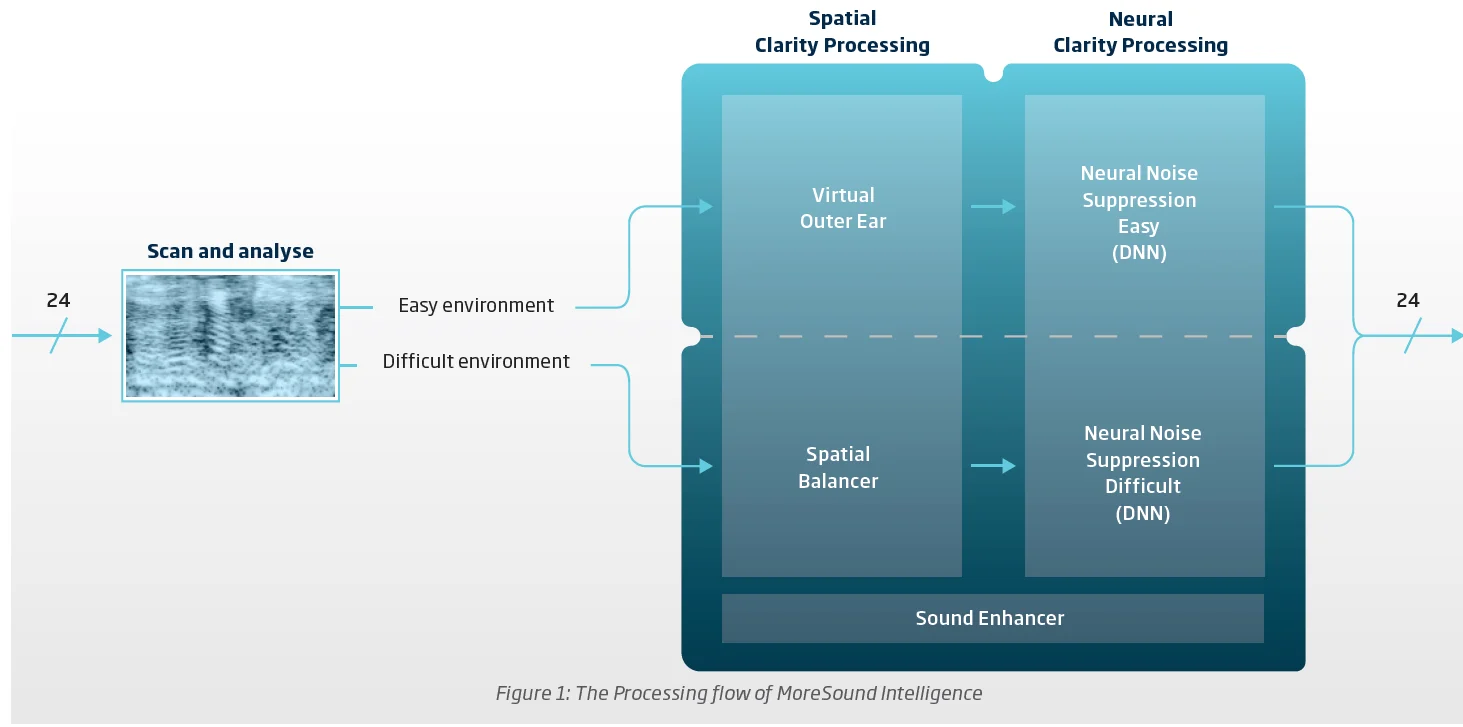
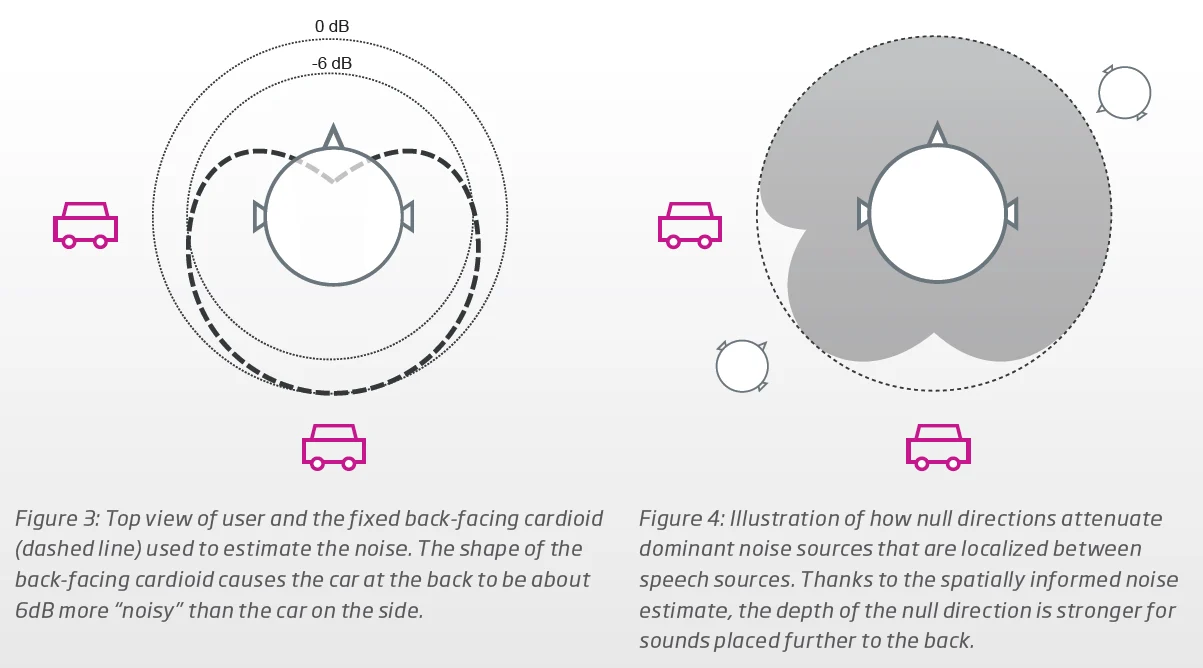
You’re ignoring this member’s posts.


@Volusiano “I don’t know why Oticon doesn’t just use the Spatial Balancer for both the Easy Environment and the Difficult Environment to keep things simple”
You can choose what situations include both “Easy” and “Difficult” enviroments.
So to max. “Easy” enviroment :

To max “Difficult” enviroment (As matter of fact you can rule “Easy” enviroment out)

It’s other story what those situations means…
I wonder if Music program is choosen, is this Enviroment Configuration still active ?
You’re ignoring this member’s posts.
That is indeed a valid point that you’re given a choice to force the More to route everything through the Difficult Environment path so that you get Max Neural Noise Suppression and use the Spatial Balancer all the times, along with the Sound Enhancer which is used in Difficult Environment only. After all, if the environment is Simple, for example, the More should judicially use only enough Neural Noise Suppression appropriately to match with Simple, so it’s not like you’re overkilling things with excessive noise suppression anyway.
I think the point of giving the user a way to define what’s Easy Environment and what’s Difficult Environment is to give them maximum flexibility in how much help they want to get from the More or how little help they want to get from the More. Maybe for people with milder hearing losses, they may prefer to hear more sounds unfiltered and as natural as possible, hence they can place heavier emphasis on most environments being less processed by defining them as being “Easy” to them. And for people with more severe hearing loss and need more help, they can define Difficult to include the simplest sound scene if they want. Incidentally, in the OPN and OPN S, they call this “Transition Help”. You can choose more help or less help. But I like the way the More lays out the options here better, because it’s much more easy to understand intuitively what “help” means.
By the way, if the built-in Music program is chosen, all this stuff is turned off and you don’t get to define what your environment is anymore. That basically means that you turn off the Deep Neural Network stuff completely, so speech no longer becomes priority, and you’re stuck with the Virtual Outer Ear model selection being the only “filter” to help you rebalance the sounds the way a human ear would, and that’s it.
The Sound Enhancer, by the way, is only used for the Difficult Environment and is a way to provide a compromise to allow users to have some say (kind of a last round out-of-the gate adjustment override if you will) after the More Deep Neural Network has decided on how much Neural Noise to suppress. Below shows how they implement the Sound Enhancer to appease a user who wants to hear more than what the suppresses vs a user who find that the DNN doesn’t suppress enough for their liking after all. The right graph shows how the 3 Sound Enhancer setting results look like against each other and also against the OPN S.
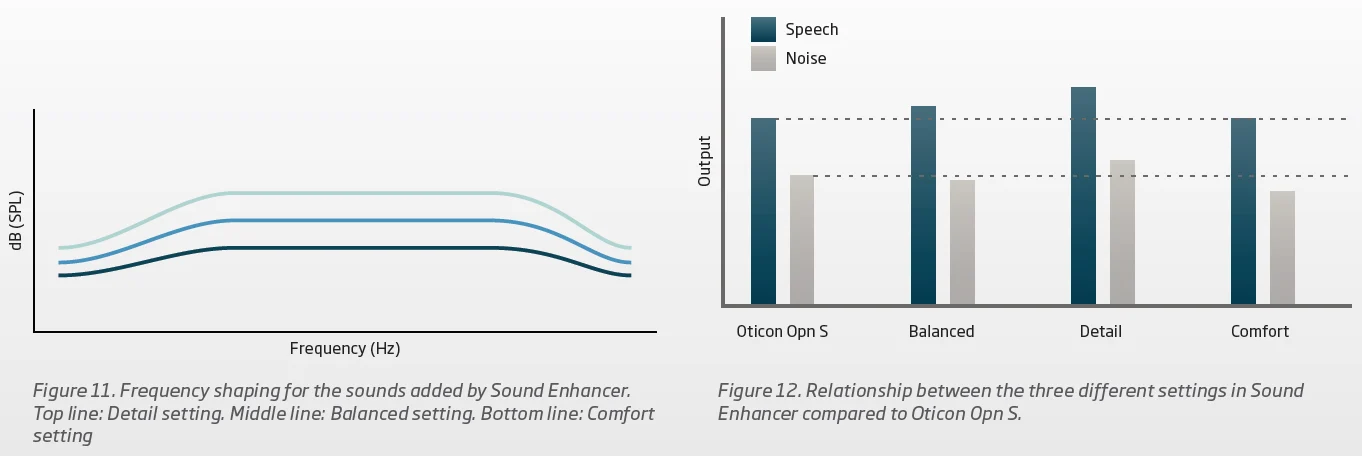
You’re ignoring this member’s posts.
The more I read this the more I believe I am confused. I have the OPNS1 aids. I have no issues in quiet environments with understand one or two people. You put me in an environment with say the TV on and two or more people trying to talk, I am totally lost.
You put me in front of someone with a heavy accent even in a very quiet environment I struggle, but with any other noise of any kind I am totally lost.
In the Jeep, with just me and my wife, even with the stereo on at a moderate volume I have no issues with talking to my wife, but you at a second or third person to the mix I am lost.
You put me in a reasonably sized room with 8 to 10 men doing the social distance thing, and with everyone taking turns talking I have no issues. But if more than one is talking at the same time I am totally lost.
You add a face mask to any environment I am at a loss.
If I am watching a movie that has music as a background to actors talking the music or sound effects drown out the speech for me.
In a restaurant that is reasonably sound controlled and I am at a table of 4 or less I don’t have issues with the speech. But if the restaurant is like the more modern ones with the high ceiling and concrete floors, I have issues with understanding even a waiter standing beside me, and carrying on a conversation is iffy.
In church I have little to no issues understand the sermon or announcements.
If the choir is singing and the organ is playing it over powers the choir, but if the piano is playing and not the organ I do not have any issues with the choir.
I have no issues with wind noise, echoing, or road noise.
I am sure there are other examples I am not thinking of.
You’re ignoring this member’s posts.
It goes to show that everyone’s brain hearing is different. I remember reading a research paper from Oticon and they were saying that if there are multiple voices talking at the same time, if all the voices are made to be heard well, the brain should able to use the various speech cues from the different voices to help it differentiate and isolate and focus on the voice it wants to hear and ignore the other voices. But if the voices were all meshed together to become “babbles” that sound the same, then it’d be much harder for the brain to isolate and focus on one voice because there’s no differentiation to be had for the brain to hear the difference in order to divide and conquer.
But that’s probably a normal hearing brain, or for a hearing challenged brain that has had a lot of practice in complex listening situations already. I think the brain hearing is only as “fit” as how often it gets to be exercised and be put in challenging environments so that it has enough practice. With the pandemic going on for the last year and a half, I stopped going to noisy places anymore and I’m sure my brain hearing is no longer as fit as before the pandemic when I had more opportunities to be a noisy places.
So brain hearing is very subjective and depends on many factors, from the degree and type of hearing loss, to the frequency of exposure to which kind of environment that can help exercise the brain hearing and keeping it fit. It makes a lot of sense for Oticon to recognize this and enable in the More the configuration of 5 environments from very simple and very complex and let the user define which of the 5 is (are) easy and which of the 5 are difficult for them.
Based on your description, Chuck, I’d probably recommend you start out defining your Difficult environment to include 4 of the 5 scenarios as seen in the screenshot below. I think for most people, they’d probably define their Difficult environment as a configuration of Moderate, Complex, and Very Complex. Of course it’s not set in stone, and you can always readjust it based on how your brain hearing progresses and how “aware” you want to be of your surrounding sounds as you progress from being more and more used to the open paradigm.

You’re ignoring this member’s posts.
Thank you I feel that is what I am going to have to have. I do have another question.
Seeing I love the outdoors and the sounds of nature. Would it be better to have two programs, one set for the difficulty that I am having with speech the second, set to very simple or simple for the great outdoors, and the times I am not dealing with speech of almost any type.
You’re ignoring this member’s posts.

But that’s probably a normal hearing brain, or for a hearing challenged brain that has had a lot of practice in complex listening situations already. I think the brain hearing is only as “fit” as how often it gets to be exercised and be put in challenging environments so that it has enough practice. With the pandemic going on for the last year and a half, I stopped going to noisy places anymore and I’m sure my brain hearing is not longer as fit as before the pandemic when I had more opportunities to be a noisy places.
To add to this fine post, everyone’s hearing is different.
An example I read on this forum some time ago compares a persons hearing to the keys on a piano. As hearing loss gets worse the sounds go away like keys on the piano going away. The brain can only do so much with these sounds. It doesn’t matter what brand aids you have or the best technology, when a person loses the sounds like keys on a piano the brain can’t figure it out. No data in and no understanding.
I totally agree with exercising the brain with as much sound as possible to keep it mentally in shape for speech and the sounds of life but we need to remember our hearing loss has limits, each of us are different.
You’re ignoring this member’s posts.

@cvkemp: Now I’m confused, Chuck, (and it takes less and less to do so, these days) because it sounds to me as though you have real problems with speech in noise!
[Maybe I have misunderstood your prior posts, but I’ve been under the impression that you and your audiologist had been getting some pretty good results in that regard.]
Another source of confusion (and frustration!) for me is all these theoretical questions about what happens if you maximize or minimize certain slider values within Genie2 that clearly go way beyond what a reasonable person would understand from the use of “normal”, "difficult ",etc… WTF??
The sense I get is one of an almost troll-like barrage of questions quite unrelated to the original quandary of whether More3s would be able to satisfy the performance requirements for certain people whose financial capability put More1s out of reach.
@Volusiano is doing yeoman’s service answering these obtuse questions, but I tend to be of the opinion that - from a practical standpoint - we ought not to credit a marketers’ invention like “virtual outer ear” with too much actual power.
As for me, I’m with Mr.V: it may mean nothing more than what someone with small, flat ears hears, in comparison with someone with ears that are large and prominent enough to sail the Flying Dutchman to Persia under wind power alone.
Do we really need to entertain such hyperbolic, hypothetical questions to understand for whom is More3 an effective treatment for their hearing loss, and who actually requires the premium features of More1s?
So, Chuck, if it’s any consolation, I’m in the ‘Confused’ camp, just like you!
You’re ignoring this member’s posts.

tenkanProvider
As for me, I’m with Mr.V: it may mean nothing more than what someone with small, flat ears hears, in comparison with someone with ears that are large and prominent enough to sail the Flying Dutchman to Persia under wind power alone
Ha ha you’ve made my day again!
You’re ignoring this member’s posts.
My speech in noise issues is due to my hearing loss, hearing aids can help, but never even close to completely. I have known this for about 17 years. Hearing aids can only do so much to help me due to the type of hearing loss I have. I as told back in 2004 when I got my first real hearing test that I was able to see my , and had it explained the me, that my cookie bite hearing loss is one of the worst to fit hearing aids to. With the OPNS1 aids I am doing much better than I am without aids, the OPN1 aids made my hearing about 80% of what the OPNS1 do. As one of my Audiologist told me back in Austin Texas in about 2007, I would have to have ear molds that blocked all sound from my ears, then my hearing aids would have to supply me with only speech. Then I was told that is impossible due to the good low frequencies and reasonably good high frequencies. My Audi now tells me that with me losing my high frequencies that it was helping him to be able to adjust my aids. My Audi also tells me never to give up and to never stop pushing to hear better.
You’re ignoring this member’s posts.
Everyone please understand I know what I am up against. I am also never going to give up, and I will keep pushing for something a little better. I also have come to understand that more than likely that I have had some cookie bite loss all or most of my life, and that it is also a very much of an up hill battle.
You’re ignoring this member’s posts.
Thanks for your explanation @cvkemp (Chuck). I have read many of your posts going back years, and have picked up on most of the facts of your individual situation.
I still misinterpreted what is the bottom line, for you.
What I have been most impressed with since I was just a “lurker”, is your ability to live within the constraints imposed by your own hearing loss, and tailor your expectations for your hearing instruments accordingly. I have been a “late bloomer” in terms of learning that lesson, myself.
@kevels55 is another member from whom I’ve learned the same thing. Because my loss is just simple ski-slope, I assumed for years that my aids could just be dialed-in to the inverse of my .
[It’s not that simple, of course, however I have only clued into this reality since February of this year.]
Thinking about it again, I have no doubt that you need all the premium features that More1s have, compared with More3s. My sincere hope is that the More1 devices you’ll soon be getting will perform as well for you as they have for me.
You’re ignoring this member’s posts.
Thank you I feel that is what I am going to have to have. I do have another question.
Seeing I love the outdoors and the sounds of nature. Would it be better to have two programs, one set for the difficulty that I am having with speech the second, set to very simple or simple for the great outdoors, and the times I am not dealing with speech of almost any type.
I think the Oticon hearing aids that embrace the open paradigm is a particularly good fit for you if you want to hear surrounding sounds outdoors in nature and still carry on conversation while you’re outdoors. Don’t get me wrong, of course other aids let you hear outdoors sounds, too, but if that’s coupled with having conversation outdoors (like in a group picnic or something), then they may put you in a speech priority mode that block out more outdoors sounds.
I would think that the default program, even with a heavy emphasis on a configuration where Simple through Very Complex is classified as Difficult Environment, can still serve you well and not rebalance everything out too much as long as there’s no speech going on. You just need to set the Sound Enhancer to Detail (or Balance at the most) and not Comfort in order to tell this “compromise” handle that you want some override over the Deep Neural Network and not let it take away too much of the details you want to hear when it does its rebalancing of sounds through the .
So maybe you can have the Default program’s Sound Enhancer setting be set to Comfort, then a second program for outdoors with the Sound Enhancer setting be set to Detail, and try both out to see.
I know you mentioned before that music is not a big deal for you, and I think that either of the 2 programs above can handle music just fine, but I think for any hearing aids, it’d be helpful and always good to have a mode where most of the sound processing is disabled so you can get a sound scene that’s as unfiltered as possible. And that mode would be the Music program, where the DNN stuff is disabled almost altogether so you can get a sense of how things would sound untouched by the hearing aids except for the amplification per the fitting rationale chosen (and also except for the effect is so chosen as well). Who knows, maybe you may prefer this Music program for your outdoors excursions much more than the second program where the Sound Enhancer is set to Detail.
You’re ignoring this member’s posts.
Jim. I just received an email from my Audiologist, I cannot pick my aids up until the 18th unless someone cancels an appointment and I can make a last minute run to the clinic. But my aids are at the clinic, and Oticon has given my Audiologist a 3 page set of steps that may or may not help him to set my aids up to my needs. Part of the email was a couple of lines that the Oticon developer wrote about the challenge my hearing loss presents to hearing aid fittings., But it sounds really encouraging.
You’re ignoring this member’s posts.
Active discussions
What the forum has been talking about this week.
Fitting Software Requests1.1k replies
Fitting Software Requests512 replies
Hearing Aids104 replies
Uncategorized451 replies
Hearing Aids169 replies