have about 3 lights on charger (say 30%). however, out to the pub / dinner / whatever, with a lot of noise and talking, always down to 2 lights, sometimes 1.
Thank you for your comments. If you have the same charger, I have and there are three lights left at the end of the day that would be 60%. Fully charged all five lights are lit or 100%.
Last night I was in a large room with many people at different tables playing games and it was noisy for a while, everyone talking at once but when the games started, it was quiet. When I came home, my Aids were still charged at 60% so that noise here and there did not grab a lot of power. The whole night was only 1 and 1/2 hours.
Thank you everyone for your responses. My granddaughter is an engineer and is dating an engineer who I think might be involved with Space or some thing. She should see these long engineers comments just to see what they say. I could Copy and Paste. Just kidding.
Most communication between the left and the right hearing aids is done using NFMI (Near Field Magnetic Induction). This takes advantage of the fact that the 2 hearing aids are located in very close proximity of each other (the width of a person’s head)
This intrigued me cuz I’ve had a lot of odd problems the past couple months streaming TV with Phonak’s TV Connector. Unless that device is placed about 3’ from my aids, it’s the RIGHT aid (for me, the “slave”) that simply cuts out of streaming, leaving annoying ambient sound, or - even worse - cuts out ALL audio.
Do you have any theories as to what kind of electromagnetic field or signal interference could cause that to happen? If I keep the TV Connector right close to the aids, I can stream without problem. But if that device is in a computer closet just 5’ away, I have all kinds of flaky streaming issues.
Any insights on this would be greatly appreciated. I get in tomorrow to see my audi and a Phonak rep, and plan to share my observations with them.
The communication between your TV Connector and the hearing aids are probably radio type signal, most likely some kind of Bluetooth Low Energy radio wave. It’s not like between the 2 hearing aids which communicate with each other.
So I’m guessing that if it used to work from far away but now you must put position it very close to your hearing aids, there’s probably some kind of radio interference recently introduced in your environment. By putting it closer to your aids, the transmission from the TV Connector is strong enough to “drown out” the interference.
I don’t know how feasible it is to do, but you can take your TV Connector to a different living environment (like maybe at a friend’s house or something far away) and see if you can use it at a distance away then. If yes, then it’s pretty conclusive that it’s due to interference, and there’s really not much your or Phonak rep can do anything about it. But at least you can try to trace back to see if you recently introduced anything new that’s wireless to your living environment that may cause this interference or not.
I’m guessing that if it used to work from far away but now you must put position it very close to your hearing aids, there’s probably some kind of radio interference recently introduced in your environment.
Thanks for that very helpful summary of what could be causing the annoying streaming issues in my TV room!
That has been my suspicion the past couple months, too. But I can’t seem to nail down the source of interference. Other than a passive, ADT security receiver mounted on the wall in mid July, there has been no new device added to the media closet here. The problems started about a month prior. I even wonder if a neighbor has a jamming device or directional antena? He’s an odd fellow who would probably not give me a straight answer if I asked.
Even more curious, the streaming issues seem to happen between 7:30-8:15pm or so on most - but not all! - nights. So I’ll fiddle-faddle with rebooting the Connector, my aids, swap in different aids, more lah-di-dah, and then, like magic find that sweet spot with streaming again that remains steady till 10 or 11pm when I’m done watching TV.
If you believe in aliens, I’m pretty sure there’s one hovering in the TV room most nights - just havin’ fun, I’m sure.
Now that you described the inconsistency in the streaming issues on most nights but not all night, it makes me suspect more that perhaps a neighboring device is interfering with your reception somehow.
The only surefire way to confirm this is if whenever you get a chance to go visit a friend’s house that is not in that same neighborhood, if it’s convenient enough for you to get your TV Connector over there, and verify whether the issues still exist or not. Even if you can confirm this, it’s not clear what you can really do about it at your own home, short of running a long RCA cable from your TV to your TV Connector, which would need to be placed right by your side. That is, I’m assuming that if you have it right by your side, then it would solve the issues.
Another solution would be to find some kind of Bluetooth adapter to your TV, if you TV doesn’t already have support, and connect your Phonak aids directly to that BT adapter from your TV. There are plenty of them for sale on Amazon if you look. Hopefully a BT adapter will not introduce too much latency to the audio to be noticeable by you. Usually the built-in BT would not have too much latency, but an external BT adapter may have a little bit. It’s just whether you find it noticeable and can tolerate it or not.
Now that you described the inconsistency in the streaming issues on most nights but not all night, it makes me suspect more that perhaps a neighboring device is interfering with your reception somehow.
Yes! It seems too restricted to a specific time of night (7:30-8:15 or so). So tonight, I will see if the Roger ON unit behaves as erratically.
I was almost hoping to commandeer the TV out in the waiting room at my audi’s to put that Phonak TV Connector to the test as you recommend, but I had limited time with the Phonak rep there demo-ing the Roger device. Dang. I really need some outside TV source to test out the theory.
As you say, not much can be done if this is a nosy/weird neighbor kinda thing. But at least it would put my mind to rest about resident aliens.
I bought, installed and tried out a snazzy B03 transmitter receiver from Amazon that promised no latency! easy hookup! dependability! NONE of which was the case. So I returned it. It was like incompatible with the Phonak TV Connector completely! It wouldn’t stay paired or connected to it for more than fractions of a minute. But when it worked - wow - the distance was 70m. Blows the TV Connector out of the water as I can’t even step outside the media room without cutting out of streaming.
BUT even so, that scientific conclusion DOES NOT imply that the power drain comes from the assumed guess that the DSP which does the noise reduction is not deactivated due to how to code is written, like you have suggested. Nobody knows for sure where the majority of the power drain from the noisy environment comes from, whether it’s due to the digital DSP not having to do the noise reduction (like you assume), or whether it’s due to something else, because we are not the designer of the hearing aid, are we? But my educated guess tells me that it’s much more likely due to something else, and that something else is the analog amplifier that has to work extra hard to drive all the busy/noisy sound traffic in those noisy environments.
I have a different take on this.
You would think that in noisy situations hearing aid programs would not increase the analog output level, but instead keep it flat, and rely on digital filtering and signal processing to reduce the unwanted noise leaving the desired speech at a comfortable listening level and easy to understand.
In this scenario, you would not be increasing the drive to the final audio amplification stage, thus keeping the required current draw from the batteries relatively constant.
I am a Ham Radio operator, and this is essentially what digital filtering and noise reduction does in today’s modern equipment.
I wear Phonak Bolero Marvel M90 rechargeable aids, and found through experimentation that the “comfort in noise” function is so effective that I have it as a dedicated program. Whenever I am getting ready to drive anywhere the first thing I do before I even get in my car is select it. It completely kills road, wind, and tire noise, leaving speech clear and easy to understand. I have not increased the audio level, and am not experiencing any meaningful reduction in daily battery life.
It also helps that I don’t rely on audiologists. I purchased my aids off Ebay, do my own programming, and have them dialed in so well, I completely forget that I’m wearing them.
You would think that in noisy situations hearing aid programs would not increase the analog output level, but instead keep it flat, and rely on digital filtering and signal processing to reduce the unwanted noise leaving the desired speech at a comfortable listening level and easy to understand.
In this scenario, you would not be increasing the drive to the final audio amplification stage, thus keeping the required current draw from the batteries relatively constant.
First off, you’re talking purely about the listening level, meaning the volume level, but you neglect audio content. Secondly, you failed to take into account the audio content in 2 different environments. In a quiet library, there maybe an occasional soft speech going on, but on a whole, there’s virtually almost no or very little noise going on. In a noisy restaurant on the other hand, not only are there A LOT more audio contents going around (chatter and background music and dishes clanging and music going, etc), the volume is much much louder as well, because now people have to talk a lot louder in order to hear each other above the noise.
A typical library noise level is around 40-45 , while a typical restaurant noise level is around 80 dB. Even if the noise around you get suppressed by the hearing aids by 10 dB (which is very aggressive) in a restaurant, you’re left with speech unsuppressed at 80 dB, and noise suppressed at 70 dB. So as long as you don’t turn down the volume manually on the hearing aids yourself, the final audio amplification drive on the hearing aids will deliver a much louder listening volume level in a restaurant compared to what you hear in a library.
The goal is to keep the desired speech easier to understand by suppressing the noise (hence improving the signal to noise ratio between speech and noise), but the goal is not to suppress the louder volume of the speech in the restaurant so that it’s nice and soft at a comfortable listening volume level as the speech in a library. The speech is still going to be louder in a restaurant than at a library, because it must be kept at 80 dB so that you can hear it above the (now suppressed) 70 dB noise. Of course I’m taking the simplistic assumption here that all sounds at the restaurants are at the same 80 dB level, but still, it should drive the point.
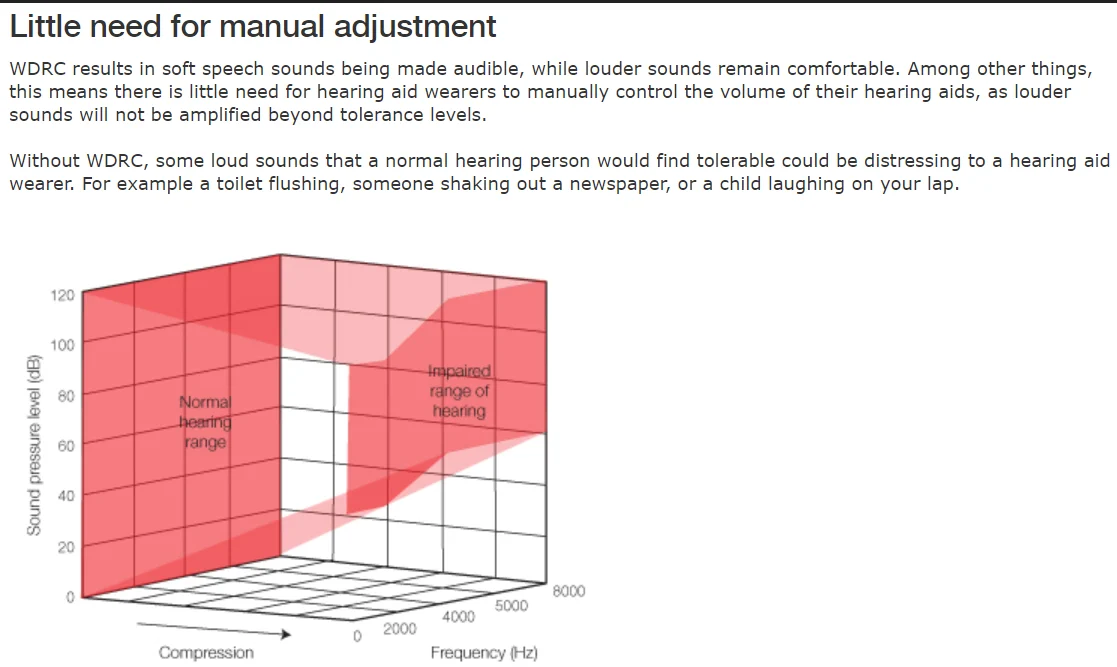
Don’t get me wrong, there is technology in hearing aids to help with listening comfort. That’s what the (wide dynamic range compression) is for. Below is a chart that hopefully explains it a little bit. But the hearing aids don’t always try to keep the listening volume level flat regardless of the situations like you think for the purpose of maintaining listening comfort. It will amplify more if the input sound is soft to enhance audibility, and amplify less (aka compress) if the input sound is too loud to enhance comfort. But it will also amplify and deliver loud-level input sounds louder than it will amplify and deliver softer-level input sounds, and therefore, draining more power in the earlier case.
Surely as can be seen below, the dynamic range for hearing challenged people becomes smaller/narrower than the dynamic range of normal hearing people, but as long as there’s a significant enough dynamic range, the listening volume level still varies (although less widely), and hence the power drain in the final amplification stage still depends on the input level, AND the audio content as well. Meaning that let’s say in a 1 hour span, if the analog amplifier has to amplify a 10 second sound 1 time, or if it has to amplify that same sound 60 times, then for sure the later will drain more power than the earlier.
Well, I’m back from a 2-weeker vacay … and I think you’re spot on with the diagnosis of my streaming issues here at home.
I was able to travel with and USE the Roger ON V2 wherever I went. To my amazement, all but ONE of the 7 hotels I stayed at had access to the back of the TV so I could plug in the toslink cable, and a wall socket within reach for the power. WoooOooOoOO!!! I’ve never traveled with any kind of TV streamer before, altho I’ve had the TV Connector for easily a decade?
The Roger V2 is not only a TV streamer, but it can be taken to restaurants, other places, used as a pointing mic or just put on a tabletop, so it was the perfect test. There were NO (none, nada, zilch, zip) issues with streaming TV at any of the places we stayed.
Got home, tonight I’m streaming audio with the Roger V2 and - NO SURPRISE! - the right aid simply won’t stream audio between the hours of like 7:30-8:30pm or so. Short of literally busting into a neighbor’s house and having a look-see, I can only assume that someone, somewhere is jamming the signal between those hours. There is no other explanation for why I can stream audio outside of those hours - no issues during the day time at all.
If I tilt my head a certain way, I can sometimes get both aids streaming (like a bird with a broken neck), but if I sit in the chair close to our Marantz hi-fi setup (into which the audio cable is plugged connecting the Roger base to the sound), that right aid is completely unpredictable - no matter if I’m watching DVD, AmazonPrime or live TV.
I guess I’ll just have to live with it! The Roger V2 has a bit more crispness than the older Phonak TV Connector, so I can get by with streaming audio to just my LEFT ear, but it’s just a bummer that something here around my own house is causing these issues.
At least I know I’m not imagining things. And at least I’ll be able to stream TV when on the road!
Another solution would be to find some kind of Bluetooth adapter to your TV, if you TV doesn’t already have BT support, and connect your Phonak aids directly to that BT adapter from your TV. There are plenty of them for sale on Amazon if you look. Hopefully a BT adapter will not introduce too much latency to the audio to be noticeable by you.
I had such a device, but had to send it back cuz not only did it not improve the odd streaming issues, but the latency was awful. AND I had to pair + connect my aids to the adapter every time I walked out of streaming distance and the signal dropped.
It is true that algos are constantly on, but in the case of Signias/Rextons they will trigger environmentally and behaviourally related processing changes (often resulting in gain manipulation) as they not only detect the situation you’re in but also detect the voice of the owner and treat it accordingly.
So I can imagine that ‘busy’ environments would be more taxing.
I’m not familiar enough with what Resound does internally but it should be similar?