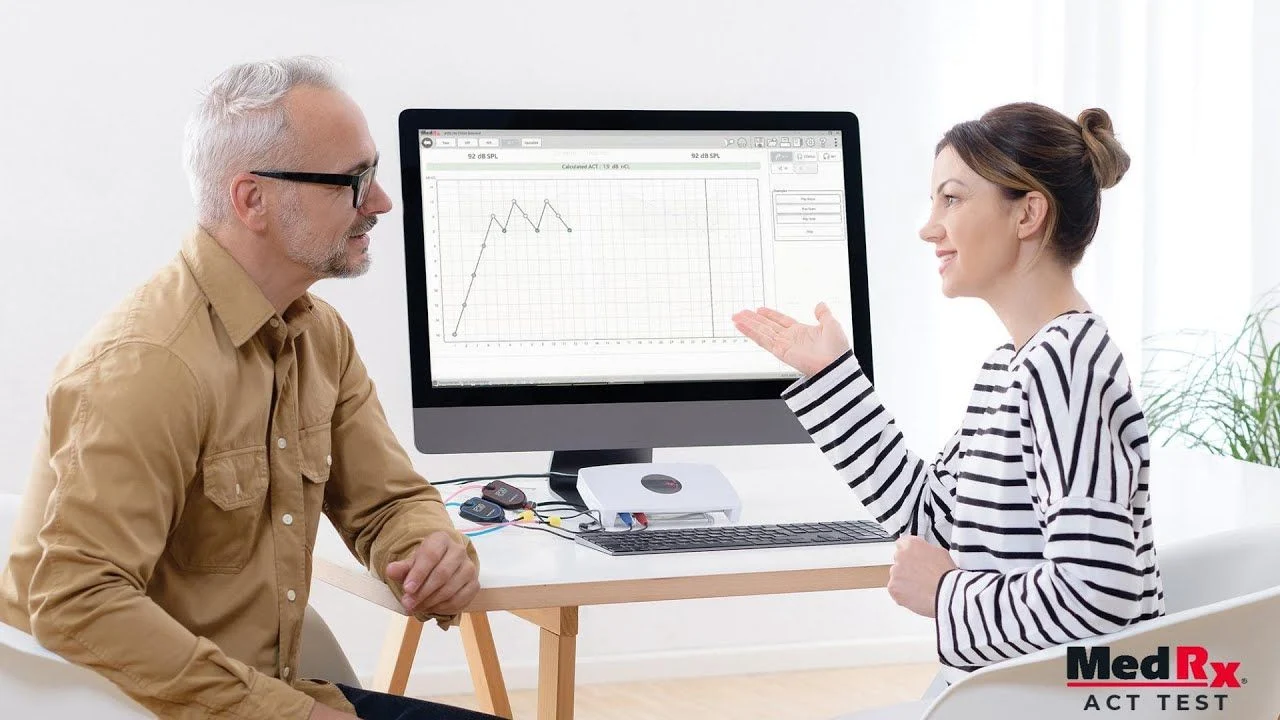
The combination of the new Audible Contrast Threshold diagnostic test, the Oticon Genie 2 fitting software, and Oticon hearing aids is the first hearing care solution to look beyond the and ...
Video is not very informative on what the software actually does with the score, the white paper is a bit more useful. It doesn’t influence the gain curves but in the Oticon Real the MSI which is the control centre for environment configurations, noise reduction etc.
Potentially sounds like it might be useful in the same way I would utilise a Quicksin score to set this up anyway and recommend a product or tech level, set up extra programs (or not) recommended (or not). Quicksin has its flaws though so potentially this will be more accurate and it will make it easier for clinicians who don’t utilise a test to add this to their assessments.
However, with Quicksin being speech based I find it can be a useful therapeutic tool to help people appreciate their loss, often once the test is finished they will say - ‘that’s just what it’s like for me when I’m…’ so maybe both tests have their place.
I guess we don’t know until Genie 2 2024 comes out.
What is not clear to me in this announcement is whether the administration of the ACT test is built into the Genie 2 software, or whether it’s done independently outside with a third party tool then its result is fed into Genie 2 so that the appropriate Genie 2 parameters can be prescribed for this result.
It seems to imply that the ACT administration is built into Genie 2 because they’re talking about it taking only 2 minutes to conduct. So it implies that you can conduct the test inside of Genie 2.
This leads to another question, which is whether there is an external hardware/software equipment to conduct this test independently of a mfg’s programming software or not? And how other mfg’s beside Oticon plan to make use of the result of the ACT test?
And another question, how many have been conducting this ACP test so far? Using what equipment? And how have they been incorporating this result into their programming of the hearing aids?
As far as I can tell the process runs on the Afinity compact using headphones and the result can then either be entered or be sent to Genie via Noah where it’s used to set the most appropriate noise management options based on the result.
My audiologist did a test on me at the time that I got my INTENT1 aids that had me listen to all types of noise, from what I believe was a noisy restaurant to a noisy city street and i had to repeat the word said. This was different from the word recognition test he also gave me. Then he said i needed my aids set for maximum speech in noise. All I know is that I haven’t struggled to hear in noisy environments like I used to.
Is ACT part of Genie 2 software or part of the Audiometer system. Also when you got fitted with Intent hearing aids did they perform the ACT test?
The ACT test is part of the audiometer system. Only certain audiometer (the newer ones?) is compatible with the ACT test, and the would have to also buy a license to use ACT on their compatible audiometer. As far as Genie 2 is concerned, you simply take the result obtained from the ACT test (basically a final number) and enter into Genie 2 and tell it to use this ACT result to program the neural noise suppression values in the MoreSound Intelligence menu for you.
As far as I understand, the ACT test introduces a modulated noise signal with a distinct “siren-like” sound (called Spectral Temporal Modulated Stimulus) embedded noise (rather than speech) and is presented intermittently. The user is asked to press a button when they hear it. Because this test doesn’t include any speech, it is language independent, therefore is “universal”. If you have tests that include specific speeches or words in noise and asked to repeat to see if you recognize the speeches or the words, then that’s not the ACT test.
To hear what the ACT test sounds like, check out this YouTube video below:
You mean rerun the same ACT test except the next time wear the hearing aids to see if you can single out the siren noise sooner/better? I don’t know but probably not. It’s probably similar to why you can’t just wear the hearing aids and run the audiometry test again to see if now you have a perfectly flat hearing response with the hearing aids on. The metrics probably don’t align well. Maybe an who frequent this forum can offer a more professional explanation.
From what I was explaining by on here nd my audiologist. What my audiologist uses is a process he developed. My audiologist is a professor of audiology and instructs audiology students at the local State medical university. I have sat in on his graduate level courses. And been a case study for some of his graduate students.
So I think the same. After a while, I found out that, rather, due to a lack of spatial differentiation, directivity can’t be assessed; maybe a at most.
It’s probably similar to why you can’t just wear the hearing aids and run the audiometry test again to see if now you have a perfectly flat hearing response with the hearing aids on. The metrics probably don’t align well.
Good point. Regarding audiometry alone, there is needed Real Ear to Dial Difference (REDD), which is primarily used to convert units from to .
“The magnitude of REDD is the difference between the sound pressure level (), a function of frequency, measured in the external ear canal and the settings of the audiometer.
In other words: it is the difference (in ) between the measurement in the external ear canal and the settings of the audiometer that generated these signals.”
Fun fact: are reassessed by tonal in free field in sound booth
What’s more, after introducing connectivity, it is possible making tonal “audiogram” (I can’t recall proper name) in Remote Check by streaming from Cochlear app.
Even is assessed by playing words of numbers 0-9 during louder or quieter white? noise.
Reportedly it is quite relevant to free-field audiogram, maybe has slightly stricter desired range of “” in graph. For example, for free-field - desired: 20 dB HL
for streamed audiogram - desired: 15 dB “HL”.





 London
 Hot Springs Village, Arkansas
 Poland