I would imagine within a few years a Roger device could contain a chip that could completely discern speech from noise, making the virtually infinite in a closed fitting. That will likely appear in the itself within a decade. Tech is small step, small step, giant leap.
Right now we are still in the small step category, despite marketing hype.
Neville, how would i find out what snr i need, and what i am currently getting?
I think there really isn’t a specific “snr I need.” No matter what your score is, we all enter environments in real life where whatever inherent SNR discernment you have isn’t good enough. Even normal-hearing people have trouble coping in many environments. It’s a pain to carry a remote mic with you and get other folks to engage in using it. So, I think it’s great that OEMs are competing to offer SNR improvements in their products, however incremental. It increases the distance from those marginal areas where you just can’t cope with your HAs alone. And for me, and probably many other wearers, it’s that too familiar “my HAs-can’t-cope” experience that’s the most annoying thing about these expensive devices. If every half dozen years, some HA OEM does come up with a device that improves SNR enhancement just a few above the competition, I’ll buy it for that albeit marginal benefit. Not sure it’s historically correct, but I think the Phonak timeline released with all the Sphere hoorah said that in 2014, digital HAs only offered a ~3 dB SNR improvement, so we’ve come a long way, baby!
On the “some situations just need a mic,” I’m wondering if things get so high-tech that we’re all wandering around wearing earbuds or hearing aids, whether each wearable device could be its own little broadcasting station. Your earbuds or HAs have mics that pick up your conversation and relay it back to your phone. If you choose, you could go live on the air. Perhaps you’d have the option as to who could pick up your Auracast channel based on your contact list or on ad hoc admission to your listening circle (like a Zoom meeting, where you have to request and be approved for an invitation to join, e.g. NFC, by touching phones???). But that way, everyone wearing earbuds or HAs might serve as . This is pie-in-the-future-sky. Wearables become remote Auracast microphones giving every conversation a 22 dB SNR advantage ( ).
At this point, all we have to do is wait for the reviews of those who will try these new hearing aids, in real life (maybe even at the cinema, which is one of the things that interests me a lot, as already mentioned).
Maybe the first one who tries them, will be able to open a new discussion reserved for reviews.
I also think about trying them, but here in Italy I don’t think they will arrive before October/November.
Was just thinking. (Dangerous, I know!) If one has an open fitting, I think noise is still likely to be an issue because the noise can still enter the ear. If I’ve got this wrong I’m sure somebody will correct me.
If one has an open fitting, I think noise is still likely to be an issue because the noise can still enter the ear. If I’ve got this wrong I’m sure somebody will correct me.
Yeah, I regret that I’m not eligible for ActiveVent receiver. It is a pity that Phonak has not improved its receivers so far… The closed position would be ideal to cooperate with noise reduction.
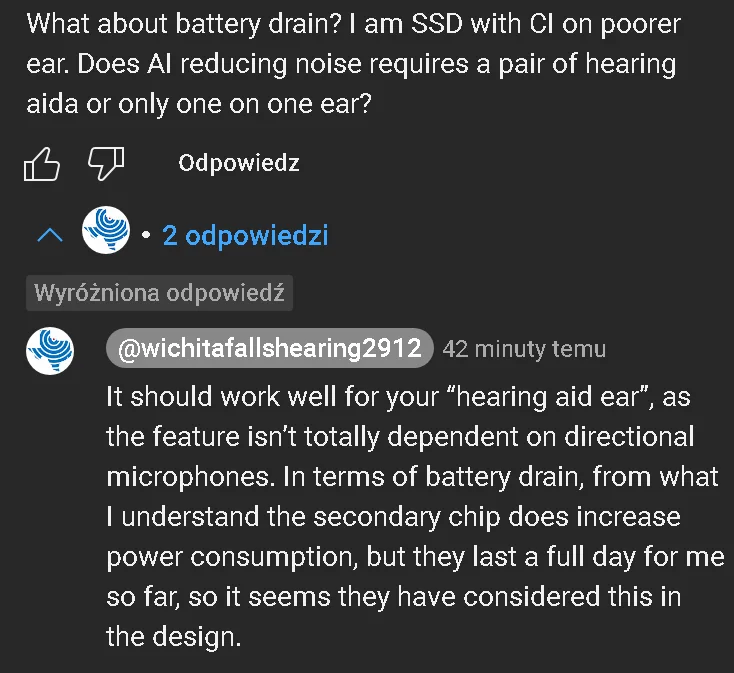
How much faster does the AI chip chew up the rechargeable battery when you are in the Sphere in Noise program.
Could be you have to use this sparingly.
I have been managing battery for almost three years with my paradise aids. streaming is expensive. Maybe I’ll still be doing that, but I’ll take the trade of doing battery management for being able to hear in situations like the wedding reception a couple weeks back. Absolutely.
Yes you have this exactly right. There are several papers that confirm that open fittings reduce the effectiveness of noise reduction and beamforming for hearing aids. I personally have been dealing with this issue as I have good hearing at low frequencies thus the often-recommended solution is to use open fittings. However, when I encounter speech-in-noise situations there is so much background noise with the Oticon Intents that I struggle understanding speech almost seems like I don’t even have any hearing aids on. I have been experimenting with more and I can definitely tell there is significant improvement. Previously I kept switching back to open domes due to the occlusion effects. So now I’m trying different closed domes to see if others will work better and basically forcing myself to continue using them to see if I can adjust over time to the occlusion. Will never be ideal but either way is a compromise so just have to decide which is more important to you!
A question for those who have experience with rechargeable batteries: is it possible to insert dehumidifying capsules inside the charger while charging?
as @tenkan mentioned if you would have Phonak - ActiveVent - you are ideally eligible
cShell with AOV by Phonak - Acoustically Optimized Vent (the most recent is needed)
Personally, I also have good hearing in low pitches, so after unsuccessful trials with a totally occluded earmold and next with pressure venting, I tried AOV, and this is the best mold I have ever had.
I didn’t have any problems with occlusion; the sounds were just so muffled, and my hearing performance diminished despite better directionality and noise cancellation.
EDIT:
Just noticed I answered a user who has Oticon hearing aids. My bad, sorry. In that case, I don’t know if Phonak would make earmolds for Oticon users.
I have good hearing in low pitches and very bad in the high ones, but I prefer to use moulds with small vents; has kind of compensated this choice but dramatically lowering the low frequencies on Target while raising the high ones, so I can get the benefits of noise cancellation without occlusion or muffled sounds.
The Phonak Infinio Shpere i90 Hearing Aid features better speech understanding than other Phonak models, providing the best clarity. Free worldwide delivery.


 ).
 Italy
 Poland
 He used Audeo Infinio Sphere in it.




 Rural New England

 Toronto, Canada



 Kent, England