and I chose the ones that had less of what were to me annoying sounds, which is to say ones I hadn’t heard for years and didn’t like hearing again or hearing so loudly. I remember complaining about the sound of gravel popping under auto tires. And when I went for adjustments, I mentioned being unhappy about things like that, which got the aids muted even more. I know better now, but to be honest if I never heard a damn bird again, I’d be perfectly happy.
And here’s a good example of why individual reviews of all have to be taken with a grain of salt. I personally am delighted by being able to hear birds again, and have gotten used to hearing gravel under my shoes and a key in the lock and all the rest. This is normal hearing, after all. some people want a curated hearing landscape, and program their aids to deliver that: no so called background noise, everything up front and focussed on conversation. Others like having a wide open sound world, and adapt to that, just as we did when our hearing was close to normal.
We all want and expect something different, and assume everyone else wants what we want. Not so. Again: take reviews with a grain of salt.
I am astonished at the knowledge communicated by Dr. Jimmy…. His Physician background provides the tools most of us lack. I have never seen charts reviewed like this. I joined because my was underperforming. The main problem was the amplifier degraded and failed. Once Costco replaced it, performance improved. I still think it could be better, but from my observation, standard audiologist training and/or talent is just not found at this level.
I got my Costco aud to show me the target curve and the REM curve. There was a big gap in the higher frequencies so I had her boost that part of the curve. Now I can hear the female voice in noise environments.
I don’t understand that which seems to be “fear from the feedback”. Instead proposing a better acoustic seal, just decrease gains in the high frequencies…
(I couldn’t get a good dome seal with the probe tube sitting in the left ear, so the low frequencies at soft and medium inputs don’t hit the target (hence my recommendation for a custom ear mold in the left ear), but otherwise, pretty close!)
You can improve it by changing the power domes size or also… manufacturer. Both changes worked for me with P receiver:
First I have Phonak L power domes - fairly good, but feedback threshold noticeably below the receiver full potential
First accidental improvement - when changed to L power domes, but from Unitron! They’re from stiffer silicone than these from Phonak and did good job with good seal.
The best setup was counterintuitive - I was forced to buy M size Unitron power domes (yes, medium size) and they’re the best!
Why? Because I can push them very deep in the ear canal withoud any soreness and possibly folding of the domes.
I am now testing the titanium cShell with 0.9mm vent (ordered 0.6mm, so I am not entirely satisfied) with UP receiver to get the highs.
It seems I hear the highs a bit better, but the earplug effect of the cShell (/REOG) isn’t better than the power domes from point 3. above. And that’s even when I occlude the vent by a piece of guitar string.
The P receiver could be placed deeper which could add a few of extra “free” dB gain compared to the shallower placed UP, which must compensate it by its power.
@Neville, @Um_Bongo, is it normal that closed cShell has less earplug effect than power domes? I wonder if UP receiver in power domes could be better (I do know that it is impossible to order them without cShell).
I don’t understand that which seems to be “fear from the feedback”. Instead proposing a better acoustic seal, just decrease gains in the high frequencies…
It’s often actually “fear of patient rejection”. Talking patients through that initial “ahh, they’re too sharp!” Is harder than just turning them down.
You’re right, although sometimes I feel this is a bit lack of counselling. Nevertheless, your point is fully valid.
You can improve it by changing the power domes size or also… manufacturer. Both changes worked for me with P receiver:
Yep I’ve noticed the Phonak domes aren’t as containing as some others. I only had a pack of large and medium Phonak domes that day. However, he’s doing great and I was just afraid of getting upward spreading of masking if that wasn’t measuring the low frequencies correctly, which I think was the case and we didn’t have much time with a Christmas party proceeding in the other room. Hopefully we’ll have more time in March, but he likes them so much now he may not let me adjust them lol.
although sometimes I feel this is a bit lack of counselling.
Oh absolutely it is. But counseling is a harder skill than fitting a hearing aid.
I think your concern about sudden loud cars is more psychological than actually dangerous. I’m not sure a pressure vent will really make a material difference.
I think your concern about sudden loud cars is more psychological than actually dangerous.
Perhaps yes, appreciate your sincerity, but isn’t already damaged cochlea more sensitive to loud noises that healthy one? Like bone with even minor cracks is more sensitive to fracture than healthy bone?
I’m not sure a pressure vent will really make a material difference.
You mean pressure vent vs. no vent difference? I don’t tested it extensively, but from little time with occluded vent by guitar nylon string I feel similarly. Better could be probably silicone earmold, but Phonak doesn’t make them with their UP receivers.
but isn’t already damaged cochlea more sensitive to loud noises that healthy one?
No, not necessarily. It’s going to differ by etiology and there are limits on our research–mostly we just don’t know. But with noise induced hearing loss, for example, most damage is done within the first decade of exposure. Certainly there are particular etiologies, like enlarged vestibular aqueduct, where one is always more vulnerable than others.
but isn’t already damaged cochlea more sensitive to loud noises that healthy one?
Certainly “recruitment” is a known phenomenon. That is why some people with hearing loss have lower (uncomfortable loudness levels) on audiometry than those without healthy ears. Basically, say, going from 95 to 100 (an arbitrary level) in some people can feel like suddenly going from a normal level to an unbearably loud one. In someone with normal hearing, the level will seem to gradually increase. This lowers the dynamic range and makes treating people with severe recruitment more challenging,strong text
Recruitment, in medicine, is a physical condition of the inner ear that leads to reduced tolerance of loudness. It commonly occurs in individuals who suffer hearing loss due to cochlear damage. While low-magnitude sounds cannot be heard in the affected ear(s), the perceived loudness increases over-proportionally with sound volume once the auditory threshold has been overcome. This can result in a (seemingly paradoxical) reduced tolerance to loudness, as loud sounds may be perceived louder than n...
There is also a loss of the stapedial reflex (measured in ) and the tensor tympani muscle reflex—both of which have a role in protection from noise.
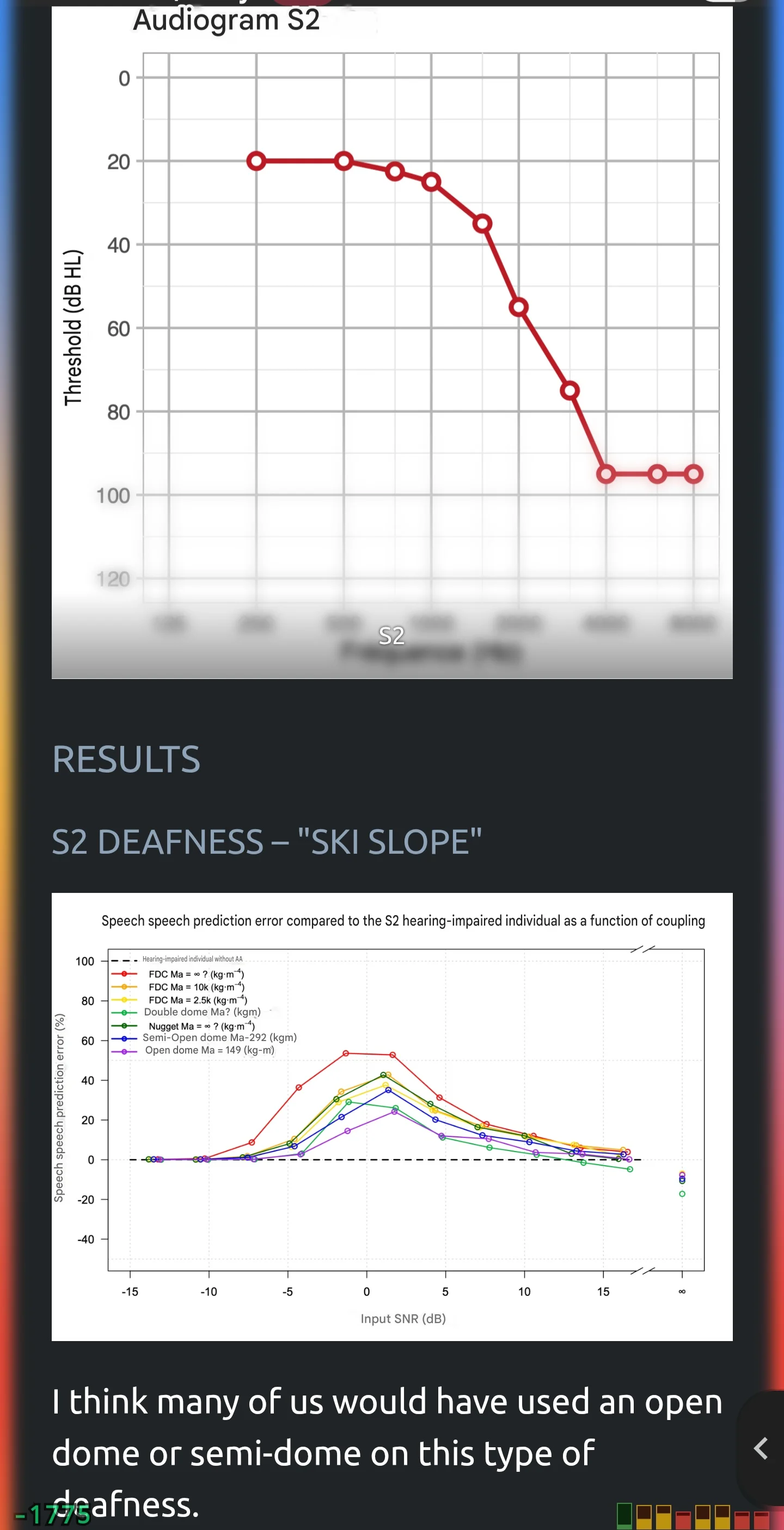
Regarding closeness, what do you think about the research described in that article? I read that translated, but outcomes is interesting especially for sloping losses:
34, 35, 37°C au mois de juin… tout va bien ! Les derniers glaciers fondent dans les Pyrénées, et se décrochent dans les Alpes. J’arrête là ce climato-alarmisme pour me consacrer à un su…
Based on that article, from speech intelligibility standpoint, for ski sklopes the best is occluded earmold (I do know that it is one research and ideally many similar ones must be performed to prove it with more credibility):
Nous avons l’habitude en Audiologie prothétique de nous intéresser beaucoup plus à ce qui pourrait « fuir » de l’oreille lors d’un appareillage (il s’agit du phénomène de Fe…
The moral is, “custom tips for all, open domes for few ( not seen here)”.
Largely this is not surprising to me and aligns with my practice. But what MIGHT be a surprise if it holds up is the difference between the totally occluded mold and the next least vented mold. I’m still on holiday, can someone else do the math for me and tell me approximately what sized vent that acoustic mass translates into?
But what is the outcome measure exactly? This is not human performance, the measures have been done in a mannequin. My instinct is that that difference between fully occluded and vented custom mold is going to be different in people. Hopefully the graduate student is doing that next.
All children start off totally occluded because their ears are typically too small to FIT any venting. But there are benefits to adding venting as they grow if hearing in the lows is normal.
All people with hearing loss have recruitment. It’s just a different growth of loudness, which is a necessary outcome of not hearing soft sounds.
Not all people with hearing loss have hyperacusis. Clinicians regularly conflate the two. One of the salient differences is that clinicians who call it recruitment don’t think it can be amenable to treatment and clinicians who call it hyperacusis do, so patients with the former type of clinician don’t receive treatment.
That wiki article is a bit of a shock. One poor reference, same old confusion. It’s been a long time since I’ve seen that on Wikipedia.
I believe the Hearing Aid Academy teaches the former. Basically, they teach that recruitment is an inner ear (outer hair cell) issue that will result in abnormal loudness growth, whereas hyperacusis is more of a brain processing issue, at least supracochlear, which can occur in people with normal hearing and normal cochlea. They teach that hyperacusis is more general sound intolerance, whereas recruitment is abnormal loudness perception jumps, via a physical process.
I personally am no expert in this, as in my MD training this was probably a one line sentence in ear physiology, which was maybe 5 one hour classes my first year of med school.
There’s a lot we still don’t know about loudness, honestly, which makes it an interesting area.
But if you think about the physical mechanics of the cochlea, it makes sense that loudness growth is abnormal when there is hearing loss. The outer hair cells lengthen and contract resulting in a narrowing and sharpening of the basilar membrane response at the characteristic frequency (increasing specificity and sensitivity). When we hear a “soft” sound, this “sharp” response means that a very few inner hair cells, and therefore auditory nerve fibres, are activated. As outer hair cells die off, we lose the sharpness of the response and so we do not hear soft sounds, and when soft sound are made loud enough for us to hear them the basilar membrane motion is more rounded leading to the activation of a greater number of nerve fibres, and quantify of activated nerve fibres is related to perceptual loudness. In a normal hearing ear, the cochlear amplifier (the outer hair cells) works at low and moderate amplitudes but as the amplitude of the sound increases the action of the basilar membrane becomes more and more similar to the passive action of the basilar membrane in a cadaver (or alternatively without the contribution of the cochlear amplifer, as in an ear with no remaining outer hair cells). Put another way, the normal cochlear amplifer is not doing anything at high amplitudes–it’s not “dampening” loudness in a way that someone would lose by not having it. So at the high end, when it comes to the cochlea, a normal hearing and a hearing loss person are similar. I’d hypothesize that any sort of disordered loudness (reduced , for example) is happening beyond the cochlea.
But I think there are a lot of semantics involved too. Hyperacusis is a newer term, and before it started to be named and categorized it was probably just dumped into recruitment, sometimes with tags like “excessive recruitement”. Without really well known mechanisms of either, if we are dividing between cochlear and retrocochlear then I would probably say that any situation where someone’s upper limit of volume tolerance is abnormally low is probably hyperacusis (retrocochlear), whereas recruitment is a bit of a meaningless word to use clinically unless we are doing loudness contour testing.
I suppose recruitment is usefully and correctly applied in situations where a sound is louder than someone remembers it being, which I would say is more often a low amplitude issue with hearing aids. I’ve said elsewhere–there is some plasticity in the moderate volume range such that moderate level sounds come to sound how we remember them sounding, but that perception of “softness” we have with normal hearing does get lost with the destruction of the cochlear amplifier and at that quiet end the hearing aid user does need to make a choice between hearing a soft sound “louder than they remember it” versus not hearing it at all.
PS. Maybe easy to infer, but I’m talking about sensorineural hearing loss, not conductive hearing loss.
PPS. It’s late and I don’t think my writing is as clear as it could be, but hopefully it’s interesting and understandable to someone.

 . So much treble!!!
 Poland
 Illinois

 (mainly old BMWs)