If you say that this will happen when she creates a new session and matches to REM that this will remove everything the previous audio has done and replace with her programming - then that’s good. That’s exactly what I want to ensure that nothing remains of anything that the previous audio may have altered.
Yes, 100% it’ll be ‘her’ settings/prescription on the aid.
15 years of NHS audiology appointments with fittings under various NHS trusts. All NHS HAs were fitted with . Recently went to Specsavers for the Audeo Infinio Sphere Ultra and they did not do REM. I asked for it but their response was really poor. Returned the HAs.
I have just got back from my 3rd appointment with the new audiologist.
What she did today
She did a test where she used what sounded like white noise (broadband) and some women speaking in a foreign language. She did that at soft, moderate and loud levels. I have definitely never had a REM test like that one. She was a lot more thorough than the high street chain who supposedly did REM on my old hearing aids.
She configured my hearing aids for three programs. , DSL5 and TV program. Long story short, I was underfit in especially the lower frequencies, but she also had to bump up the higher frequencies according to the REM test.
The appointment took just slightly over an hour.
Result
I am only trialing out NAL-NL2 for the next 14 days as she says my ears need to adjust to the new sound profile as she has changed a lot. Things do sound louder, although not a massive difference in volume. It is certainly nowhere near as loud as Widex (that I trialed out) were. I am noticing sounds that I didn’t really notice before such as the fan on my laptop. Initially I didn’t know what sound I was hearing, then suddenly realised it was the laptop fan! So, she has clearly addressed the soft sounds problem because people do sound louder (but not shouting loud - just louder).
I will need to wear the hearing aids for a full month to give a proper report, because I am wearing NAL-NL2 for two weeks, then for the following two weeks.
What I have noticed (and according to Chatgpt this is to be expected), is that I am not hearing speech clearly like the radio in the car, or men’s voices in the supermarket as well as I did this morning. The reason being is that my brain got used to a sound profile where the high frequencies were artificially more prominent and the low frequencies were somewhat missing (because I was underfit). In short, I need to retrain my brain as there is now less contrast between high frequencies and low frequencies. I am definitely noticing that the sound has changed. In a way, my old configuration unintentionally acted like a noise filter which probably does explain why I always heard so well in noisy backgrounds!
Good news is that my voice no longer sounds robotic and unnatural and in addition, as far as I am aware, she seems to have fixed the compression problems that I had with the previous NAL-NL2 configuration as setup by the previous provider.
I wish that I could say that upon fitting her configuration and doing REM, all my problems have gone away, but unfortunately only time will tell as my brain has to get used to hearing more lower frequency sounds than it’s used to, which is now unfortunately masking clarity of speech. One good thing is that men’s voices don’t sound muddy - so it’s not indistinct as in compression that is the issue - more like their voices are blending in, so it’s masking that we need to adjust slightly by reducing lower frequencies down a tad if no improvement? Can others on the forum advise whether I should be experiencing this?
Conclusion
While my hearing is not where I want it to be at the moment, I would be very happy to recommend her. She is thorough, her process is very scientific, she makes use of all the tools at the disposal of hearing aid audiologists and she has a clear process. I believe that at my next appointment, once my ears have adjusted, we will make the decision NAL-NL2 or DSL, she might tweak the lower frequencies back a tad (if my ears haven’t adjusted) and then I believe that she still has to do the unaided/aided speech test with the hearing aids. I can’t quite remember now. The next appointment is just over a month away.
Hopefully in a month or two, I can report back and finally say, I can hear soft speech and hear speech in noise. But for those of you who are looking for a new audiologist, I have been very impressed with her. Charlene has a clinic in Farnham called Farnham Hearing and address is 4, Carlton Yd, Central Car Park, Victoria Rd, Farnham GU9 7RD. So it’s not too far from London. It only takes me an hour to drive there.
Specsavers like most high street chains are poor. I originally went with Leighton’s many years ago and they are equally bad. I will never use a High street chain again.
Glad that you got really good service from the NHS. I really am. All I can say, is that I was very unfortunate and got very poor service when I went to the NHS. That was obviously down to the audiologist that I saw as she was clueless.
A small update wearing the hearing aids for nearly a week using .
The main changes/improvements that I have noticed are the following:
I am definitely noticing more sounds that I was not hearing before such as laptop fans, birds tweeting is a lot more noticeable and other sounds around the house I am now more aware of etc. So, I am definitely more connected to the world in that sense. has clearly made a huge difference as I was obviously quite underfit.
I am still experiencing a very slight occasional feedback, particularly in the right ear. She needs to adjust that down even more than she already has as she said the gain required in that ear was right up to feedback level or something like that.
My voice sounds more natural (it’s not robotic anymore) and watching tv, I find the vowels are more rounded and accents are now more pronounced than they were before. It’s not perfect, but much better than it was when vowels were noticeably thin, flat etc.
Compression issues seem to have gone away now. Typing on my computer keyboard no longer keeps cutting out the sound, so she has obviously fixed the compression.
I am still experiencing some issues mishearing words as I did on the previous Nal configuration. I did not have this problem as much with Vac+, so I think the issue may be too much compression with NAL-NL2 and/or I think I may still have a slight audibility problem with softer speech. In another week or more, I will switch from NAL to Adult DSL5 and wear that sound configuration for two weeks. I suspect that DSL5 should address this issue because this profile is supposed to be better than NAL for audibility which I think may still be the problem here as Vac+ does have higher lower frequencies than NAL-NL2. I am not sure if the problem is compression or audibility. Hopefully can answer that question.
In conjunction with point 5, I am still noticing struggling to hear soft speech when some people do not project their voices. Again, I am hoping that DSL will address this. So, at this point, the changes have not fixed the main issue I wanted to resolve.
I have mixed feelings on speech in noise. I don’t feel that I hear as well in speech in noise as I did before the changes, but it is possible I just need to give my ears more time to adjust and learn to hear a lot more bass and lower frequencies than I have been used to for a long time. She lifted the lows quite a lot, although I don’t find everything too loud - which was a problem that I had with the Widex Allure which were deafeningly loud. I am hearing speech in noise, but it is clear that the higher frequencies don’t stand out as much as they used to and men’s voices in particular are being masked a bit by the increase in low frequencies that I now hear.
I will update again once I have started wearing the Adult DSL5 program as I think the results might be very interesting.
Great you share your experiences. Out of curiosity, regarding your slight feedback - what receiver power and diameter of vent in your earmolds do you have?
I am not 100% certain, but I think I have 0.8mm vent sizes and 105dB receivers. The square at the end of it seems to be silver which I guess is grey/black for 100dB. I will confirm that with her. She did say that she thought the receiver was overpowered for my needs, but I remember when I was given my my previous hearing aids, I was on 85dB and I kept blowing the receiver, so I presume that my local audio who sold me these hearing aids, probably kept to same receiver as the previous hearing aid.
I am intending to ask her if getting a less high powered receiver would address the feedback issue.
I am intending to ask her if getting a less high powered receiver would address the feedback issue.
Short answer - no. Feedback issue depends on tightness of fit and gain. Receiver power has nothing to do there if it has to provide proper gain according to your prescription. If you have feedback, the first and foremost step is to provide better fit with less leaks. Decrease the gain most often defeats the purpose of getting proper audibility.
Your is definitely for 105 . There are articles about underestimating of role of , which I posted here on forum in the past.
I am not 100% certain, but I think I have 0.8mm vent sizes and 105dB receivers
Very, very good.
Look at my audiogram - I have 0.9mm vent and UP and it’s much better than lower power receivers. With such an audiogram, I would usually get a vented/, which in reality would be poor for me. Theoretically my audiogram says I am for M receiver, but it’s bullshit based on imperfect clients average parameters.
Additional thoughts:
These articles emphasize the important role of a sufficiently high MPO, especially when hearing in noise. Note that theemphasize the important role of a sufficiently high MPO, especially when hearing in noise. Note that the first article presents a situation with an SNR of +15 dB speech in noise, so quite favorable, but with too weak receiver intelligibity can be poor.
I am curious as to why she would think that my receiver is over powered unless she was talking about just one of the ears? I will stick with the 105 because I definitely had problems with the 85 blowing on my previous aids. Thanks.
I have just started trialing out the sound configuration. It is very early days, but I don’t think that I am going to be going with DSL. I am finding that stairs creaking, packing dishes, even my mother talking loudly (almost as if she was shouting), the boiler when water is turned on and even the printer - just sounds as if they are just too loud and I am sure that normal hearing people would not be hearing the sounds as loud as that in that they are quite invasive. I have also noticed with interest since moving to DSL, I no longer hear the clock ticking from the radiator sensor, yet I was hearing that perfectly with the adjusted NAL. To me, that is very interesting as I should be hearing that clock. I believe that is a mid frequency sound.
Last, but not least, I notice that while my mother’s voice is (so far) now never too soft, I am still having issues when she doesn’t project her voice and stamp out those syllables.
I absolutely hated the Widex and Resound (which both boost the low frequencies massively for natural sound) and DSL doesn’t seem to be addressing the speech clarity problem when certain people’s voices don’t project. Thus I am leaning towards the conclusion that my ears do not tolerate a lot of low frequency sound (Widex, Resound, DSLv5), partially because it just makes everything a lot louder, but more importantly is not passing any useful “speech information” for me and given the loss of the clock ticking in the lounge now as well as no improvement with my mother’s voice when she doesn’t project the syllables, it’s looking more like a gap in the mid to high frequencies that is the problem and not requiring any major lift in the lower frequencies. I am not sure, but that is the conclusion I am drawing.
I will trial the DSL for as long as possible, but I suspect that is better for me, albeit with a further slight adjustment somewhere in the mid frequencies, especially for the left ear.
I have to say that the NAL-NL2 REM configuration that my new audio has setup, has not solved every single problem (yet), however, this is the best fit I have ever had in my life. Sounds are not too loud, I can hear speech in noise quite well now that my ears have adjusted, vowels are now rounded and balanced again, accents have returned, I am hearing sounds that I never heard before and I am hearing the birds sound so musical and immersive like they never have before. So, I am very pleased with my new audio accomplishing all that in just one single fitting as opposed to endless tweaking just to get the aids functional.
My next appointment with her is in mid April. Hopefully she can resolve the last outstanding issue as it were.
To me, that is very interesting as I should be hearing that clock. I believe that is a mid frequency sound.
You can test its frequency by e. g. Spectroid app.
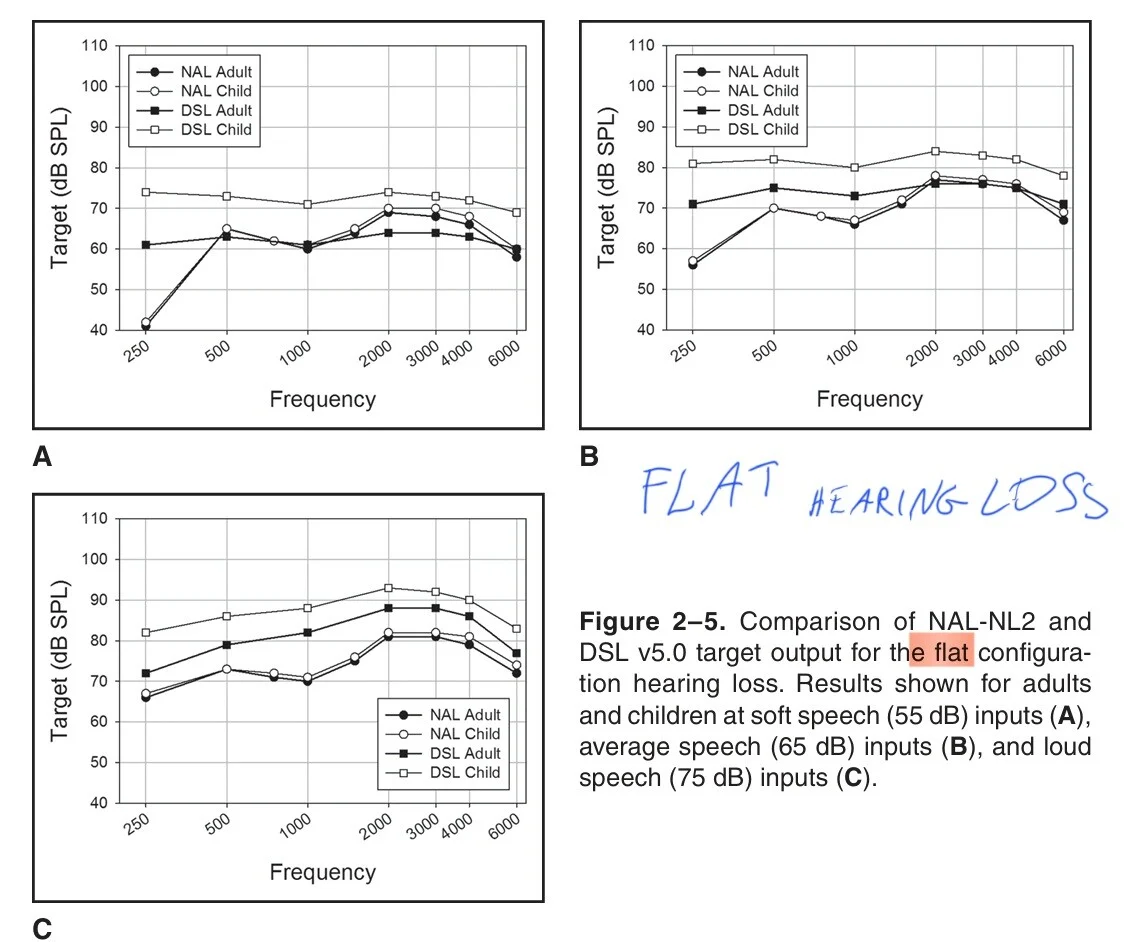
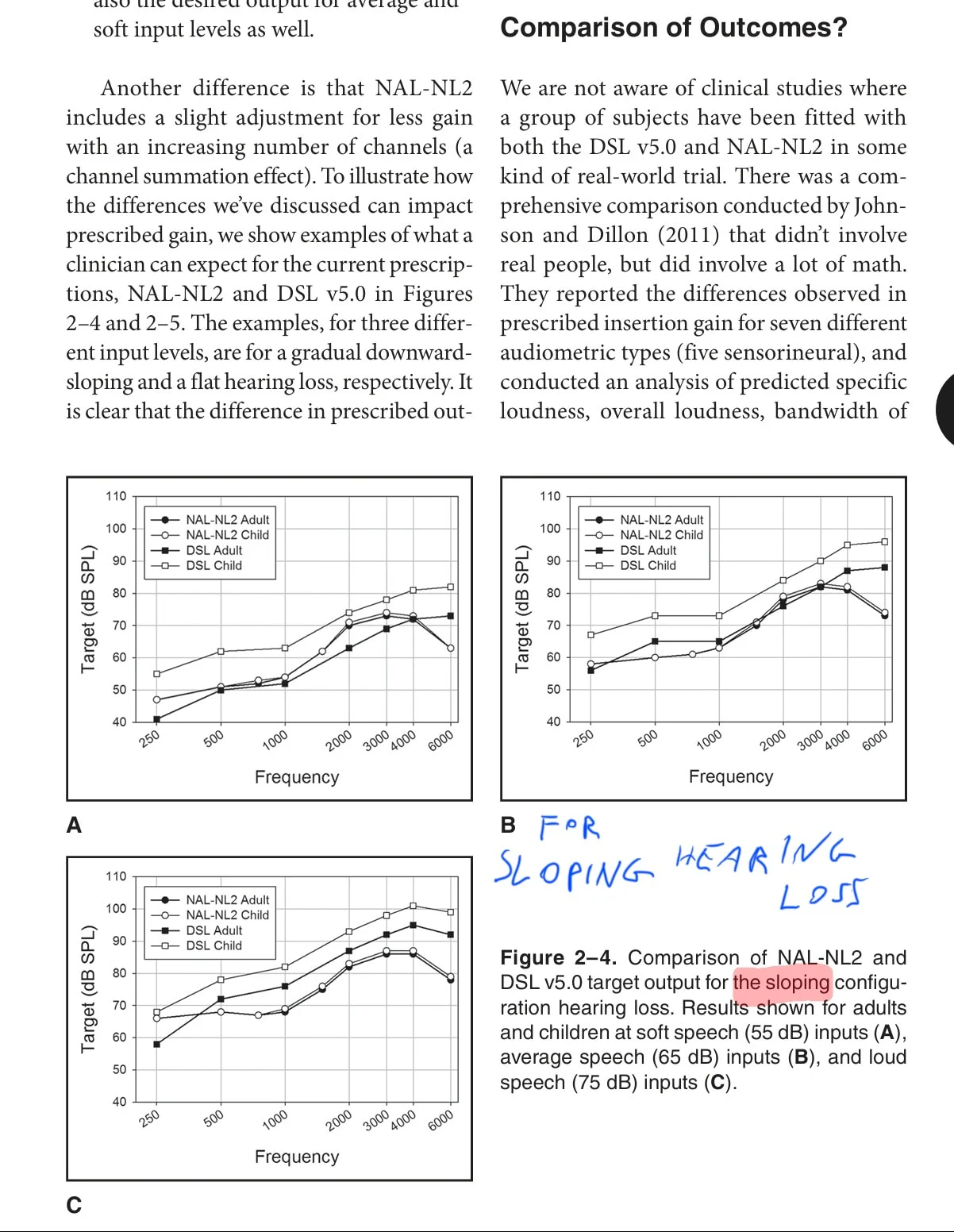
puts greater emphasis on higher frequencies, but it is more hearable in sloping loss and in 65 and 80 stimulus.
As you can see below, perhaps you need additional gain for 50-55 dB inputs in 1500-4000 Hz range to get the same gain in DSL 5.0 Adults as for . That can solve your issues witb clock ticking or mother soft voice:
So, perhaps you need simply a bit of minor adjustment of DSL. Or perhaps, you can try DSL 5.0 Pediatric and step down in all frequencies a little.
Have you ever considered discussing introduction of NAL-NL3? It may be not temporarily possible if your hasn’t MedRx system.
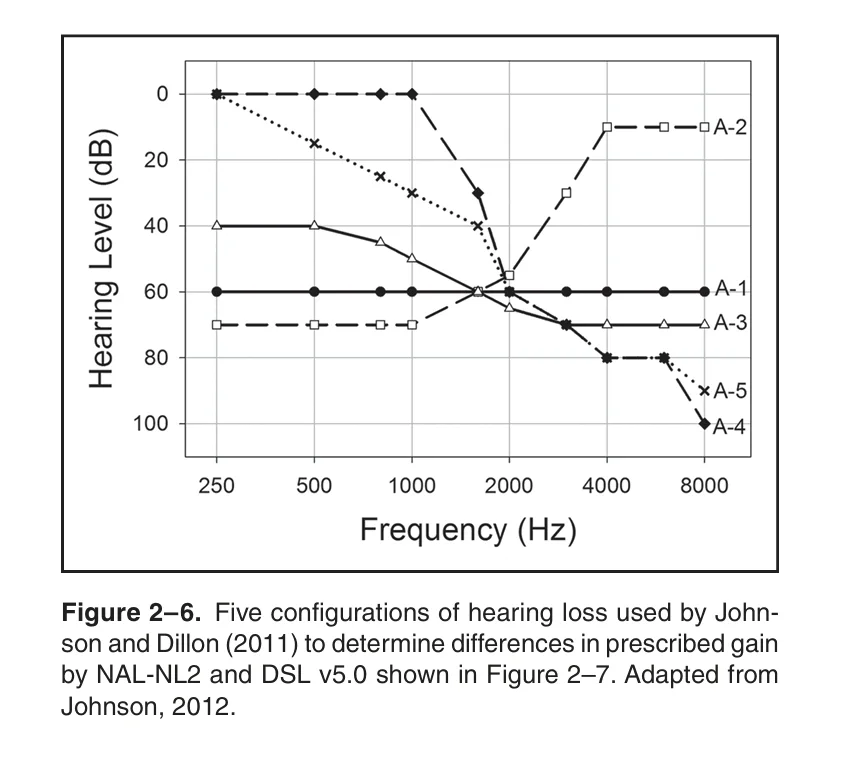
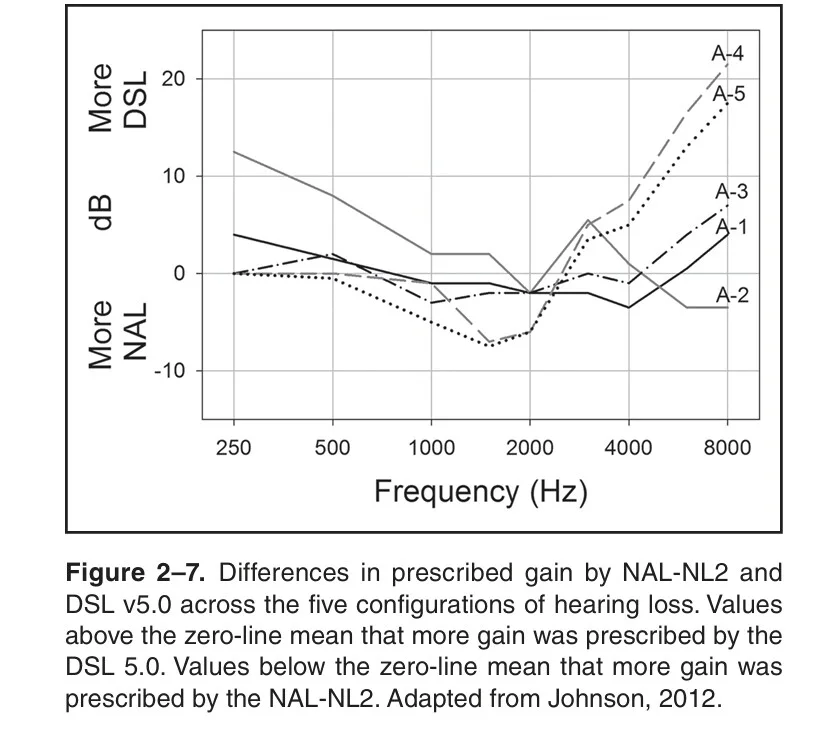
Additionally, @Roberto, look on 5he outcomes in the A3 , which is the most similar to yours:
I have discovered that the reason I was not hearing the clock ticking in the lounge is that if you have the cover on the front of the heating sensor, you don’t hear the clock ticking even with . So, disregard that as the issue was not with . I never realised that the cover blocked the sound of the ticking, but then again, before and this audio’s NAL-NL2 I never heard the clock ticking in the lounge anyway.
I have tried changing DSL so that lower frequencies have been reduced by 1dB in the equaliser settings. This has made DSL comfortable to wear. I need to do more testing to see whether DSL helps with onset audibility etc. I am not sure if the equaliser really is reducing by 1dB as that is not a huge change, yet it did take the edge off and made background sounds comfortable surprisingly.
However, I suspect that I will stay with NAL-NL2 and just ask the audio to tweak settings for remaining issues. She also has aided and unaided speech testing or something like that to do on the next appointment - which may well resolve my remaining issues.
I am also going to trial NAL-NL2 where I adjust the lower frequencies up 1dB to see if I like that for actual soft speech and hearing quietly spoken supermarket cashiers better because I did feel in the supermarket that I could hear people at a distance better with DSL than with NAL-NL2 simply because there was more low frequency volume. I just probably need slightly more boosting in the lower frequencies for NAL-NL2 but not as much as with DSL. DSL I think will be too tiring for me even with the 1dB reduction in lower frequencies.
I think the problem with my mother’s voice is a lot to do with the fact that a lot of people over 80 don’t speak loudly and they don’t enunciate the syllables anymore - it all blends in and there is just not enough contrast for my ears to distinguish. So, my audio and I just need to work out how to address this specific issue which I can see is not a low frequency or audibility issue. I don’t mind considering NAL-NL3, but I think it might be premature as it is still so new. I think it might make sense to use a tried and tested solution for the time being. Just to be clear neither NAL, Vac nor DSL currently solve the problem with my mother’s voice when she is speaking where her voice does not project or stamp out the syllables. So, it’s clear that we need to customise the hearing configuration for that as it’s not just her, but a lot of people over a certain age seem to have this style of speech.
Thank you for those charts. I was actually looking for something like that to see what the actual differences are between DSL and NAL, so that really is helpful. There seems to be a massive difference between NAL and DSL at 250hz at soft speech, which may explain why I am hearing voices from further away in the supermarket much better now. Perhaps I just need to go half way between NAL and DSL for that frequency as I do think that NAL is still slightly too soft at soft speech levels when a person is more than a metre away from me and they are not speaking loudly as many supermarket cashiers seem don’t seem to be that loudly spoken. DSL at current config is just too loud.
I have just come back from a holiday cruise on the Cunard. Think more like Titanic ambiance rather than a frat party ship so that you know the listening environment I am talking about.
Anyway, I used the opportunity to do a lot of testing with my hearing aids and found the following.
In the swimming pool, without my hearing aids, I could hear people talking reasonably well, which suggests that my hearing issues are predominantly soft speech input issues. I seem to largely manage very well at moderate to loud speech volumes without my hearing aids.
On my current settings at default, I discovered that I did not always realise that music was playing softly in the lounges until I increased the hearing aids one click up. So, this suggests I am slightly underfit audibility wise at soft speech. I presume low frequencies.
I also found with the waiters, who can be softly spoken, I lacked presence - not always aware that they had come up and said something to them - again I believe a low frequency issue at soft speech input.
I discovered at a restaurant that my mother and another lady of near her age, I could hear them much better when I had my hearing aids at one click up and also adjusted the high frequencies (not the mid frequencies, but the high frequencies) up 3dB. More than that, I just found the restaurant too noisy.
Testing in different environments on the ship, off the ship, in quiet and noisy environments, it would seem that (in general) one click up (for all frequencies) and 3dB for high frequencies seemed to help the most to address audibility (presence, low volume) and increasing the high frequencies definitely helped me understand what my mother or the other woman was saying - not because she was sitting that far away from me - were were all sitting at a round table - but I could not quite understand what she was saying without that 3dB high frequency bump.
In conclusion, I think I need to get a low frequency (and presumably mid frequency) bump at soft input volumes and a much bigger high frequency boost at soft to maybe moderate speech input to address the issues hearing my mother when she doesn’t project her voice as well as a general feeling that overall sound volumes are a fraction too soft. I don’t need the boost too much at moderate to loud as it just made noisy environments louder and ironically actually made it harder for me to hear in the restaurant etc.
I have tried and I just don’t think it is suitable for my hearing loss. It just makes everything much louder and does not at all help with understanding my mother, because DSL boosts high frequencies a lot less than . I don’t know if NAL-NL3 would work better for my hearing loss than NAL2. The only area that I ever saw any improvement was hearing in the supermarket, like the cashiers etc, simply because it addressed audibility at soft input speech volumes. But this can be corrected with NAL-NL2.
My next appointment with my new audio, I believe that she is going to do unaided and aided speech tests, which if I have understood it correctly, will help her to identify how much of a boost she needs to give to my aids for soft input to maybe moderate input volumes to address the remaining issues.
I also remember someone on this forum saying that their hearing aids are fit to 115% of what their prescription says that they supposedly need. I am thinking, it looks a bit like the same case for me - more specifically at soft input, rather than moderate or loud. Having said that, I probably still could benefit from a very mild boost to moderate and loud volumes as I probably am slightly underfit as my loud is not perhaps as loud as normal people’s loud?
I have abandoned being able to hear what waiters say as many of them, English is not their first language so they don’t say the words like English speaking people do and they speak too softly sometimes. I am surprised how badly many waiters on that cruise spoke. I just got my sister to translate what they said half the time.
What I found is that I have no issues hearing speech in noisy environments - provided that the speakers are speaking loudly enough to get past that soft input audibility issue. So, I clearly hear extremely well in noisy environments - the issue is always the person is not speaking loud enough or I am lacking those high frequencies - so it’s not noise that is the problem.
This post is obviously not a review on my audio, but I have put it in this topic, because I have discussed my hearing a fair bit in this particular topic. If anyone has any thoughts on my latest findings, especially whoever has their hearing aids set at 115% - was that at all volumes and frequencies across the board or just soft input etc?
Having said that, this new audio has setup my hearing aids significantly better than any other audio ever has. I don’t have volume imbalance, I don’t have robotic voice, nothing is too loud, vowels sound rounded, accents are present and I can even tell where sound is coming from. We just need to tweak things slightly. So, I am very pleased with my new audio and will definitely buy my next hearing aids from her. I hope her aided/unaided tests can help determine how much boosting I need for primarily soft input now that I have a much better idea of what I need.
Edit: I did say that I no longer have a volume imbalance. That is not strictly correct. It is slightly noticeable with her changes because we boosted the low frequencies a lot more more than the other audio and this hyperacusis in my right ear does create complications. In addition, I have noticed with using the tv streamer I usually have the volume set at 12 for left ear and 10 for right ear to balance the sound. So, there is obviously still a slight imbalance between the two ears, which I will need her to fix for the tv streamer particularly.
@LRav Can I ask which you got from UCLH? It’s been a long winded battle with them offering the Nathos Nova PR which I have tried for 2+ years and then today finally recognising that I need the Naida.
@Demerara I got the Oticon Cros But started out without with phonak cros the oticon cros for me is better than the phonak but i’m still waiting to see if they ever get a rechargeable as i have dexterity issues with my hands
 Wales, UK
 England, UK
 Poland