The technical stuff here is beyond me, sampling rates, bluetooth implementations, dynamic ranges etc
My loss is severe to profound. I am lucky enough to wear and own Oticon Intents and the Phonak Spheres. I own an iPhone 15 after switching from Android because of the compatibility with the Intents when I got them.
I saw Dr Cliffs comments about the weakness of Oticon streaming and superiority of Android and , and I was surprised.
Yes, the Phonak’s connectivity is superior in terms of ease of connection and switching between devices. However, in terms of pure sound quality and also, listening and watching videos etc, the experience is far superior for me. This may be for a different reason, but the Intents pull the voice out of a speaker much more clearly, and separates the background noise, whereas with the Phonaks I sometimes struggle when watching, say, a vlogger talking and there is background noise.
With music the experience is also better with MFi. Much richer. So I am a little baffled by Dr Cliffs comments that if you want a good streaming experience then this is a weakness of the Oticons. But this could be down to my severe to profound loss and I am not able to tell the difference between LE Audio and MFi. I have listened to LE Audio on my wife’s Android Samsung S23 with the Oticons and it was comparable with MFi but I wouldn’t say it was noticeably superior.
But this could be down to my severe to profound loss and I am not able to tell the difference between LE Audio and MFi. I have listened to LE Audio on my wife’s Android Samsung S23 with the Oticons and it was comparable with MFi but I wouldn’t say it was noticeably superior.
That's really what it comes down to. Many people with hearing loss, particularly more significant degrees of hearing loss cannot perceive the difference and sometimes less information is actually beneficial to them because its easier to process. One size doesn't fit all when it comes to hearing loss.
It is however important for clinicians to know about these differences because it helps when guiding different clients towards the solutions that best meet their needs and preferences.
Is Reveal worse than Phonak Sphere when comparing speech understanding? Trying to find a review on how much (Oticon Reveal) dual improves speech understanding?
First, the article you linked to is clearly at least sponsored by Widex, if not a Widex advert itself. It's hardly going to be objective.
That article states:
1) Sample rate conversion: Up-sampling the wireless stream from the default sampling frequency in the 2.4 GHz codec to 33.1 kHz in the Widex hearing aid ... (cont.)
Which implies that the sample rate the phone/tablet sends is lower than 33KHz - probably 24KHz or 16KHz. Since most audio on a phone is either 44.1KHz or 48KHz, the phone/tablet must be downsampling before sending it.
The article never states what the audio codec, bit depths, or sample rates is for Mfi. I'm giving them the benefit of the doubt that they are under an Apple NDA for that info. And it might be an adaptive codec anyway.
My take on the article (whether accurate or not) is that it's Widex touting their "special sauce" to make a low sample rate/bit rate stream sound "not awful". Which maybe they do it better than the rest but who knows...
This is fascinating stuff. When I listen to classical music with my Philips 9050’s on an Apple device, the higher pitch strings create fine grade continuous static, like a cymbal when it is almost decayed. It is really annoying.
You have failed to point out anything that is actually "BS" in your post. If you want to engage in discussions, please don't go around accusing others of falsehood.
First, the article you linked to is clearly at least sponsored by Widex, if not a Widex advert itself. It's hardly going to be objective.
Widex are also not likely to lie about the technology inside their devices and how they process sound, which is what the article discusses and why I linked to it. Widex are also very unlikely to falsify the results of a study when almost anyone can just pick up their hearing aids and hear the difference in streaming audio quality. We aren't talking about black boxes here...
Which implies that the sample rate the phone/tablet sends is lower than 33KHz - probably 24KHz or 16KHz. Since most audio on a phone is either 44.1KHz or 48KHz, the phone/tablet must be downsampling before sending it.
As already discussed earlier in this thread uses either a 24 or 16 kHz sampling rate. MFI uses proprietary codecs and they are adaptive depending upon signal strength.
Yeah, I hear similar things. Even with electronic music it doesn't sound good to me because of the spectral distortion the re-sampling creates. This is something that can be improved though.
You're correct, I was mistaken in using "down" in that sentence. There is another poster writing about down sampling and I was responding to them. You won't find "down" used in this context my other posts on this page. Widex is probably the only manufacturer that up-samples from 24 kHz to ~33kHz.
Oof yeah, somewhere in the chain the audio is not being down sampled correctly.
When I first implemented 48KHz sample rate support in Pico-, I did not perform any filtering before down sampling to 16KHz, and got those sort of static artifacts you described. Once I implemented a proper FIR low pass filter, those artifacts went away.
Interesting. Fortell is longer on the market than Sensia and it takes longer to test? (this is not an accusation or a grievance, maybe it's something I don't know as a layman)
Long story related to private lab work we did for them while the device was premarket and non-disclosures (and then difficulty getting their production device due to short supply, I assume). Anyway, good news is we've tested their new 2.0 and it's better than the premarket version. Sorry, I can't share more yet.
Just got fitted with Oticon Reveal 1s. My previous are Intent 1’s. It’s been a few hours spent at a noisy kids park and just wanted to post some first impressions.
I saw Dr. Cliffs video and his piece losing signal in the gym when he walked away from the phone stuck with me. Similarly, when I go to my gym i do struggle putting the phone in my pocket while streaming music to my Intents as it often cuts out. I have to resort to putting the phone on the floor to get a stable connection. Today at the park i was able to have the phone in my pocket and stream to the Reveals for quite a while without it dropping out. I have an iPhone 15 Pro same as I believe Dr. Cliff said he had. This is not about sound quality (my loss probably does not let me appreciate great music) and just about connection stability. It might not be perfect but it felt better.
While at the noisy kids park I noticed the Reveals would focus on my wife’s voice above the icecream truck jingle in a pronounced way. Lots of kids screaming, etc. The music form the truck was still loud and present but i had no trouble understanding my wife. This somewhat subjective but i noticed an improvement.
The Oticon Companion app has now some features that weren’t there with the Intents like the reminder to change ear . I also see a Stream filter button that is supposed to “Reduce ongoing background noise around me when I play audio to my hearing aids”. I didn’t have this on the Intents.
From some of the Oticon documentation I understand that the firmware upgrade feature is supported in the latest Android because of the support of Bluetooth while this is not available on the iPhone over
I hope that Apple will support Bluetooth LE Audio on the upcoming 18Pro since they are rumored to be upgrading to the N2 wireless chip. Not holding my breath.

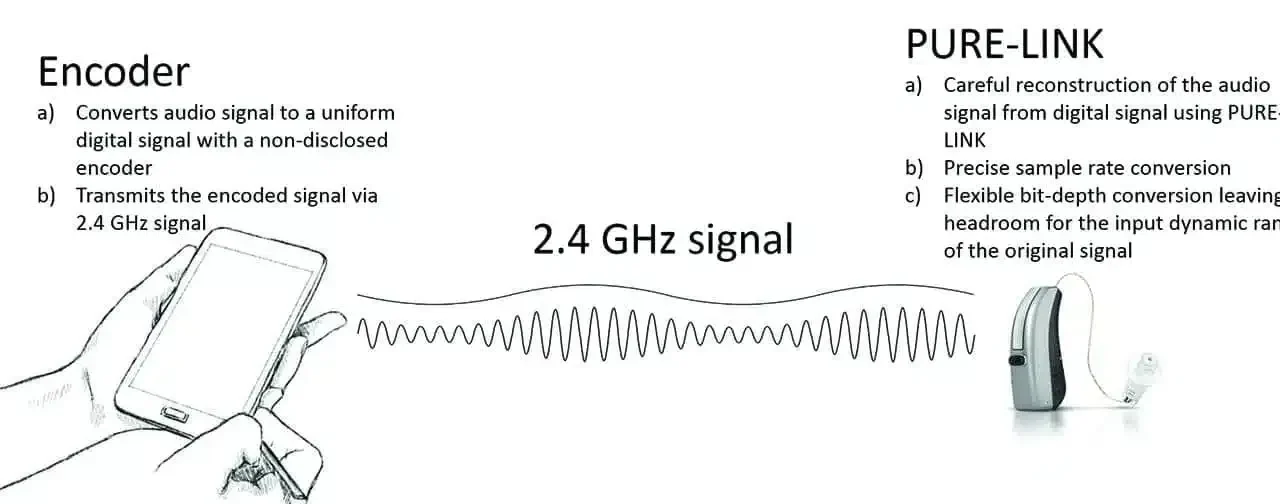 The 2.4 GHz signal is down sampled at the hearing aid itself for and all other bluetooth signals. See: https://hearingreview.com/hearing-products/amplification/amplified-caption-phones/wireless-streaming-sound-quality-comparison-among-mfi-hearing-aids2


 Croatia
 New Zealand
 Poland