Hello everyone! After receiving the programmer, I adjusted the hearing aids and improved the settings. Now I am satisfied with everything. I have a question. Will the “Speech in Noise” program eat up batteries a lot? Because Autosense is of little help at work, because it is played. Therefore, I forcibly turn on the “Speech in Noise” program to hear what my colleagues are saying to me. But I do not know whether this is a burden.
I don’t find speech in noise costs excessively, particularly compared to speech in loud noise. That eats up battery on my Audeo p90s! Naidas might be different but I wouldn’t expect so.
Thank you for your opinion! I should still try to turn on the program “Speech in Noise” every day during work. Outside of work hours, I will put the program Auto.
Let’s see how long it will last.
You cannot get even manual “Speech in Loud Noise” functionality because it requires a second hearing aid to connect wirelessly, coupling the microphones on that aid and finally enabling narrower beamforming.
In Speech in Loud Noise there are 4 microphones working (2 from each hearing aids).
The only solution is buying a Naida Paradise (make sure it is compatible with your Target software). However, outcomes may vary depending on the individual and access to Real-Ear Measurements and it can be costly.
Didn’t you have a CI evaluation for your poorer ear?
Luckily, I decided against cochlear implantation. I’d rather get a good hearing aid than have surgery. It’s risky and there’s no point if I can hear through a hearing aid. As for the second hearing aid for the “Speech in Loud Noise” program, I have already understood this and have come to terms with it, since the second ear hears absolutely nothing. That’s why I go with one hearing aid.
It all started because I stopped wearing two hearing aids as a child because it wasn’t pretty. I wore one. I could hear well with both ears. But now my right ear has completely degraded.And I lost the ability to distinguish and understand sounds. I can only hear bass on the second ear, and on the first I can hear every note, words, melody.
I agree. It is very convenient. Also, 675 batteries are powerful, one such battery lasts for 3 weeks. I wear it almost 10 hours a day. I am almost always in a noisy place. Autosense always uses the programs “Speech in noise” and “Comfort in noise”, and also listen to music via Bluetooth or watch a TV series. On average, 3 hours of streaming. Surprisingly, I wear Phonak Naida P70-UP already 1.5 years. In all this time I have used only 2 packs of 675 batteries. Before that I had an old hearing aid on the platform Oticon , which cost about 40 thousand rubles at the time. They had 13 batteries. And it irritated me that the batteries ran out quickly (about 5 days). In addition, there was no Bluetooth before. And the hearing aid was without noise cancellation, which caused great discomfort. I could hardly understand the speech of people who spoke to me. I heard only noise. Because of this, I was often ashamed. But now everything fell into place, new Phonak Naida P70-UP gives me pleasure.
I’d rather get a good hearing aid than have surgery. It’s risky and there’s no point if I can hear through a hearing aid.
I respect your decision; however, I want to ensure you made it fully informed:
Your better ear has severe hearing loss. So you’re in quite risky position, because it is quite possible that one day you will be completely deaf in it without a rehabilitated second ear with a as backup.
The longer your poor ear is unstimulated, the harder it is to rehabilitate.
Of course, I had rehabilitation myself after 20 years of deafness, so it is possible, but it is much harder than doing it shortly after deafening.
It is also more difficult to rehabilitate if you wouldn’t have better ear as a control.
I don’t know who told you that CI implantation is risky, but that is simply not true, or it is an overstatement regarding the much-improved quality of life after getting a CI.
Yes, there is always a risk of side effects or complications, but the majority of them are relatively mild and reversible. Not to mention that even driving a car is risky, but no one gives it up.
There are many more normalized, but riskier, surgeries; for example, appendicectomy or orthopedic surgeries, etc.
Nevertheless, it is your life and your decisions; I just provide my experience.
In Russia we don’t have the best technology. The hearing aid for cochlear implantation is simply huge, which looks ugly. And the magnetic coil that is in the “cochlea” is very fragile. Therefore, after the operation, we will have a magnetic coil in our ear + a huge hearing aid cochlear implantation limits us to sports activities: such as running, swimming, wrestling, etc. As I already said, the magnetic coil is very fragile and, if it breaks, it can no longer be fixed, and we will be haunted by headaches for the rest of our lives.
As I already said, the magnetic coil is very fragile and, if it breaks, it can no longer be fixed, and we will be haunted by headaches for the rest of our lives.
Again, this is simply not true or at least an overstatement. The device can withstand external impact of up to 2.5 joules, which is quite severe and can make concussion. The impact must be a direct hit exactly at the place of the coil, which makes it much less probable. There is source about 2.5 joules:
Regarding headaches, this is not entirely true. Even if we suppose the worst-case scenario (which is very rare), the coil most often stays in place, and in worse situations, it can be relatively easily explanted.
The only case where headaches can occur is after the activation of the sound processor, when the patient too ambitiously and too quickly increases the level of stimulation, causing sensory overload when he/she hasn’t yet accustomed to it.
I must respond keeping in mind that there are other forum users reading that and making decisions, refusing devices which can substantially improve their quality of life based on untrue information.
I don’t know who told you about breaking the coil or where you read about it. I am interested in the source of that information.
There are documents about the reliability of the internal and external devices, which is very high, even after years:
Надежность импланта имеет крайне важное значение при выборе кохлеарного импланта, поэтому есть только один выбор: линейка Cochlear™ Nucleus®. Узнайте, почему надежность имеет значение.
This is comprehensive precautions about Cochlear CI632 device. Keep in mind that I have a much older model (CI24RE, which was released to the market around 2005), and I have no issues.
Therefore, after the operation, we will have a magnetic coil in our ear + a huge hearing aid cochlear implantation limits us to sports activities: such as running, swimming, wrestling, etc.
Again, it is not true. There are many testimonials about a relatively normal life with a cochlear implant. There are aqua accessories that let you even swim with it. The general rule is to avoid direct hits, which is very easy, especially if the user wears a helmet.
The same applies to /power hearing aids.
I normally run, scuba dive up (after temporarily taking off the external device). According to the documents, users can dive up to 40 metres underwater.
Okay, I get it. Thank you very much for such a detailed explanation about cochlear implantation. It was interesting to learn. However, I will not change my choice. I will wear it with pleasure Phonak. Therefore, I propose to close the topic of cochlear implantation. Since this topic is about a hearing aid.
I have an interesting question. Please tell me when you wear hearing aids and regularly use Bluetooth streaming. Does the hearing aid wear out quickly and shorten its service life or is this not true?
I don’t stream much to my Sphere because I mainly do it to my sound processor due to the necessity of rehabilitation.
However, it seems that Bluetooth Classic v. 5.3 in it definitely uses less power than Bluetooth Classic (v. 4.2? I’m not sure) in my Phonak Audeo Paradise P90-RT.
The range of Bluetooth with Sphere is much larger, too.
After firmware update and activation of Bluetooth the power consumption will be additionally improved.
Hello everyone! I work at a furniture factory. It is very noisy there and I have trouble hearing speech on my Phonak Naida P70-UP hearing aid in a noisy environment (operating machines, noise of people talking to each other, operating press, vacuum. Everything is constantly humming). I really like my hearing aid settings only outside of work. On the street, at home, in a shopping center, in a car, etc. (comfort in noise, quiet situation, speech in noise) everything is ok, there are no problems with this. The main problem is only at work. I have trouble hearing my colleagues’ speech because of the noise. Tell me, is it possible to somehow adjust this so that at work the speech of my colleagues is more or less audible and understandable? Who can help me with this? Please.
Hi @bjrunning
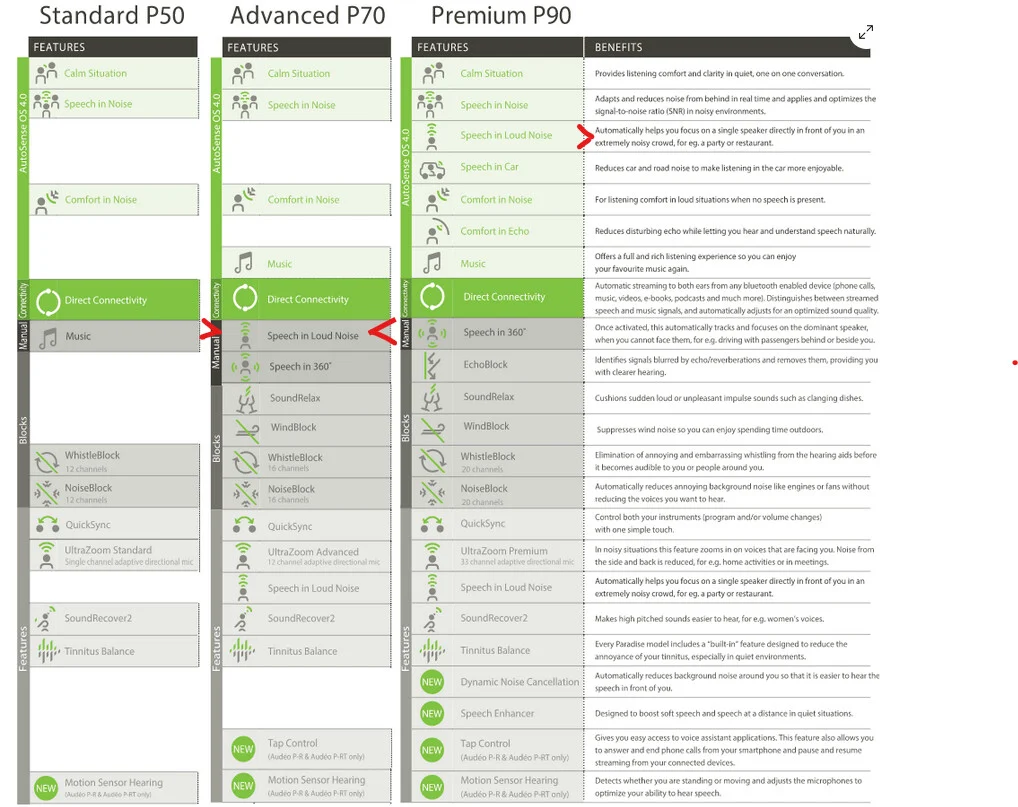
I would suggest you try the program " Speech in Loud Noise " at work.
Your audiologist can add an extra program for " Speech in Loud Noise " on your Naida P70-UP.
The Speech in Loud Noise activates the " UltraZoom Advanced " feature of the P70. This feature zooms in on voices that facing you. And noise from the side and back is reduced. With the MyPhonak app you can adjust this features for " Speech in Loud Noise ".
You need to manually activate this programm via button press or in the MyPhonak app.
On the P70 the " Speech in Loud Noise " is available but only as extra manual programm, and not in Autosense (automatic programm) like the P90 can have.
" Speech in loud Noise " activates a strong focus to speakers in front of you. While reducing noises from sides and back.
You can add maximum 4 seperate programms.
P70 and P90 also have a special “Speech in 360°” programm, which could be added as seperate programm. You could also try this, to see if this helps you at work.
As an alternative you could try a different fitting formula.
@bjrunning I assume there is a maximum noise level where you will need ear defenders/protection PPE.
If it is noisy, your employer should get you the right PPE.
Are there any bluetooth walkie-talkies! you can use with your hearing aids?
Have there been real measurements of sound levels? Are the levels within bounds for the day you spend there? PPE is a good idea even if it isn’t consistently “that loud” if it is uncomfortable.


 Rural New England
 Poland