IF she is a good candidate for cochlear implant, the fear is something that could be worked on.
I will ask the doctor performing the test if she could be a candidate for a cochlear implant.
At 90 years of age with a moderately-severe to severe loss in her left ear I wouldn't think she would be a candidate for at this point in time. I would focus on getting her well-fit hearing aids first and seeing how she does as this is a prerequisite for any CI candidacy assessment anyway.
Many audiometers cannot present speech at levels higher than this, but that doesn't mean that the individual won't perform better at higher sensation levels. Only that the equipment couldn't get loud enough to prove this.
One year ago I had performed with small loudspeaker which cannot made sound more powerful than 80 , maybe 82.
I discovered that with very kind and helpful because I requested to check my and that was impossible even with 85 dB input.
(I do know that is different equipment than audiometer).
I think you should try and get some rechargeable SP BTEs for both ears
I wasn't aware that rechargeable max power (fitting range of up to 120dB) existed.
Regarding the ReSound Enzo IA, are you referring to the "EI98-DWHC - Metal hook" model on page 2 of this PDF1? I see that the metal hook model covers up to a 120 fitting range starting from 750 Hz, but looking at her , her worst loss in the right ear is 100 dB at 500 Hz. Do you think it will provide enough gain at low frequencies?
I couldn't find a datasheet for the Signia model you mentioned. Do you happen to have a PDF link for it?
Regarding the disposable battery VS rechargeable issue, I want to emphasize that it is secondary. What matters most is fitting her with hearing aids that maximize her speech intelligibility. If necessary, I can go change the size 675 batteries myself once a week as long as it helps her hear well.
Honestly, I was hoping to stay within the Sonova family because their Bluetooth implementation seems to be the only one compatible with my relative's basic feature phone. In fact, we successfully paired both her Unitron and the recent Phonak aids. If I'm not mistaken, it uses the Hands-Free Profile (HFP), streaming audio directly to the hearing aids during calls without requiring any extra steps other than pressing the call answer/end button. Conversely, it seems that the Bluetooth used by all other manufacturers requires a smartphone (/) to connect. Please correct me if I'm wrong.
Many audiometers cannot present speech at levels higher than this, but that doesn't mean that the individual won't perform better at higher sensation levels.
Beyond a certain sound pressure level (dB), isn't there a risk of acoustic trauma or damaging the eardrum? Isn't that why the testing equipment doesn't go past 90 dB? Or did the hospital audiologist intentionally stop at 90 dB when they could have pushed up to 120 dB, which is the full scale on the chart?
I do phenomenally well with Phonak Lumity Life aids.
Those are , so I doubt they can handle the profound hearing loss in her right ear. Keep in mind that her current RICs with UP receivers have a fitting range of up to 105 dB, and that is severely insufficient for her right ear despite the custom earmolds.
Beyond a certain sound pressure level (dB), isn't there a risk of acoustic trauma or damaging the eardrum? Isn't that why the testing equipment doesn't go past 90 dB? Or did the hospital audiologist intentionally stop at 90 dB when they could have pushed up to 120 dB, which is the full scale on the chart?
It is probably to do with hitting the limits of the equipment. With a mixed loss and a large conductive component you can go higher than 90dB for speech and not cause damage.
Thanks for supplying more of your reasoning. If you want a device that's compatible with her existing Unitron aid they also have a Stride B UP . It might be worth checking to see if it can be fit with one of her existing Unitron aids and if you can still get one. It might save you some money and hassle.
I know that Unitron and Phonak share a lot of underlying technology, but I’ve noticed some feature differences and I’m unsure whether they could be decisive in this specific case. Our primary goal is to maximize speech intelligibility in an environment that can occasionally be noisy, specifically with competing background chatter.
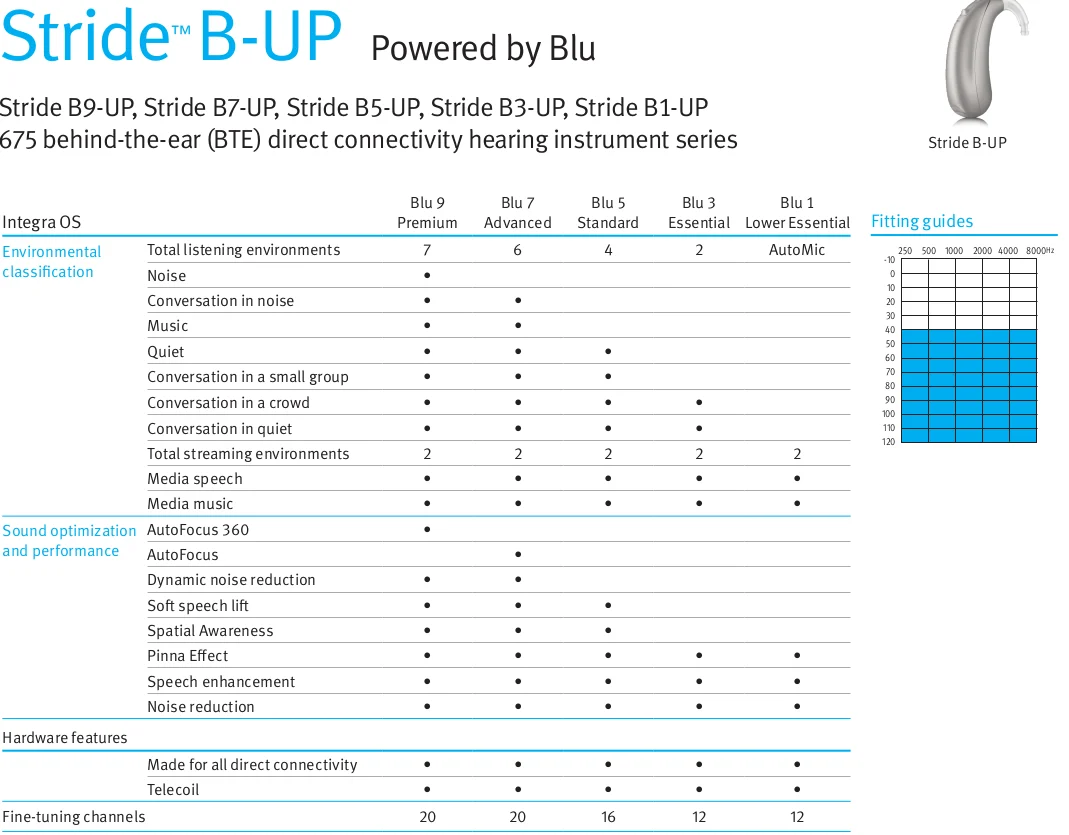
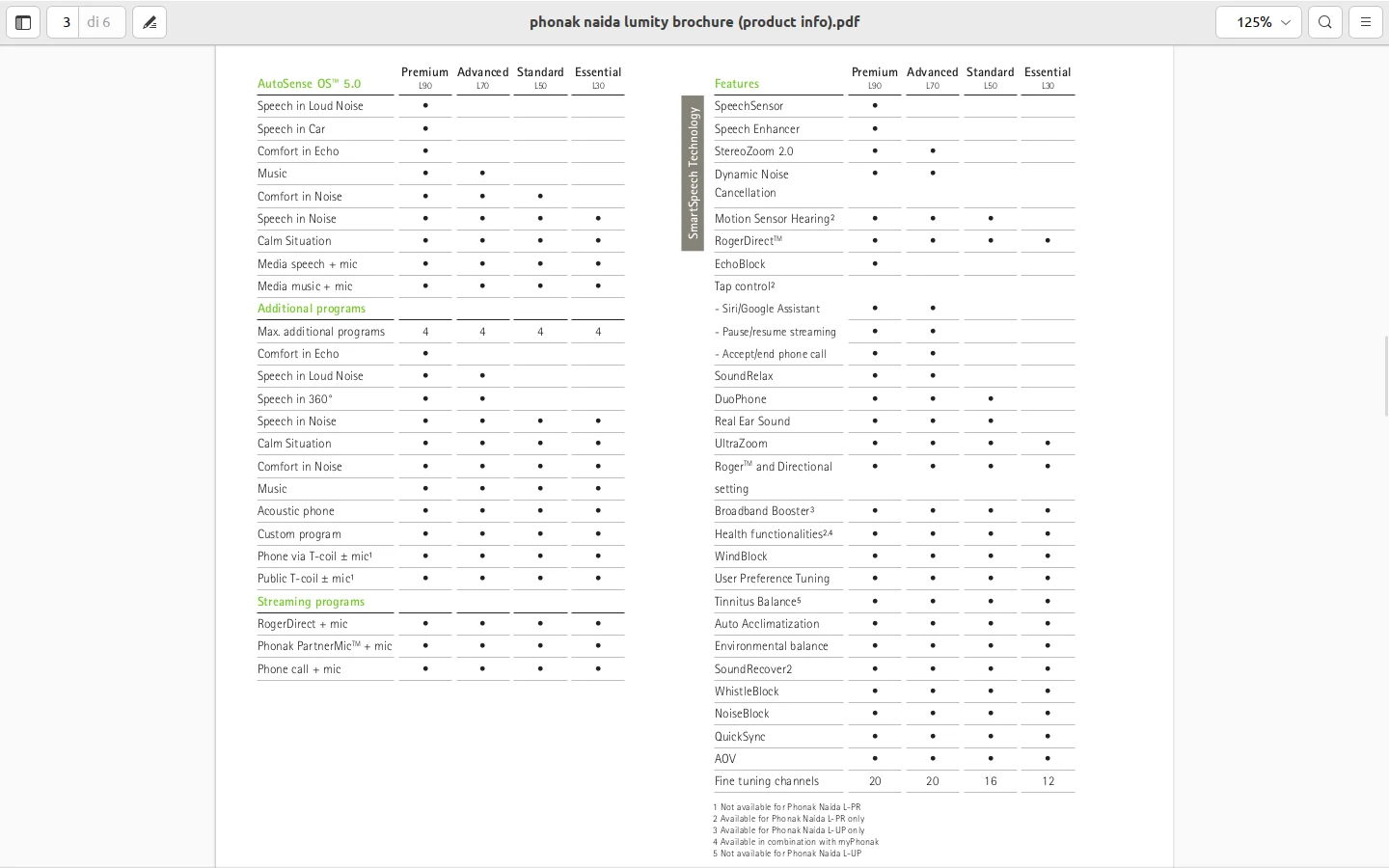
Here are the features for the Unitron Stride B : And in the next post there are the features for the Phonak Naida Lumity BTEs:
[...]
I find it difficult to draw direct parallels between their feature sets. In other words, which specific features are critical in this case to maximize speech discrimination in background noise?
For the Phonak Naida Lumity BTEs, I suspect the key algorithms are "Speech in Loud Noise", "Speech in Noise" and "Speech Enhancer" and I noticed that "Speech Enhancer" is exclusive to the L90 tech level. For the Unitron Stride Blu BTEs, I imagine the equivalent features would be "Conversation in Noise", "Soft Speech Lift" and "Speech Enhancement" though I am unsure how critical "noise" feature is, given that's only available on the B9 level.
Could you help me understand which key features are most important to evaluate for both the Phonak Naida Lumity and the Unitron Stride Blu?
By the way, I haven't been able to find the technical specifications for the Unitron Stride Vivante BTEs. I assume the Vivante platform is Unitron's direct counterpart to Phonak's Lumity. Do you happen to have access to those datasheets?
I had a look and unfortunately the Stride B UP isn't compatible with her existing Unitron aids so there isn't any advantage from a financial point of view there.
The features of Unitron and Phonak aren't the same. They were and continue to be run as separate companies with independent patent portfolios even though they share Rogerdirect connectivity and chipsets.
If it were me I'd choose the Unitron product as their soft speech lift works in quiet and noise (and is available at 3 levels of technology) vs Phonak's speech enhancer that works only in calm situations and is only in premium devices). The Unitron product is better value for money at most technology tiers. Here's a link to the Stride V UP Datasheet.1


 Poland