I went to the audiologist yesterday, for the 1st time. I am quite tech savvy and wanted to try the LivioEdge as they claim to have some Deep Neural Network () technology, and I think there is value in machine learning…
The Audiologist installed them in my ears and fiddled a bit. It sounded like I was hearing an echo almost a reverb. In addition the pitch seemed off, as if I were in a small confined space with hard reflective surfaces.
My hearing is not ‘awful’, just at the point where my wife is tired of repeating herself, and the TV is a bit to loud.
‘Deep Neural Network’ is computer science jargon. I guess Oticon could have usurped it for some market speak, but they certainly did not invent it… See more information than most would want here: Deep learning - Wikipedia4
I will look into getting my data posted.
Until then are there general explanations that can help me understand
The Audiologist installed them in my ears and fiddled a bit. It sounded like I was hearing an echo almost a reverb. In addition the pitch seemed off, as if I were in a small confined space with hard reflective surfaces.
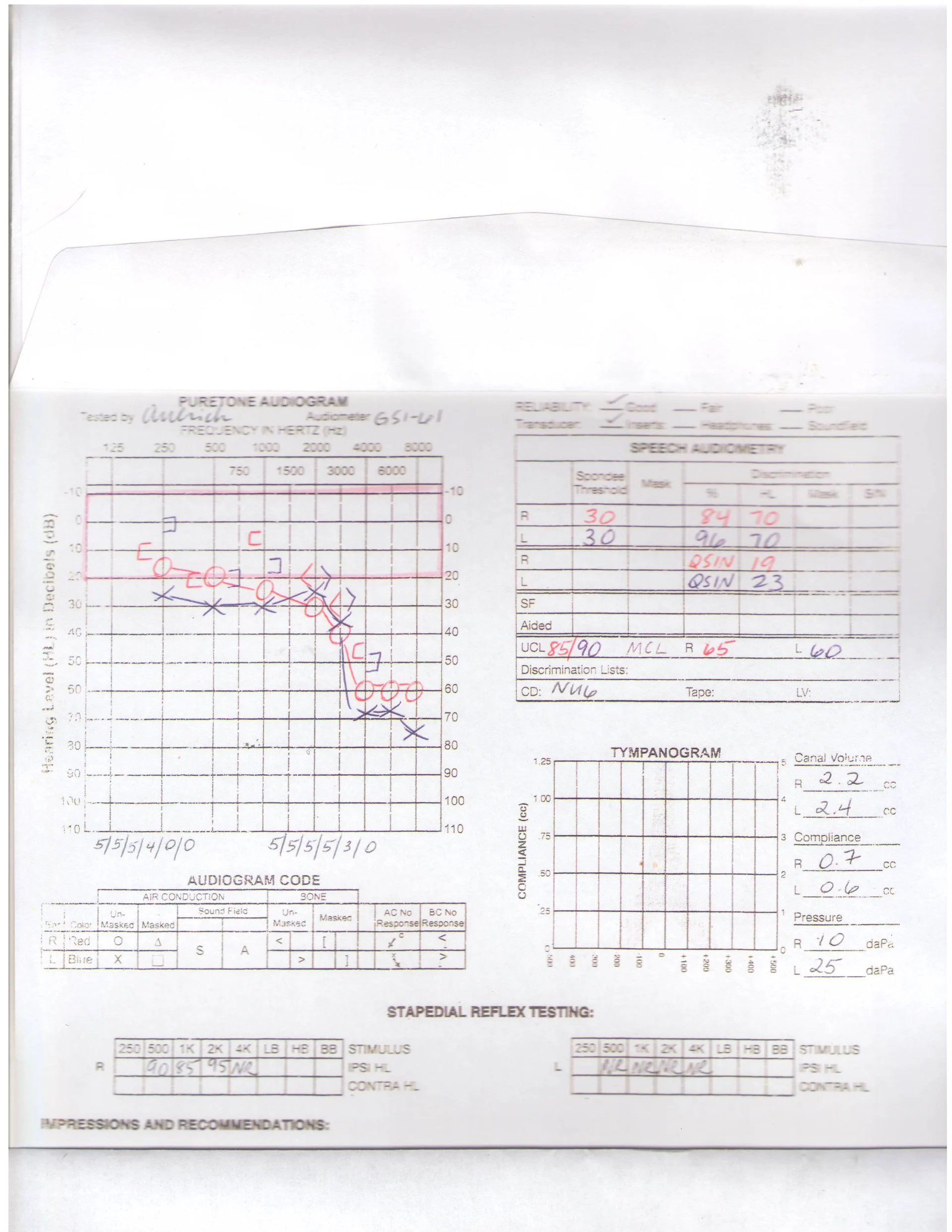
Besides entering your and your word recognition scores, if you have them, mentioning what type of dome or mold you have been fitted with would help, too. Or whether you have the custom, in-the-ear variant of the Edge with how much venting.
With regards to the pitch seeming off. I’m going to guess you have a high frequency loss. You’ve grown used to not hearing high frequencies. The hearing aids are restoring SOME (not all) of those high frequencies and it sounds off. One can adjust to it.
Thanks for the link, Ray. I guess I incorrectly assumed that Oticon had dibs on “Deep Neural Network” in the specific context of . I am reading the Wiki writeups with interest.
Have you done any digging with the Search function for explanations of your phenomena? I believe there should be numerous relevant threads that have discussed what you’re hearing.
Deep Neural Network is just a subset of techniques, and it’s not a proprietary Oticon thing or term. It’s just an approach to using neurons (mimicking the brain’s neurons) to represent abstract things then use weights and biases to classify the importance of each neuron relative to other neurons in propagating information to arrive at accurate enough results inside a network of neurons. I posted some links to YouTube videos that explains pretty well in the original Oticon More release announcement thread in this forum way back in January of this year if anyone is interested in learning more about it.
I downloaded and read the whitepaper on the Starkey Livio Edge to try to understand more about its AI approach/technique, but I didn’t see even one mention of the word deep neural network in their whitepaper. So I doubt if Starkey uses the DNN in its Livio Edge, or otherwise that term would have been mentioned a lot and their approach explained in more details consistent with DNN techniques (like the whitepaper that Oticon published). But it wasn’t. They only said that they have a database of 2000 active participants giving them environmental data that allows them to match hearing aids parameters with environmental conditions and predicted listening intent. So if a user is not happy with the automatic parameters currently set in their hearing aids in certain difficult environments, they can simply push a button to access alternative settings from the Starkey database for different parameter settings that may work better for them.
Widex does something similar by asking users to make a selection between 2 A/B choices of parameter settings that are being presented to them that they may like better for a particular environment, then this choice is stored to be shared by other users later on who may run into the same or very similar environments. The premise is that if enough users make enough choices, the shared database is improved over time and the choices become more and more accurate and effective in the long run for most everyone.
But neither the Starkey nor the Widex approach resembles the training of a deep neural network like what was done for the Oticon More. Just to clarify, I’m not saying one approach is better than another. I’m just saying that only Oticon seems to be using the DNN subset of the AI field as far as I can tell. Widex and Starkey seem to be using other AI approaches. The new Philips 9030 model released at Costco recently also claims to have used AI. I looked into it and it doesn’t seem like it’s the DNN stuff either.
In the above paper, Dr Wang specifically mentions working with Starkey.
Volusiano: does not at all use neurons. I would also suggest that based on my research - limited as it is, we don’t really know what these folks at any of these companies are doing beyond the marketing nonsense they feed us.
Volusiano: DNN does not at all use neurons. I would also suggest that based on my research - limited as it is, we don’t really know what these folks at any of these companies are doing beyond the marketing nonsense they feed us.
LOL, I thought that when I used the word neuron in my post above (per the Google dictionary → neuron: a specialized cell transmitting nerve impulses; a nerve cell), it should be obvious enough to anyone here that I’m not literally talking about a real human nerve cell, but I’m only talking about the abstract concept of a neuron, and that’s why I put in parentheses “(mimicking the brain’s neurons)” to make it a no brainer to anyone that I’m talking about the concept, and not the real nerve cell. For anybody who mistook what I meant for the literal sense like you did, I guess I’d have to clarify again here that I’m not talking about the real human neurons here. Come on, I’m not that naive to think that Oticon can put real nerve cells on their chip.
And I hope you didn’t make the generalization “we don’t really know… marketing nonsense” above to include me. I put in the time to learn to understand what a deep neural network is (in computer and mathematical terms, mind you, don’t think literal again), not at a professional level, only at a layman’s level, but still, enough to understand the concept such that when I put in the time to read the Oticon whitepaper on their stuff, I had enough of a layman foundation to understand abstractly what they’re talking about in their whitepaper, and be able to correlate what I learn about DNN to make sense of what they say in their whitepaper.
So unlike you, I happen to believe that Oticon is using the DNN concept for real, and that they’re not just spewing marketing nonsense. So it’s OK if you had said “I (meaning you) don’t really know”, but because you said “we don’t really know”, I’ll take an exception to that and want to be excluded from that “we”.
A misunderstanding on my part. I am quite familiar with these terms I have been involved in both applied and pure research in computer science for a long time. I see them misused frequently, and your assumptions were not obvious to me, I can be literal at times esp. with technical terms and assumptions and I was concerned that others may not really understand.
WRT the marketing I am able to read and understand the technical data that I see from these companies and have been trying to do so for a bit. I do admit that I have yet to go through the patent disclosures that are filed, but I have been looking at the technology used from a hardware perspective, and have a passing understanding of some of the signal processing and certainly the software. That said MOST, not all, but most of what I see is indeed marketing nonsense. When I said: ‘we don’t really know what these folks at any of these companies are doing…’ I was not saying that ‘they were not’, but ‘we don’t really know’, very different. This comes from many years of reading ‘marketing nonsense’, even at the DARPA level.
It is possible that you have access to information that is generally not available, in which case you will indeed have an accurately informed opinion, and sadly I don’t have that access, but am more than willing to learn.
All this said, I hope to try the Oticon product precisely because the claim to use this technology, and I like the idea.
Now, can someone PLEASE help me understand what happened when I tried the LivioEdge?
On the use of the term “neuron” in , it depends on who’s doing the talking. Sometimes people just refer to “units” or “nodes” in a layer but lot of folks refer to them as “neurons” as in “artificial neurons.” How can you have an artificial neural network and be banned from calling the units “neurons” ?!
Source: Neural network - Wikipedia. And you can find lots of other blogs on the Internet where computer science whizzes refer to the units as “neurons.” (I spent two years taking 10 courses in Microsoft’s now-defunct AI/Machine Learning track on edX.org).
I’ve never started a thread asking for support so feel I don’t need to supply one. If I feel I need to start a thread asking for support, then yes, I’ll supply one!!
I agree. I thought that I was being helpful by guiding people to the fantastic resource of the Search. Tons of questions are answered instantly, and in detail. There’s also different “takes” on the same subject.
I apologize if that’s taken as unfriendly.
[BTW, my reference to “reinventing the wheel” was a reaction to a certain tone of “entitlement”:
First: I apologize to all for being an aggressive jerk. Some of my comments were unnecessary.
I am aware of the Real Ear measurements and have selected an Audiologist that follows that protocol.
The situation I find myself in is that I am trying several models to make a determination for longer term. It is unclear to me if the proper ‘fitting’ should be applied to loaners. If not, meaning that the audiologist just does a quick matching of your hearing profile, how does one make an intelligent choice, as all options presented will be sub-optimal?
Others will differ, but my take is that one does not “test drive” a bunch of different hearing aids. They are impossible to compare objectively. I think one makes a choice (by whatever method one wants) and then make a determined effort to make it work. If one is not satisfied during a trial, return it and try something else. And yes, anything you’re going to “try” should receive a proper fit.





 Oticonian/Disposablyte


 Texas Hill Country