
Yup. Article is just about the implant. While we won’t get any benefit from the new implant, it’s great to see what the new gen of implants is like.
You’re ignoring this member’s posts.
This topic is closed.
59 replies3.2k viewsLast reply
Yup. Article is just about the implant. While we won’t get any benefit from the new implant, it’s great to see what the new gen of implants is like.
You’re ignoring this member’s posts.

That’s a very interesting article, I like the fact that it stores maps. Not that the Nexos will affect me, unless the surgeon pictured in the article agrees to let me go bilateral. He’s been a steadfast no so far due to not hearing high frequencies for 7+ decades.
You’re ignoring this member’s posts.
Interesting article.
However I don’t understand the idea of storing MAP in internal device, assuming most of us wouldn’t have broken sound processors where the MAPs are stored. Maybe it is something extra I am not aware.
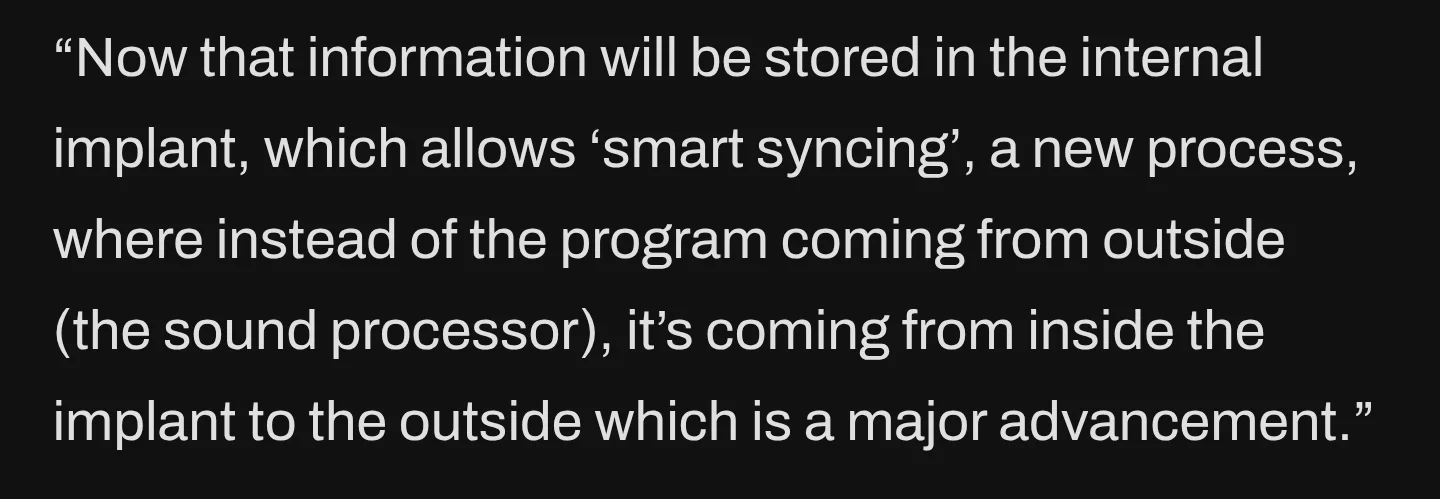
I don’t understand this. Does that mean sounds go to the sound processors, then to the internal device, and then come back to the sound processor again?
Apparently I’m missing something important.
"“Syncing throughout the day” - perhaps it is adjusting MAPs depending on variable impedances?
Energy management, which can increase daily battery life by ¼ to ⅓, represents a tangible improvement.
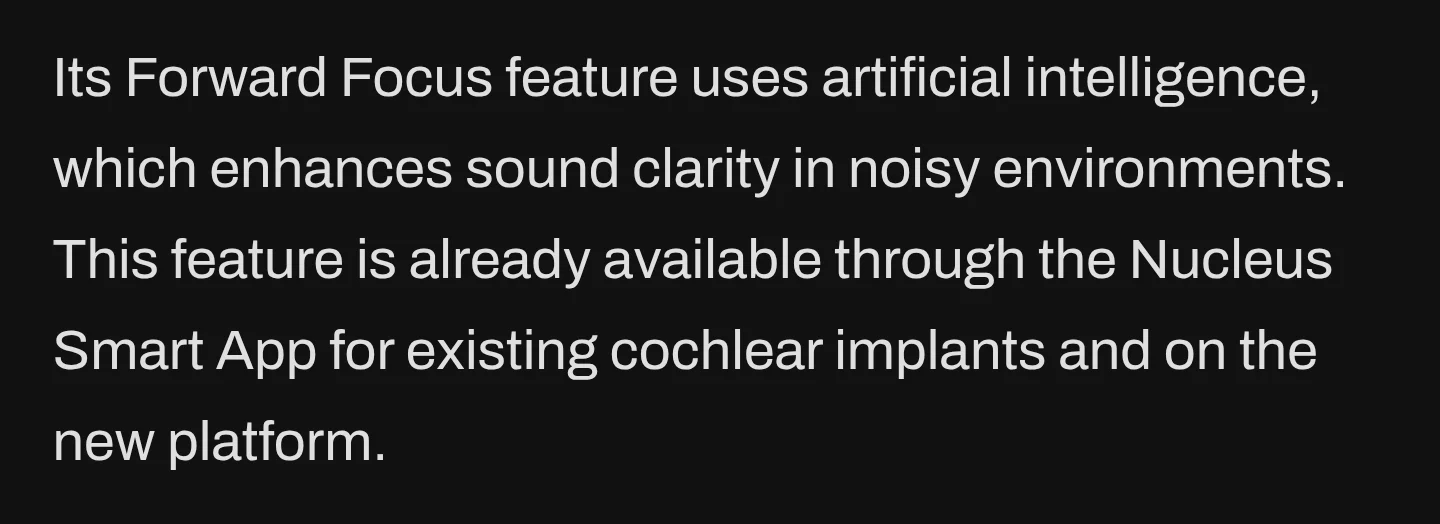
This is a bit of an overstatement because it looks more like an AutoSense in Phonak’s hearing aids than the DEEPSONIC chip.
What worries me is they talk much about convenience features (improved battery life, easier firmware upgrade, easier mapping), but I didn’t find anything about improving speech understanding or music experience - better signal processing, coding and stimulation. I hope it aren’t because that new features aren’t a big step.
This is because I completely agree with @Raudrive - I can hear leaves even with my 2005-technology internal device:
I’m hearing sounds I’ve honestly never heard before in my life, such as the swishing of leaves in a tree.”
This is why I asked about their first or an upgrade from an old implant.
This example could well be my words. My implants were as they described, wonderful. A world of new sounds.Just saying
You’re ignoring this member’s posts.
Experience the world's first and only smart cochlear implant system.*

Interesting, most of the brochure videos were made 11 months ago.
You’re ignoring this member’s posts.
I don’t understand this. Does that mean sounds go to the sound processors, then to the internal device, and then come back to the sound processor again?
Apparently I’m missing something important.
I don’t think so. I think it’s just as you wrote in the previous paragraph. That the MAP that’s programmed to our sound processor also gets stored on the internal implant. If you need to change to a new processor, then just put it on an it will autoload the MAP from the implant. Eg. On holidays and lose the processor. Pick one up at a local convenience store (haha) and be on your way without having to return home to have it programmed.
There may be more things they have in store that they can’t say yet. Maybe there is something indeed which will help in future.
You’re ignoring this member’s posts.
I think you are probably right with your description of MAP storing. I also think there are more things they have in store that they aren’t advertising yet, such as hardware that supports new coding/stimulation strategies. The results of the Phoenix system clinical trials will probably help determine what they make available. I personally think that there will only be small incremental improvements in sound until they make significant changes to the neuron interface (electrode array).
You’re ignoring this member’s posts.
I borrowed this from FB, it’s what Cochlear are saying for the professional people.
You’re ignoring this member’s posts.

I read through that attachment.
Personally I do not use SCAN programs. They tend to make processing adjustments that are bothersome. I prefer the non scan processed sound, it’s more natural to me. My brain does the processing rather than the processor.
I do seldomly use the Forward Focus in rare occasions. It is helpful. And also rarely use the Sensitivity setting to just turn things down when it’s just too noisy.
This talk about a new implant is heavy about processing sound. It might not be the best for everyone but should be very interesting to keep up with. Thanks for the information.
You’re ignoring this member’s posts.
. I personally think that there will only be small incremental improvements in sound until they make significant changes to the neuron interface (electrode array).
From what I’ve read, Focused Multipolar Stimulation (FMS) can really be a big progress because more accurate (narrower) currents from many sources could mean that pitch recognition and the ability to differentiate between interlocutors talking at the same time will improve.
The only concern is about energy consumption, because if I understand correctly, for achieving more accuracy through narrower electrical fields, Additional electric fields must be generated on adjacent electrodes of the opposite potential (vector) to zero out a certain part of the previously wide electric field.
Personally I do not use SCAN programs. They tend to make processing adjustments that are bothersome. I prefer the non scan processed sound, it’s more natural to me. My brain does the processing rather than the CI processor.
Which programs do you have? I use the Music and SCAN2 mainly because of my being used to AutoSense in Phonak . My audiologist couldn’t explain me what exactly means “Work” program from the technical standpoint, which is my No°3 program.
I couldn’t find any accurate informations about programs from Cochlear sources.
You’re ignoring this member’s posts.
I wore Phonak aids exclusively until the Cochlear implants. Self programmed them from the beginning.
I have 4 programs, 2 with scan and 2 without.
1&2 are everyday, 1 without scan and 2 with.
3&4 are in loud noise programs. 3 without scan and 4 with.
I use #1 99% of the time if not 100%. It’s the least processed program that lets most sounds in.
If I try I can hear a mouse fart at a 100 yards. Just teasing.
IMO processor programming is very similar to hearing aids. Directional and noise reduction technology. Both can take away the sounds the brain needs to understand things. It’s a balancing act to get the best sound.
The K3 has more technology to to deal with. I wonder how they will end up being set up for my best hearing. Very similar to people getting new hearing aids.
You’re ignoring this member’s posts.
I use #1 99% of the time if not 100%. It’s the least processed program that lets most sounds in.
If I try I can hear a mouse fart at a 100 yards. Just teasing.
Haha  That means that you have much usable nerve fibers of VIII nerve so you can get much potential of !
I wonder what impressions would you have after Music program (it has slow release time and maybe less compression). I think it’s worth a try!
Directionality (in Forward Focus) in N8 reportedly much improved compared to N7 - +5 , because of adding Beam feature, hence narrower beamforming and more null points in noise (in automatic mode, in manual mode FF is narrowest but have static null points, IIRC).
It’s a pity that there is no such thing as a fitting algorithm like or NAL for CIs 
Theoretically it is an ESRT for more objective measurement, but it is rarely used.
You’re ignoring this member’s posts.
You’re ignoring this member’s posts.
You’re ignoring this member’s posts.
@Raudrive the way different in different countries MAP our processors I find interesting. You said you don’t like scan maps, the clinic I go to only use scan. In my 6 years scan and/or FF is all I’ve ever used. I had a specific music program shortly after being activated. Music at that stage was awful so I don’t know if it would be of any benefit now that music is very enjoyable, but that MAP is long gone.
You’re ignoring this member’s posts.
In my 6 years scan and/or FF is all I’ve ever used. I ha
Same here.
I had a specific music program shortly after being activated. Music at that stage was awful
Definitely yes in the early stage, as you have written. I found that even in the Scan2 program, music is easier for me to recognize. However, I think the Music program has the potential to achieve better music enjoyment, especially with music that has many legatos. It requires much time and effort to rehabilitate with it.
You’re ignoring this member’s posts.
It requires much time and effort to rehabilitate with it.
For music I found an old song I really liked and knew by heart.
Then I streamed it often for probably a month or two. Slowly the song started sounding like it did to me 40 years ago. Then other songs started sounding better.
This process might help you too.
You’re ignoring this member’s posts.
I’ll try in the near future. For now, I started streaming a podcast almost exclusively in English two weeks ago, because Polish recognition is somewhat good. We’ll see what the results will be.
I suppose that after different kinds of training, my Polish understanding will improve too, because in my better ear, the highest loss I have is in the 1-2.5 kHz range, which is the most essential for English comprehension.
You’re ignoring this member’s posts.
I think it must be stressed on the Cochlear company, that it should be mandatory to share us results of the Remote Check! More precise brochures from the technical standpoint should be released for patients, e.g., what differs between the “Everyday” and “Work” programs, and why the Music program could provide a better experience, etc.
It is our patient’s right, considering that they use that much data worldwide for free for their development.
I think my requirements in this regard are not excessive, it should be the norm.
You’re ignoring this member’s posts.
that it should be mandatory to share us results of the Remote Check!
Oh how I agree! In the 3 years I’ve done the “remote check” the results I’ve got back are just useless. All I get is “your results look stable” or “they are the same as last year” Now that can mean anything. It’s a total waste of our time and the ’s time, if they only issue this rubbish.
You’re ignoring this member’s posts.

What is this Cochlear Nexa !!!:
Cochlear présente son premier système d’implant intelligent - L'Ouïe Magazine2
Nucleus Nexa de Cochlear embarque un micrologiciel évolutif, qui permettra aux utilisateurs de bénéficier des innovations à venir.
You’re ignoring this member’s posts.
Cochlear Implants5 replies
Cochlear Implants8 replies
Cochlear Implants1 reply
Classifieds5 replies
Hearing Aids174 replies
 Melbourne
 Poland
