Sometimes when I’m trying to describe it to people, I’ll draw a sharp sloping V with little hashmarks for different decibels. And then I’ll explain that the bottom half of that is not functioning, so we have to turn up the volume. But when we turn up the volume, we wake up the neighbors and they start banging on the wall telling us to turn it down.
I’m still on holiday, can someone else do the math for me and tell me approximately what sized vent that acoustic mass translates into?
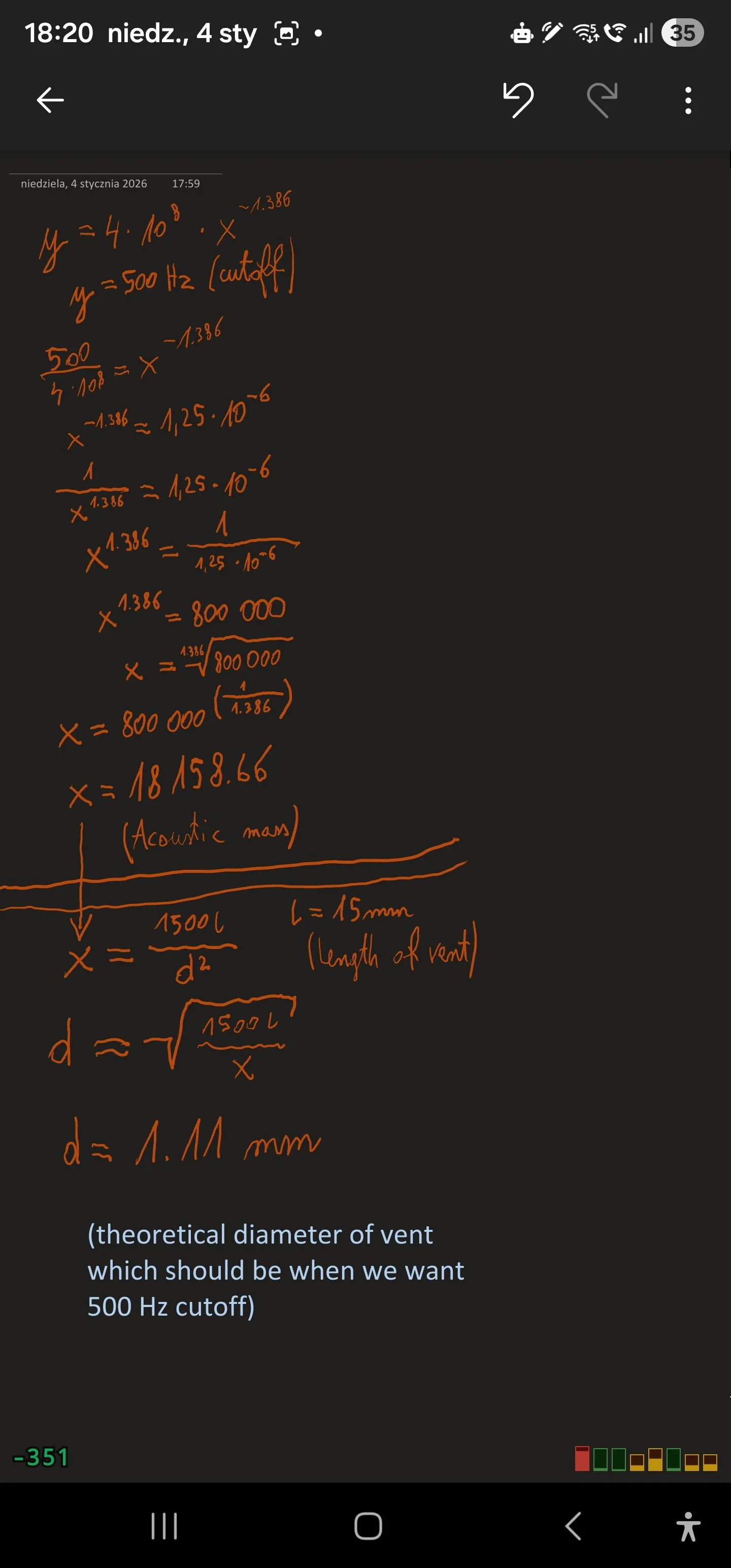
I’ll try, but I have to find a math solver which I saved 1 year ago and can’t find it yet One year ago I have made an equation for fast transitioning diameter to acoustic mass (and vice versa), assuming constant length.
It worth be noted thats that equation in the second screen is very rough, which we see in R² = 0.59 value, which roughly means that cutoff frequency value can be determined by x (acoustic mass value) with 59% certainty.
Interesting Costco fitting problem: I got both a Jabra pro 30 and a Philips 9050 at Costco so I could compare them (and return one) before the 6 month return window expired. Had testing and adjust mentioned on both by the same Costco fitter. With the Jabra, I could barely hear the TV at the folks are were visiting and our ghost voiced we’re excruciatingly loud. With the Phillips, the TV came booming thru and I could barely hear our hosts voices. At the airport, with the Jabra, the voiced and PA system was crisp and clear. With the Phillips, it was garbled. I would expect that after REM and adjustment the two would sound somewhat similar. This makes me seriously question Costco fitting altogether. I go back to Costco in a few days and will raise this issue with the fitter.
You can ask for a printout of the . They started giving a paper to me automatically. It doesn’t show the curves but some sort of numeric variance? You could also ask to see the results on the monitor as they go along.
eBay. Mostly available are Verifit VF-1, but you want to make sure it is verified working and expect to pay over $2000. Mine was medrx which don’t come up often and was $2500. You can get a Fonix FP 35 for under $1000 if it has the rem hookups but there is a steeper learning curve with those as they are 90s tech even though they were made through 2017. I have one that I use as a HIT box but I’ve done rem just for kicks and it matches the medrx but is harder to learn.
If you buy machines new, they are $5000-$15000 and, at least in the US, you need to be licensed.
To answer your question how does this happen, years ago it was believed that ALL HF losses should be open domes, hell, they tried to put ME in open domes and you can see my . They thought it would solve the issue of elderly people not wearing a hearing aid because of the earmold occluding. Now we know by simple acoustics that this can have a bad effect, but some people just don’t think for themselves and only do what the computer or fitting software tell them. The low frequency of that left ear is enough to warrant a mold, which I understand you have told him.
Nine times out of ten, I know more than the or HIP I’m dealing with simply because I’m a unique loss who they may see twice in their careers, Everyone should ideally have a base knowledge, but it’s incumbent on the professionals to impart that knowledge on their clients, which costco failed at for your dad, frankly inexplicably so because he isn’t exactly a difficult fit.
They should have noticed this when he went back again and reported the devices were not working. There were a ton of failures here that brought us to today, and I do not think it would be inappropriate for you to talk to the fitter yourself.
Oh, I forgot the most important cause of my purpose.
The more efficient earplug effect of my side greatly facilitates my ear isolation when I rehabilitate. It’s then as simple as turning down volumes maximally and turning off HA microphones OR simply turn off the Sphere.
With my new cShell my HA ear isn’t occluded as effectively and I can talk with someone in quiet situations even when I have no CI and HA turned on, with my cShell values.
Oh, I forgot the most important cause of my purpose.
The more efficient earplug effect of my HA side greatly facilitates my CI ear isolation when I rehabilitate. It’s then as simple as turning down volumes maximally and turning off HA microphones OR simply turn off the Sphere.
With my new cShell my HA ear isn’t occluded as effectively and I can talk with someone in quiet situations even when I have no CI and HA turned on, with my cShell REOR values.
OH. Yes, that makes sense. So nothing to do with the gain of the hearing aid at low frequencies–I would be suprised if it was significantly affects with and without just a pressure vent.
But I was hoping to get an idea of what sized vent has an acoustic mass of 10,000 kg/m^4. I thought Henrys were current.
Edit: Goodness it’s been a long time, I got most of the way there but I forget how to manage dividing kg/m^2 by kg/m^4. tells me that if I assume a standardish earmold length of 12 mm then the diameter is 1.36 mm, but I have asked for confirmation from my father the mathematician.
But I’m just not sure I believe what this paper is suggesting (or what I’m interpretting with a rough google translation and my limited french for interpretting untranslated axis labels). I just find it super hard to believe that at -5 that the difference between no vent and a 1.36 mm vent is 35% speech intelligibility. This doesn’t mesh with my patients’ experience, although it is not something I’ve looked at systematically. I’d need to see more in support.
Lour, something you might look in to, I recently got Jabra ’s from Costco and was having a terrible time with muffled speech and overly loud noises. Basically they were terrible to wear. My fitter changed my earmolds and that helped slightly, but when she switched the programing from the Jabra/Resound method (or whatever it is called) to it was like someone flipped a light switch in a dark room. Dramatic difference. I’m happy now.
OH. Yes, that makes sense. So nothing to do with the gain of the hearing aid at low frequencies–I would be suprised if it was significantly affects with and without just a pressure vent.
When I occlude that 0.9mm vent with guitar string (not only in Sphere cShell, but also in Paradise) I feel it works a bit better when I increase the lows by 1-2 step in myPhonak/Amplifon app (roughly 2-5 gain). However it isn’t blinded randomized trial, so I can be biased much.
Even with that thing, new titanium cShells aren’t that occluding like M sized power domes placed past 2nd bend. Although my Paradise cShell have SDS 5.0 receiver, so it can be placed a bit deeper (or it had better fitted its shape to align with mybear canal wall) than Infinio SDS 6.0 with up and the same vent
But I was hoping to get an idea of what sized vent has an acoustic mass of 10,000 kg/m^4. I thought Henrys were current.
Edit: Goodness it’s been a long time, I got most of the way there but I forget how to manage dividing kg/m^2 by kg/m^4. AI tells me that if I assume a standardish earmold length of 12 mm then the diameter is 1.36 mm, but I have asked for confirmation from my father the mathematician.
I’m sorry, I missed your request about 10 000 Henrys. My calculations are roughly similar, 1.34 mm assuming 12 mm vent length.
But I’m just not sure I believe what this paper is suggesting (or what I’m interpretting with a rough google translation and my limited french for interpretting untranslated axis labels). I just find it super hard to believe that at -5 SNR that the difference between no vent and a 1.36 mm vent is 35% speech intelligibility. This doesn’t mesh with my patients’ experience, although it is not something I’ve looked at systematically. I’d need to see more in support.
Indeed, you surely are right. The purpose of that article is to show that chasing like “the more open, the better” is not necessarily much beneficial.
 Poland
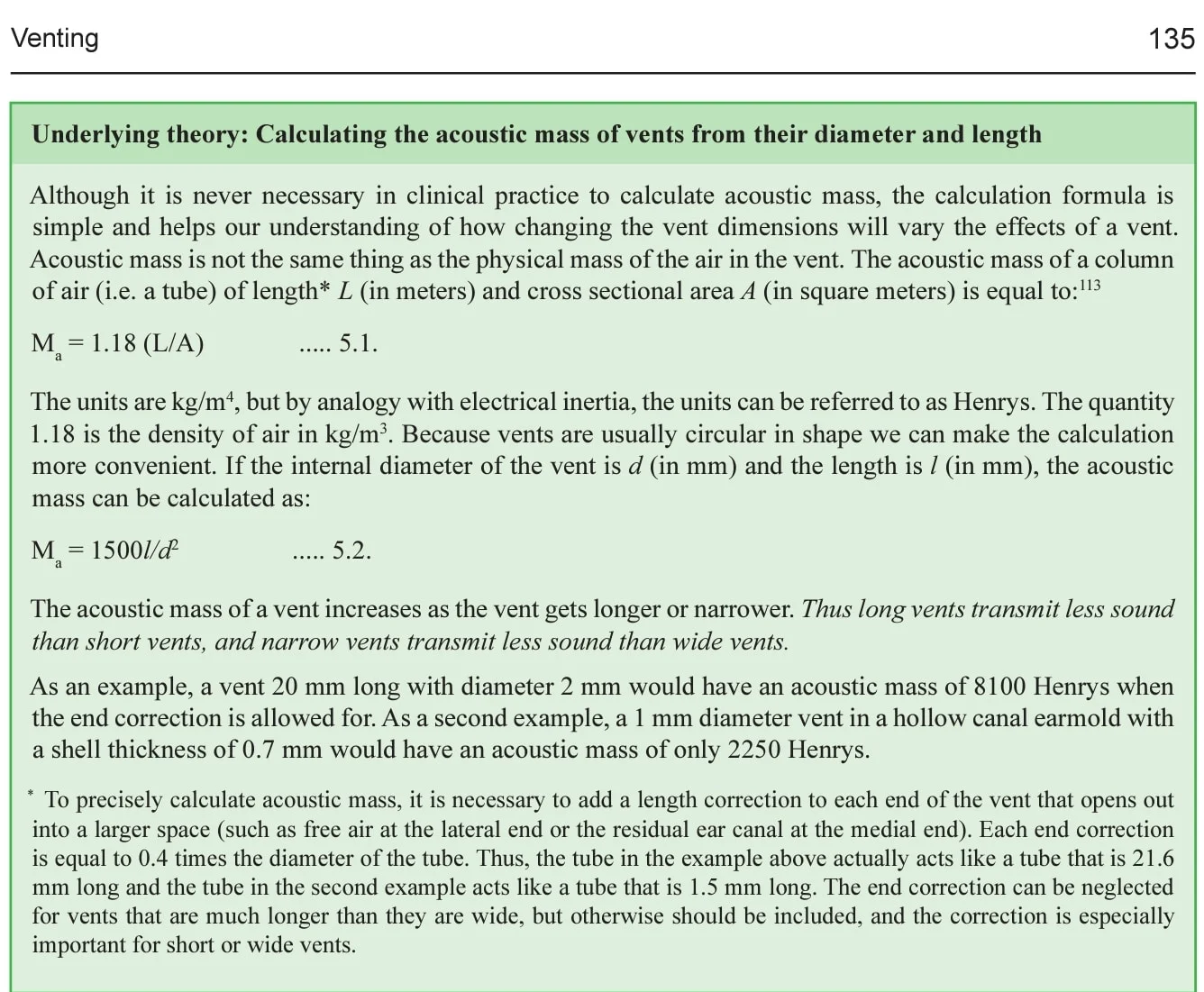
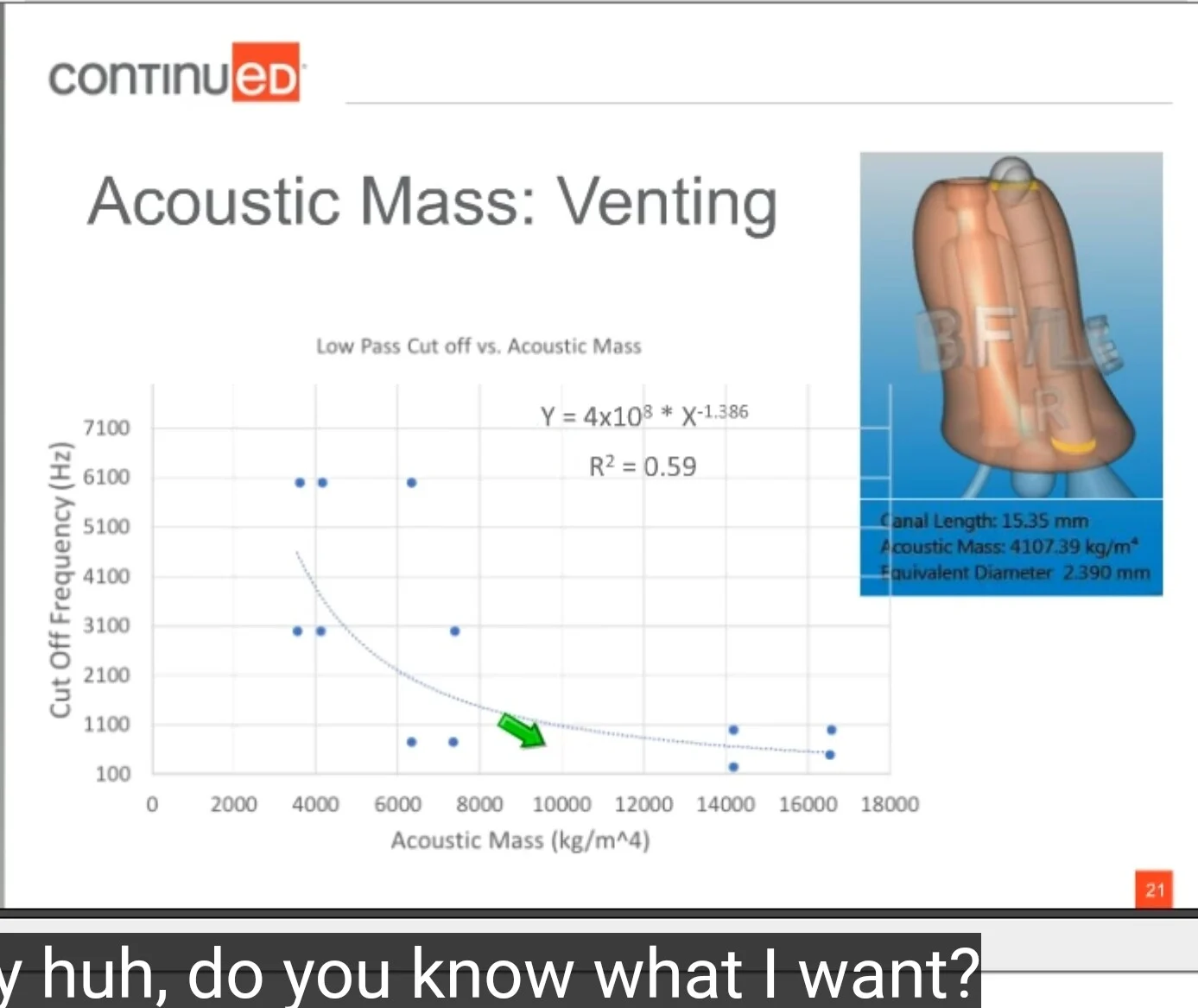
 One year ago I have made an equation for fast transitioning diameter to acoustic mass (and vice versa), assuming constant length.