I'm about to migrate from Costco KS10's (Paradise platform) to the new EON Sphere 90's. My is like the classic straight slope with reasonable lower frequencies to severe loss in the higher ones. I consequently have trouble with speech recognition even in quiet. I'm currently using open domes with P2 receivers.
I tried power domes but found that the occlusion and loss of the auditory cues at the lower frequencies actually made my speech recognition worse. I'm wondering if anyone out there has anything they could share from their own or patients' experience that might persuade me to try custom moulds.
would really appreciate a brief explainer and reassurance that I won't get the disbenefits I got with power domes.
Your own voice doesn't just travel through your airways and out of your mouth. It is also transferred through the ear canal via bone conduction. Power domes if correctly sized trap your own voice inside the ear canal resulting in a boomy/echoey own voice perception. This is known is as the occlusion effect. You can cause it yourself by sticking your fingers in your ears and talking.
Custom shells include a vent that allows your own voice to escape. They allow your audiologist to optimize the size and shape of the vent to balance the competing needs of providing sufficient gain to make the mid and high-pitched you don't naturally hear audible, while at the same time minimizing own voice occlusion.
Custom molds typically have a remake period so that if things aren't right the first time for whatever reason they can be remake to resolve any problems you're having with them. I'm not saying they'll be perfect first time around, but they will be much better than power domes.
The right dome can make a surprisingly big difference in comfort and sound quality. I’d mainly look at how well it seals without feeling too tight, and whether you’re getting feedback or a plugged-up feeling. If you’re unsure between sizes, trying each for a few days can make the difference easier to notice.
I believe you are asking for reasons to use molds rather than domes, correct?
As far as domes go you have many choices. There are pretty good options between open and power domes available. Something very cheap to experiment with.
As far as molds go you also have many choices. To fine-tune ear molds it takes a good and patient fitter to help you find what's best. Your hearing loss doesn't really lean towards molds but they won't hurt you.
When acoustics are changed it's important to run the feedback manager for best results. Performing each acoustic change is also a possibility.
From reading this forum and others experiences with the Spheres the more occluded acoustics seem to really take advantage of the Spheres technology best.
that sounds like a significant upgrade to explore. hopefully the sphere 90s can give you clearer speech while keeping the sound comfortable with your hearing profile.
I had been fitted with custom earmoulds due to my hearing loss and have had comfort struggles starting with standard UK NHS acrylic skeleton moulds, then refit with silicone scooped full shell and ended up trying slimtubes and power domes and I must say that sound quality is much better with custom moulds, generally crisper clarity, music bass excellent and vent to limit occlusion so if its an option then I'd recommend moulds over domes every time. I'm just unable to tolerate but I know most people have no problems. Obviously you have recievers and probably wouldnt need full moulds but the mechanics are similar. If you used power domes you'd limit your excellent low frequency natural hearing
You can try power domes adn push them deeper to decrease occlusion effect. That may require smaller size of power domes, e. g. from L to M in my case.
You can trial Unitron power domes which is from thicker silicone.
Regarding your poorer speech understanding, that was exactly my case when I went to closed fitting ~7 years ago. But there was a mistake, because there was no gain adjustment after changing earpiece. Ideally that should be done with .
I suppose that no one adjusted your amplification after giving you power domes, hence problems.
The earmold/cShells are the best option.
Choosing the vent it's a bit hit and miss. I have no occlusion effect, but I had very good deep silicone impression, at least 5mm past 2nd bend of ear canal.
I don't know if you have dead regions in your highest frequencies (possibly yes, but I am unsure). Didn't you perceive any distortions when, for example high frequency tone were played? From audiometer or anything else?
If not, and if you like to experiment, you can take a risk like I did and go with the UP receivers with no vent (that must be deep fitting to minimise occlusion effect). YMMV, but that was the best fit I experienced.
If there will be too much occlusion and if you won't get used to it, you can always go with e. g. 0.5, then 1mm vent diameter, etc.
I suppose it is better to just go with open domes if you can for a variety of practical reasons. One reason is to spare your from struggling to deliver bass notes, which it can't do too well at the best of times.
In terms of sound, "open dome" means having even just a very little hole or gap for ambient sound to pass through.
The key to proper set-up is to think in term of a HiFi sound system (sadly, an analogy entirely lost on my Costco techies). If you need no HA amplification of lower frequencies, bass "woofer" sound is the ambient which passes through an open dome.
The art is to balance the loudness of that sound with the amplified HA treble sound (in HiFi, that is called "the crossover").
Only the user can do the matching . The user has to adjust the HA gain (AKA amplification) so that the bass matches in loudness the treble. You do this by listening to sources with lots of bass and choosing the good level of gain where the bass is not too loud and not too soft relative to the treble. (I'm ignoring here the task of adjusting upper treble loudness.)
In my experience, I can adjust my Rexton Reach gain so that my HiFi (with a big woofer for organ music) sounds great. But for conversation, I need more HA gain for intelligibility. So for me, there's one setting for music and one for talking.
(One of these days, I'm going to write-up how to do an instrumented subjective evaluation with warble tones.)
I suppose it is better to just go with open domes if you can for a variety of practical reasons. One reason is to spare your HAs from struggling to deliver bass notes, which it can't do too well at the best of times.
In terms of sound, "open dome" means having even just a very little hole or gap for ambient sound to pass through.
If someone is struggling with hearing even in quiet that advice isn't appropriate.
Look at:
Having open fitting will decrease available gain in frequencies over 1500-2000 Hz.
Thanks again to all. This issue is bigger than I realised. I was having dinner with three people last night who all wear ’s. I mentioned the issue of domes and no one realised that there was any choice or that different domes affected their HA’s effectiveness.
Can you explain the reason behind "Having open fitting will decrease available gain in frequencies over 1500-2000 Hz".
Open fitting means, there's much higher risk that already amplified sounds will leak outside of ear canals and get into mics again, making positive acoustic feedback loop.
That means open fitting is only for people with relatively mild high to moderate frequency hearing loss and for people who don't have much problem with speech understanding in noise. That's because unwanted noise gets unprocessed into ear canals making speech understanding difficult.
To make feedback threshold higher, so to get more available high frequency gain, we need to block at least partially ear canal.
In OP's case even complete block may be necessary, unless he has problem with unmanageable occlusion effect or no benefits from high frequency amplification due to e. g. distortions.
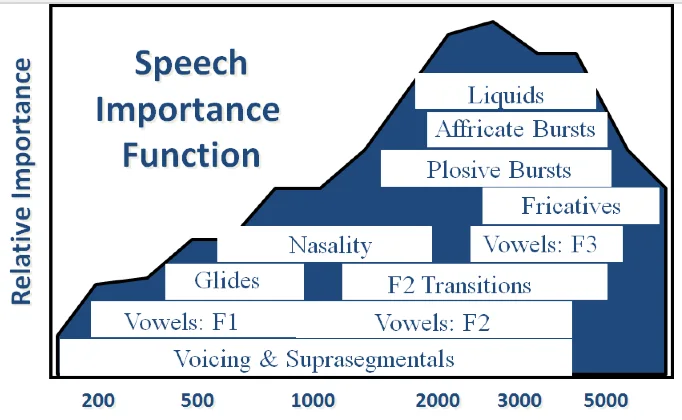
Can you please explain the chart. The frequency bands seem OK but what does the "importance" axis mean or how assessed?
For non-linguists, like me, the most important information from the graph is that hearing sounds above 1000 Hz are crucial in English or human speech in general.
Hence the conclusion that sound amplification in this frequency range is also very important.
Yes, I tried power domes in the hope that they would allow the Paradises to suppress background noise and allow the signal from the hearing aids to help me more but somehow it didn't work out. My word recognition deteriorated. Possibly the audiologist didn't increase the volume sufficiently to compensate for the occlusion - I'm not sure.
When I'm streaming something and I press my fingers into my skull behind my ears to squeeze my ear canals, I guess, I can suddenly hear twice as well. What does this indicate?
What I'm afarid of is that, if I use something that occludes, I will lose all my direct perception at the lower frequencies which still work tolerably.
Possibly the audiologist didn't increase the volume sufficiently to compensate for the occlusion - I'm not sure.
Strictly speaking - gains. That should be with verification, which gives a clue, which frequencies should be amplified more after changing type of earpiece. In my case that would be probably all frequencies from 500 Hz and above, by even 10 more in not beyond that.
When I'm streaming something and I press my fingers into my skull behind my ears to squeeze my ear canals, I guess, I can suddenly hear twice as well. What does this indicate?
Then your ear canal are more tightly sealed, there is less sound leaks, especially bass (but also some high frequencies, which are less modified by antifeedback mechanisms). Hence better general sound quality.
What I'm afarid of is that, if I use something that occludes, I will lose all my direct perception at the lower frequencies which still work tolerably.
With your hearing loss (and mine, which is somewhat similar), you must accept some trade-offs if you want to maximise speech understanding.
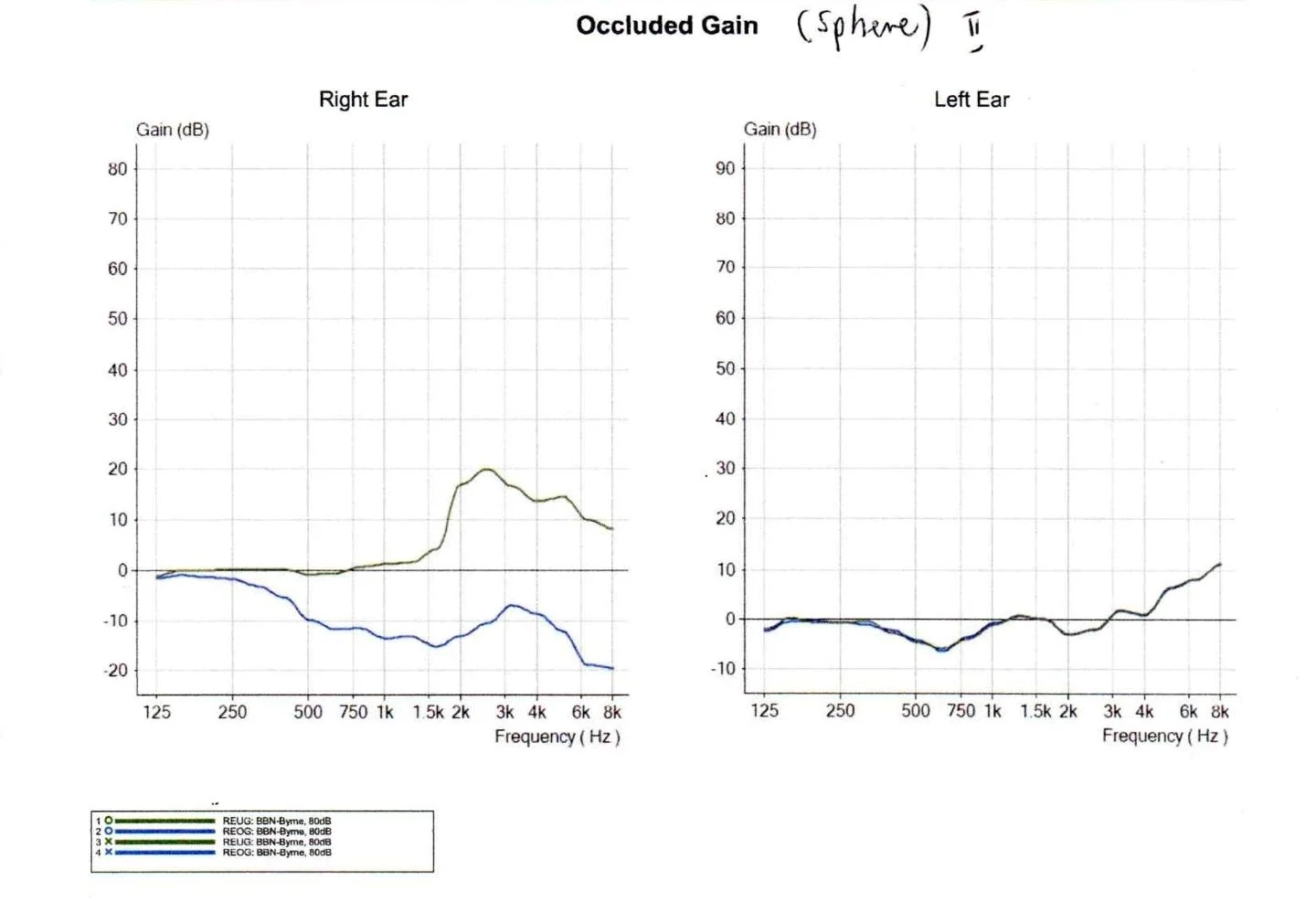
To be honest, I don't feel any particular loss in my low frequencies when having power domes. I don't feel any drawbacks. Look at my REOG with deep placed Unitron thick silicone power domes M size and with 80 dB input:
As you can see, there isn't significant earplug effect below ~300 Hz. YMMV a bit.
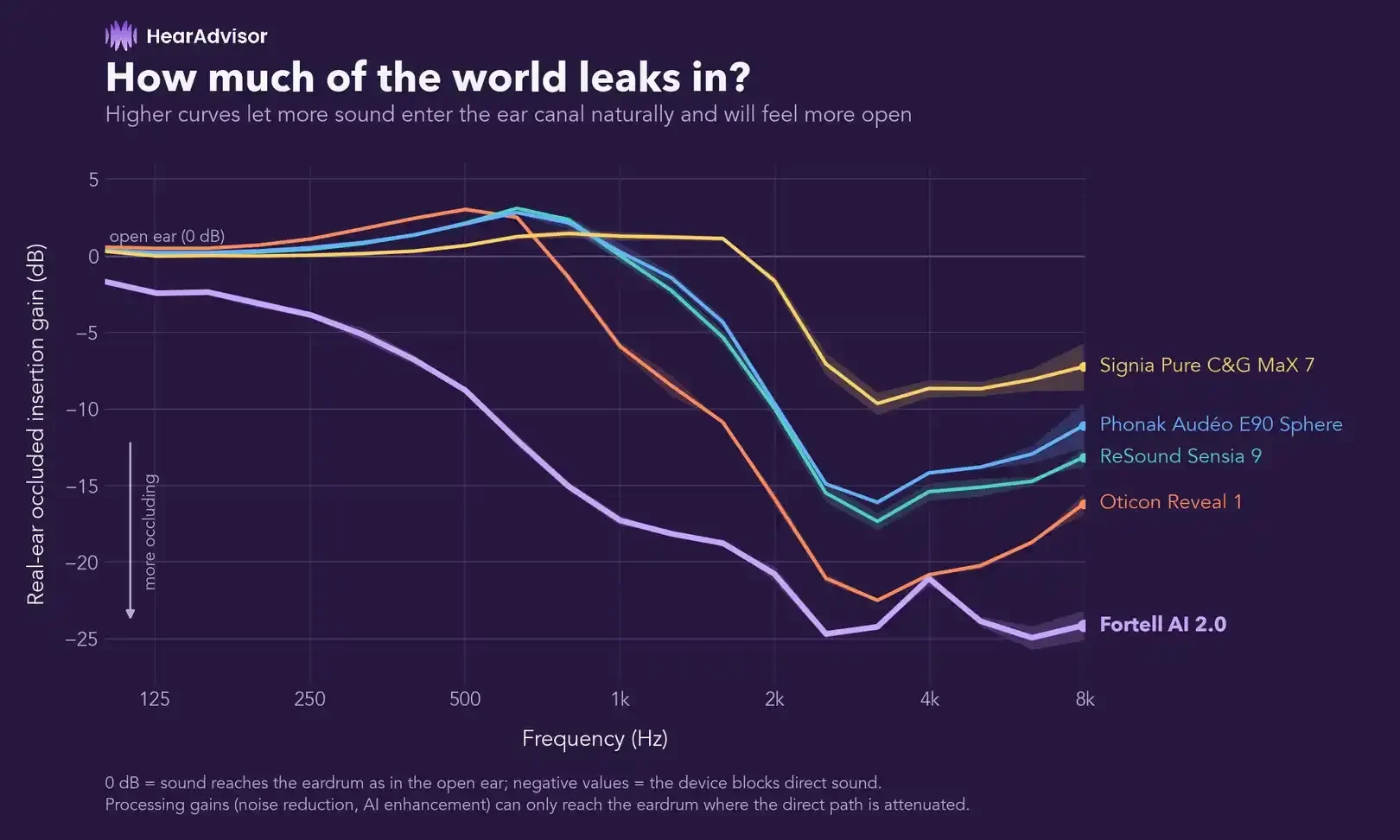
Look here at KEMAR (something like artificial head) in HearAdvisor testing configuration:

 Stroud, Gloucestershire



 Texas Hill Country
 Canada (Toronto) YYZ

 Poland