Audigram Direct is a Phonak feature I have used quit a bit over the years. I’m in the process of buying new aids and thinking about switching brands.
How many of the other manufacturer’s offer the ability in their software to input tones to establish an ?
Test your client’s hearing directly through any hearing instrument fitted in Phonak Target, taking into account the properties of the individual ears and the chosen hearing instruments. It then provides a fast and accurate starting point for the fitting. AudiogramDirect ensures a more personalized pre-calculation, leading to enhanced spontaneous acceptance and less fine tuning efforts.
Additionally, it is very easy to select and compare diagnostic data obtained in different sessions without having to exit the fitting session. You are able to overlap two curves in the same view for easy comparison and showing the progression of the clients hearing loss over time, a feature that is extremely valuable in the counseling process.
Widex has this feature. For some reason, Oticon/Sonic have removed in-situ audiometry from the most recent versions of their apps. IIRC, Signia/Resound don’t have it.
Differences between conventional and in-situ threshold levels may be attributed to (1) frequency, (2) device/hearing loss, and (3) calibration/manufacturer effects. Frequency effects primarily resulting in an overestimation of hearing loss by...
Considering that in-situ is inaccurate, and especially unusable in cases of conductive hearing loss, I would always follow up in-situ based fittings with , where possible.
I’m confused. I know nothing about audio measurements. . . But I’m being told in-situ is inaccurate because it doesn’t match another measurement technique. Yet it seems in that study the clients were not consulted. Frankly I don’t think the clients care what the numbers are or if they are “inaccurate”. The client is after an outcome where they can hear.
The conventional hearing test and rem depend on the equipment being properly calibrated. So is everything always properly calibrated? What happens when they aren’t?
During an in-situ test who cares what calibration is. The aid generates a tone and asks the client, can you hear me now? Can you hear me now? Can you hear me now? This is how much noise I’m going to make at this frequency, can you hear it? Peculiarities of the aid, receiver, and ear canal all in place and the client asked if they can hear.
I’m confused. I know nothing about audio measurements. . . But I’m being told in-situ is inaccurate because it doesn’t match another measurement technique. Yet it seems in that study the clients were not consulted. Frankly I don’t think the clients care what the numbers are or if they are “inaccurate”. The client is after an outcome where they can hear.
In-situ can be accurate, Widex has used the method (Sensogram) for years to establish in situ gain adjustment. It’s simply not transferable, which is often the basis for such studies - which involve comparisons of efficacy.
However, within the closed loop of a single fitting, the gain adjustment from the transfer function generated by the in-situ measurement works - and you can check the result with a separate R.E.M. However, the gain will not necessarily reach the full R.E.M. target, simply because the manufacturer wants the hearing instruments to sound good on the first fit, rather that the potentially ‘harsh’ full prescription.
However, within the closed loop of a single fitting, the gain adjustment from the transfer function generated by the in-situ measurement works - and you can check the result with a separate R.E.M. However, the gain will not necessarily reach the full R.E.M. target, simply because the manufacturer wants the hearing instruments to sound good on the first fit, rather that the potentially ‘harsh’ full prescription.
It would be a fascinating run in-situ and then choose over the manf’s own fitting rationale in the programming software, and then verify a NAL-NL2 target. My guess is even then the would be off … not sure such a study has been done. I performed in-situ with Widex/Oticon/Phonak in the past and was never happy with the resulting REMs, but it’s been a while, and I can’t recall whether NAL rationales were available or whether I selected them.
I use PHONAK AUDEO serie and SIEMENS PURE BINAX, both type.
Considering PHONAK AUDEO, I have 2 pairs;
S SMART III-312 xP
Q70-312 xP
If I interchange the receivers (both are xP) from S SMART with Q70, my final hearing sensibility is different. I guess it is due the intrinsic difference in receivers production.
So when a ha user measures using in-situ or direct … I think that this process consider the particular difference between RIC pair or even HA deviation.
I raise this topic from the grave, here is the topic from 2017. But I’m just wondering what the situation is now with the AudiogramDirect option.
Has anyone now worked with the new Paradise series of hearing aids to see how effective this IN-SITU option will be compared to the one done according to the and of course according to the measurement.
Could the measurement now be carried out with the installation of noise shields to eliminate external noise. Because new hearing aids do not need a wired connection.
I figured it out.
We do the in a cabin that is soundproof and we raise our hand when we hear the slightest quiet sound and it is then marked on the chart.
And “In-situ” is when we do it with hearing aids.
is a measurement of hearing to determine if a hearing aid is delivering sound as prescribed by an audiogram. The hearing aid may measure the volume differently, or perhaps the cause of the insufficient or excessively amplified sound may be in the mold or uneven channels in the ear. I read that somewhere on some forum.
In-situ should be the most accurate measurement, because we do the same thing we do when we make an audiogram. The chart may not be the same as in the Audiogram.
And when we go to REM, it will look at the audiogram to see if the hearing aid is delivering the same sound. Whether I understood correctly or not, correct me if I am wrong. Isn’t REM wrong then? The equipment we use for Audiogram will probably not be calibrated in the same way as the hearing aid.
wrong
is to find prescriptive target is correct
let say you wear dome so gain is to give 20 db
but actually its giving 15 db even though software show 20 to compensate REM will add another 5db …
For the past 10 years I have always relied on the done by competent audiologists. I have a record of them over the years and can see my hearing decline gradually as I age (and hopefully not because of bad hearing protection habits).
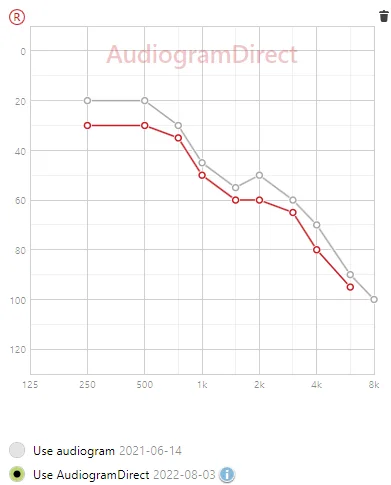
And, for my last three annual “checkups” I was able to benefit from adjustments to my (currently M90-R). My last Audiogram was 14 months ago. Before planning to travel 2 hours to my audiologist again I spent some time (quite a lot of time) experimenting with AudiogramDirect (Target’s in-situ hearing test software). Here is the final result - the grey is the 14 month old Audiogram and the red is my right ear AudiogramDirect result…
The difference could be due purely to a 14 month decline in my hearing, but I doubt it (based on my 10 year trend pattern of decline). And, after applying the results of the AudiogramDirect my hearing is greatly improved across the range (not surprisingly). So, I don’t yet have the benefit of REM on top of these AudiogramDirect results but my hearing is currently about as good as I can ever remember (i.e. since before 10 years ago).
Could it be that conducting one’s own AudiogramDirect is “more accurate” than the audiologist’s Audiogram? Note: I probably ran the AudiogramDirect tests over 20 times overall to get them as exact as I could, in a very quiet room. I tried various levels of “I can hear that”, applied the results, and tested the sound of the HAs over a few days. Each time going back and adjusting up or down the amount to which “I can hear that”. The happy medium, for me, was when I could just barely hear “something” then went another step louder to where “I know I can hear that” but softer than “I definitely hear that very clearly” - if that makes sense.
I’m just offering my personal experience at this and hope it helps someone else. It’s definitely worth a shot and I think I’ve gotten my HAs “better” (for me) than what my various audiologists have arrived at in the past (no knock on them - they are very good at what they do but, I think, appropriately err on the side of being a little conservative.)






 Auckland, New Zealand


 Wales, UK

 Croatia