There is a cool video on edge and Dr. cliff has one on the Livio Edge. Hope this helps answer your question. Please feel free ask any other questions.
I watched this Dr. Cliff video mentioned, and one thing he said toward the end (which made me wonder myself, too) is if the Edge Mode seems to always improve the experience, why not just enable it automatically all the times from the get go instead of making the users turn it on and off as necessary? Is there some kind of drawback to leave it on all the times?
Too many posts to search to find the best one to reply to but Starkey are mentioned as having some involvement in the Alphabet (Google’s parent company) Wolverine project.
@bluejay2025 I was wondering if the Thrive transcribe app that you use can also be used for phone calls? Say if you receive a call with the speakers voice streaming by bluetooth directly to your hearing aids and you leave the phone on the table and read the transcription as the person talks? Sometimes i miss words on the phone and transcription with the Thrive app would be very handy if this feature is available? Thanks.
@bluejay2025 I am sorry for the confusion. My understanding from the Starkey website is that the translate and transcribe is only for close up interactions and not long distance phone calls. What i meant was that can the transcribe feature be used for long distance phone calls? As both speakers on the phone will be English no translation will be needed. Thank you and i appreciate your great posts on your experiences for the Starkey Livio Ai Edge 2400.
You understand me well @bluejay2025. Maybe Starkey will release an update (firmware i believe it is called) in future to transcribe for phone calls like from a friend or family member calling from home. Currently it seems from your post that it only works up close and person to person. I get you
I believe that half the stuff makers claim is not true for everyone. In a perfect scenario with symmetrical hearing and no unusual hearing issues they might work. Widex has PureSound but to me there is nothing pure about it. Many people would not be a candidate for PureSound. Signia has sensors that are supposed to adjust to your environment but it doesn’t work for my hearing with nerve damage that causes a static sound at medium high frequencies and impact sounds. Autosense cannot adjust for this.
I am trying the Resound Jabra (like the Resound One) from Costco. Early on the, Ultrafocus, would be hard for me tolerate for long. The Jury is still out on the Marie receiver but I am hopeful with further adjustments this would work for the long hall. My settings are at 70% of target and I still have to adjust things down to reduce that static crackle sound with the app. So far, if you could use the KS10 from Costco with the stability of the Resound app you would have one of the best values anywhere for HAs. Sorry for the long comment.
Hi all , It is my understanding that if you have the Starkey Livio 2400ai Edge mode then i would assume that there is no need for mask mode? Also no need for customised memory settings such as car, cafe, theatre and other regular geotagged locations. Just double tap for Edge mode.
Isn’t that what Edge mode is made to do? Or does it have it’s limitations in adjusting to environments and it is better with customised settings in the thrive app? Thanks.
Many thanks your very informative post. I am starting to understand much better now the difference between Edge mode and why it is important to use customised settings.
Please let me recap. So everytime Edge mode is turned on in a new situation such as a noisy restaurant it needs to be turned off after leaving the restaurant so it can rest. Got it!
And if you get in your car say 10 minutes later and start driving and there is background noise you need to use the customised CAR settings in the thrive app (or hearing aid) because the Edge mode will sound tinny if it is turned back on too soon. So Car mode in the thrive app can now be used for any amount of time because Edge mode is off. Again, got it!
The confusing part now follows…When you go to a new situation such as a family gathering and you turn the Edge mode on, how do you know when to save the custom setting as family gathering? Is it better to wait until Edge mode is turned off so it has finished analysing or do you make adjustments in real time and save the settings to what you think sounds best?
So everytime Edge mode is turned on in a new situation such as a noisy restaurant it needs to be turned off after leaving the restaurant so it can rest. Got it!
And if you get in your car say 10 minutes later and start driving and there is background noise you need to use the customised CAR settings in the thrive app (or hearing aid) because the Edge mode will sound tinny if it is turned back on too soon. So Car mode in the thrive app can now be used for any amount of time because Edge mode is off. Again, got it!
First of all, to clarify, I don’t wear the Starkey Livio Edge so I don’t claim to know much about it.
I just want to ask using common sense here, but I don’t think machines get tired and need to “rest” in the literal sense, right? My understanding of the concept of turning the Edge mode on when needed, then turning it off when leaving that environment and entering a different listening environment, is that the act of turning it on allows it to analyze the new environment, then maybe retrieve from the ’s memory that is a trained database of settings for different environments, and activate a new adjustment of the various hearing parameters in the HAs that are more suitable to this new environment.
Then when you leave this environment and enter a different environment, you need to turn off the Edge mode, not because it needs to “rest” as in being tired per se, but the more appropriate word to use here is that it needs to be “reset” and the HAs get put back into the regular mode, since the last Edge settings may no longer be appropriate for the new listening environment anymore. Then if you’re not happy with the regular mode’s settings in this new environment, you can activate Edge again so that it comes up with a more optimum setting/adjustment for this new environment.
So the idea of needing to give Edge a “rest” and “can’t turn it back on too soon” (because it’s still too tired?) is not really true, right? It’s more like you need to turn off Edge to allow is to reset (not “rest”), then reactivate it any time (even very shortly thereafter) after the reset if needed so that it can re-analyze this new environment in order to re-adjust to a more optimal setting for a new environment if the regular setting is not good enough for you.
@Volusiano Reset would be the right word although i understand this is what bluejay2025 meant by rest. I was thinking that Starkey livio must be overheating from all the analysing, lol
So basically it means reseting (turn off/on) Edge mode everytime you enter a challenging environment and preferably use the saved memory settings if it gives a better result. I can understand that it would be a nuisance to do this for so many different environments and having to save customised settings. It was mentioned in earlier posts that Edge mode should always stay on so no resetting would be needed and thus there would be no need for customised memory settings? Could there perhaps be any downside to Edge mode being in Auto mode?
Edge like I wrote is situational. It needs to be turned off to learn from the experience.
This statement about Edge “learning from the experience” implies continuous learning by the particular hearing aids worn by that particular wearer and it continues to get better over time. It also implies that each set of smart that learn by themselves over time become different and unique from other sets of Livio Edge HAs, and maybe a set of HAs that are worn by a wearer who is exposed to many different difficult listening environments may eventually become “smarter” (strictly in terms of dealing with a myriad of difficult listening environments) as compared to a set of HAs that are worn by a different wearer that seldom is exposed to difficult environments.
But I don’t think this is true. I read the Starkey Livio Edge AI whitepaper, and there’s no indication that the HA has the ability to continue to self learn and self improve. There’s also no indication that there’s a mechanism that it can connect through the internet to share its unique continuing self learning database (if there were one) back to Starkey so that all users’ self learning HA’s newly acquired data can be used to improve this AI database.
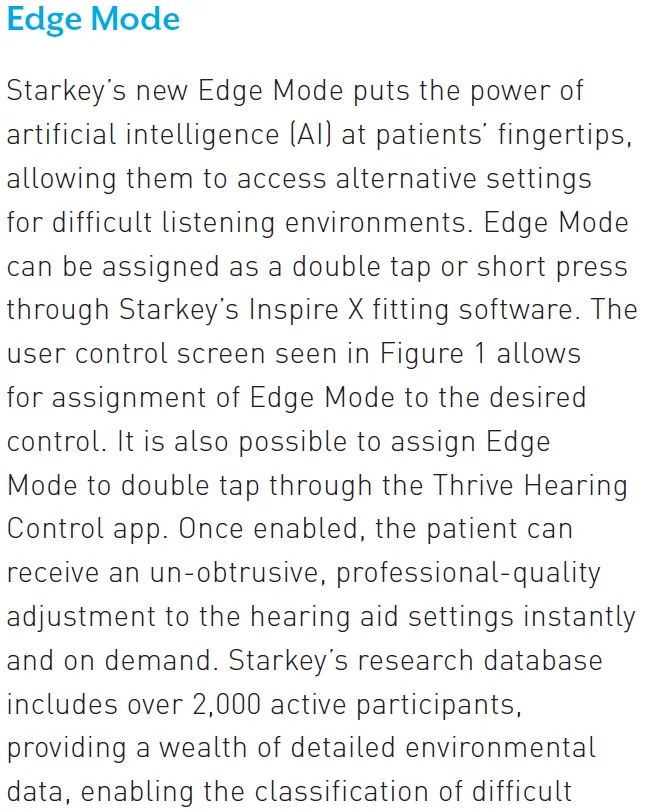
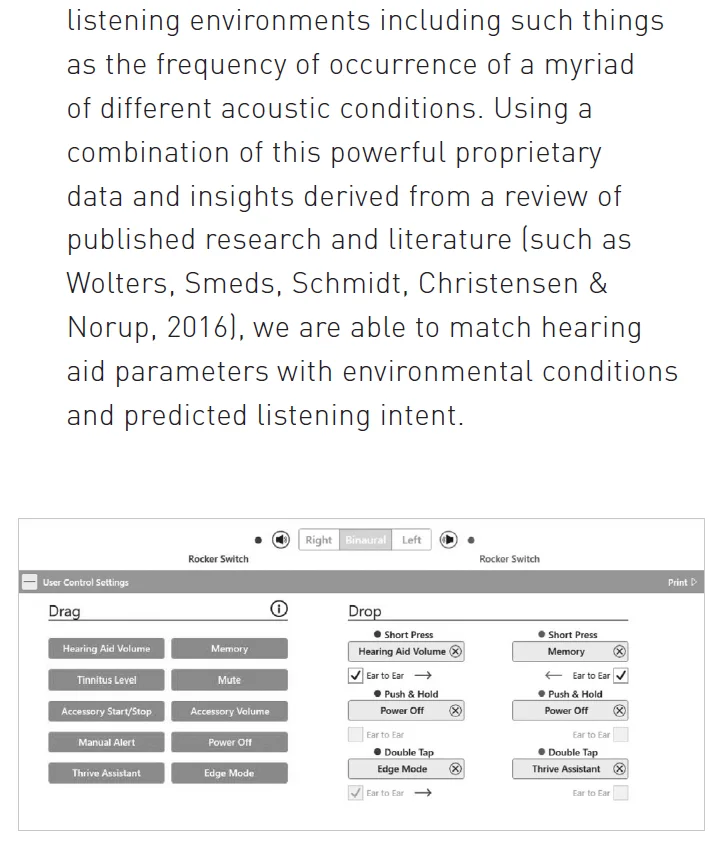
My understanding is that the AI was used to build up a database from over 2000 participants, and the Edge mode taps into this database (which presumably is stored into the HA) to match then set the HA parameters with the most appropriate environmental condition in the database to the current live listening environment that it has analyzed when activated. Below is a screenshot of this description in the whitepaper.
Now maybe over time, Starkey will continue to improve this AI database they have, then through firmware updates, users can download Starkey’s newer and more improved databases in the future to perform even better and better over time.
But the bottom line is that I don’t see any ability for self learning inside the HA described in this whitepaper, nor any mechanism to connect and upload this self learning data back to Starkey mentioned as well. The AI has been pre-trained into a database that’s presumably loaded up and stored inside the HAs, then retrieved via the Edge activation to get the most appropriate HA parameters for the particular environment. But no continuous learning going on as far as I can tell.
Interesting posts…thanks for these valuable contributions. It helps many of us newbies like myself understand the complexity of Ai and machine learning? (or perhaps programming) when deciding to purchase the Starkey livio edge ai hearing aids. My conclusion is that i will use Edge mode whenever i face a challenging situation and let it choose the pre-programmed situations that it thinks is best fit for the current situation. Starkey did say that Edge mode can be used in a mask situation but i will rather use mask memory mode in the thrive app as bluejay2025 has the experience with masks. And if i jump in my car i will use Edge mode again. Do we really need so many custom memory settings for the ai 2400 when Edge can be automatically activated with 2 taps on the hearing aid?
I have extracted this information but not from Starkey…Maybe this is why it is confusing regarding Ai and Machine Learning.
The launch of Livio Edge in July 2020 continues the tradition established with Livio AI by using artificial intelligence to mimic and, even, surpass human intelligence.
What is artificial intelligence and how is it used in hearing aids?
Artificial intelligence (AI) is a program that can sense, reason, act, and adapt. It encompasses machine learning, which has been available in hearing aids for some time now, in the form of acoustic classification of different environments. However, with the introduction of direct connectivity in hearing aids along with Cloud computing possibilities, AI can now be implemented in hearing aids to improve performance and customise personal performance in a way that has never before been possible. Livio Edge AI is the culmination of advanced AI and complex Cloud computing to offer instant optimised adjustments via a feature called Hearing Reality Pro .
I searched Google to learn more about Hearing Reality Pro is, and it seems like it’s just the name of the Starkey platform that the Livio Edge is based on. I don’t know why they call it a “feature” in the text you mentioned. Maybe because whoever wrote that text (which you said did not come from Starkey) didn’t really know what they were talking about specifically and was just making assumption that the Edge AI is a cloud based feature called Hearing Reality Pro, even though according to Starkey, it’s just a platform name. I could not find any indication from my Google search of Hearing Reality Pro using cloud computing to upload or download self learning data,.
Anyway, below is the link to the whitepaper on the Livio Edge AI’s Edge Mode that I was referring to. If you can find any mention of using cloud computing to upload or download self learning data, feel free to point it out to me because I’m interested to know and maybe I missed something.
@Volusiano. Thank you. I shall read the whitepaper. You are a very wise and informed forum member. This is why i get trust issues because it takes a lot of digging around to find the truth.
I would rather not say where i got the information but i am disappointed in what i assume may be a kind of Bend the Truth advertising. Not many people looking to buy hearing aids would read white papers or even have heard of it. The first thing they do is read the advertising and then perhaps visit a forum or read reviews from Google or Redditt/Quora.
@Deafas: I’m also glad that @Volusiano has decided to apply himself and his considerable expertise to the layman’s explanation of Starkey’s take on /Edge, but I’m still puzzled:
Surely a Starkey Livio Edge 2400 AI user isn’t obligated by the complexity of the hearing instrument to do so much ex ante analysis? It’s not like you’re buying a small aircraft, the advance knowledge of whose idiosyncrasies is necessary to avoid a crash.
It’s a pair of hearing aids that - if it were light years ahead of the other big makers - would have people flocking to it in droves.
[EDIT: I wish I had taken my own advice and done a Search, prior to making this assertion:
This seems not to be the case, judging from the few users who are actually posting about it on the Forum.
In fact, there have been a significant number of posts by satisfied Starkey user/members that attest to Starkey’s popularity.
What I was originally trying to say - but flubbed badly - is that if the Livio 2400 Edge AI was actually as revolutionary as it is sometimes described, the rush of people to buy it would crush the competition (viz. Oticon More). This, clearly, has not been the case.
{@jim_lewis gets credit for calling my cards on the original false assertion.}]
If you’re absolutely set on your self-determined decision to purchase these instruments, surely wearing them will provide a quick and authoritative response to your queries?
My concern is that you seem bent on doing the selection and fitting of your hearing aids all by yourself. Were you already an experienced user, equipped to enter the realm, that would be no cause for apprehension, for it would not compromise the satisfaction that you’ll receive from your devices of choice (any make).
Have you considered what disservice you may be doing to yourself to have already given the role of an audiologist such short shrift in your ongoing theoretical evaluation?
My comments are intended just as a friendly challenge to your path, that I’d ask you to consider - because I’m on your side.
Not many people looking to buy hearing aids would read white papers or even have heard of it. The first thing they do is read the advertising and then perhaps visit a forum or read reviews from Google or Redditt/Quora.
@Deafas: If the truth were known, I think that most people (and not just Forum members) would do none of the above, but would just go with their audi’s/’s recommendations (to their possible chagrin!).
They might check your cited sources, after the fact, to reduce any post-purchase cognitive dissonance they may be experiencing because their audiologist gave them a bum steer.
This seems not to be the case, judging from the few users who are actually posting about it on the Forum. (In fairness, they may be such satisfied customers that they don’t feel the need to post, as they’re already happy.)
I think it’s always dangerous to judge the ACTUAL current quality of anything on such bases.
Bill Gates in his 1995 book The Road Ahead, which was interesting in many ways although it may very well have been ghost-written for him, begins by mentioning tornadoes of group enthusiasm or deprecation that lift some software companies up and tear others down despite the relative quality of their products because some are in the right place at the right time and others just get screwed up on the luck of the draw, crowd psychology, etc.
Starkey was once the darling of the hearing aid industry. It prescribed hearing aids for five U.S. Presidents. It’s founder and CEO Bill Austin got too busy being a media and social “rock star” and left the running of the company to his compatriot Jerry Ruzicka and things went south from there. Hopefully, Starkey’s present ’s are more in line with the quality of their original products but they have a terrible interim history to live down. So no matter how good present Starkey HA’s actually are, any potential new HA wearer coming to the forum and finding the substantial enthusiasm for Phonak, the past (hopefully well-over) clouded history of Starkey, how much do you think actual present HA quality determines a trial and buying decision…? It’s a positive feedback cycle, either in the UP or the DOWN elevator (tornado).






 Oticonian/Disposablyte