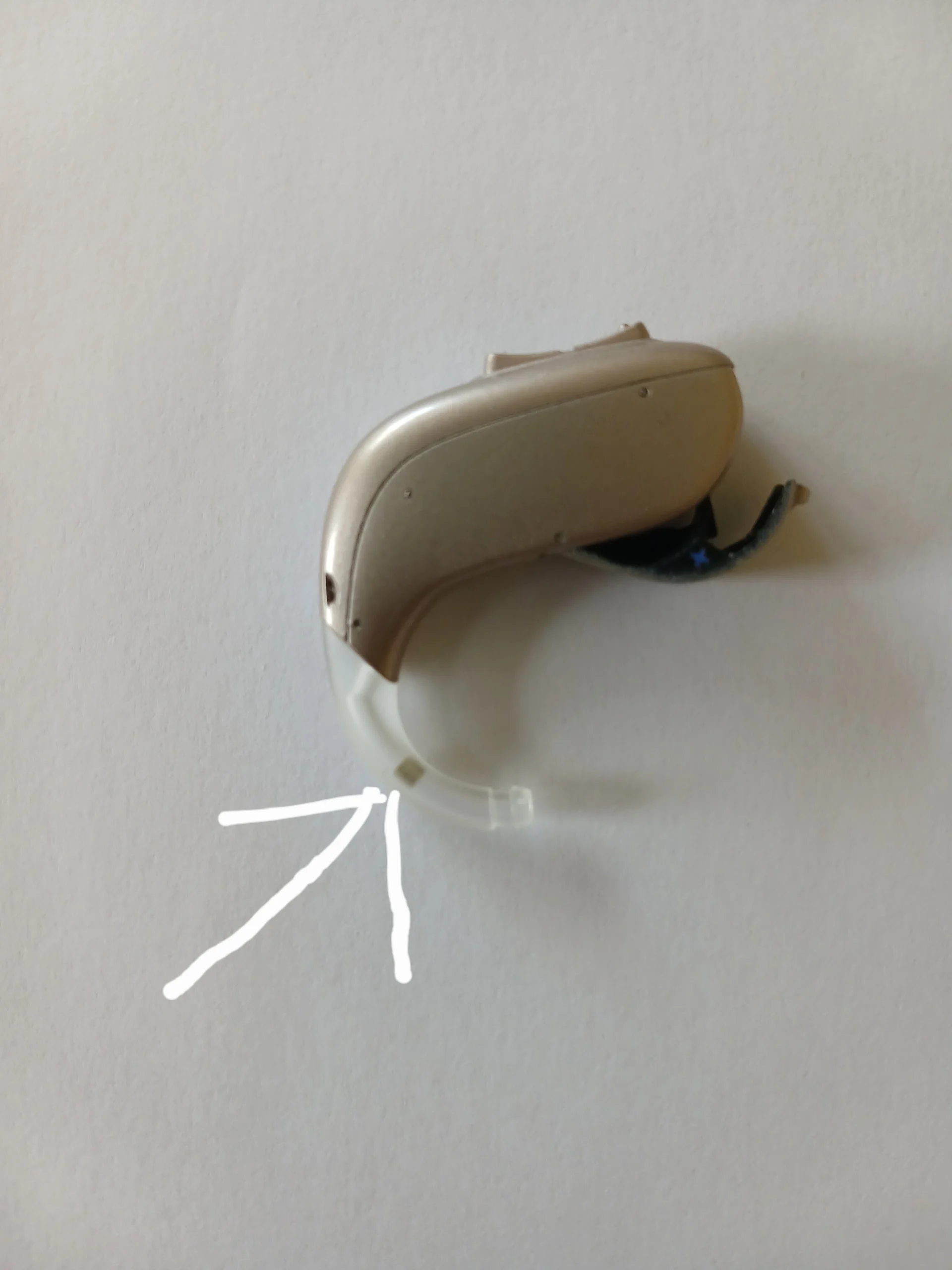
Reading how important it is to replace regularly, I contacted Oticon UK, sending a photo, to ask if my aids have them as none of the instructions or videos I found seemed relevant to my Oticon Engage aids with custom moulds. They replied promptly saying mine did not have wax filters which surprised me a little. However, they didn’t identify the object inside the transparent sound hook which looks like a filter to me (see photo)
. Can anyone confirm this or otherwise?
If it is a filter, how can I change it ? I recall the NHS audiologist once detaching the sound hook from the aid with a special tool, perhaps to change the filter.
The reason you don’t have a is because your hearing aids don’t have receivers that go in your ear canal, where they would be vulnerable to wax. The receivers on your aids are located in the main body of the aid, the part that goes behind the ear, hence the name “behind the ear” or . The sound is transmitted through a tube, which could get blocked by wax, but this is easy enough to clean out, and no electronics will be damaged if the tube gets blocked, unlike the case with receiver in canal aids (), which do need filters.
Thank you. Understood. The dampener is a long way from the ear canal to be a . Any wax would become visible in the tube I suppose which I haven’t noticed. I do get a little bit of moisture in the tubes though. I guess the dampener is a sound buffer.
My Danalogic Ambio hearing aids don’t have a dampener.
Sound Damper’s can be a proverbial pain… In the last couple of years I have removed them altogether, as they can swell up with moisture, and solidify, completely blocking the ear hook so that no sound can pass the blocked damper! If I leave the damper in situ, within 6 to 8 weeks it will solidify, usually at the most inconvenient time, I use a paper clip to hook it out…TBVH, I do not notice if a hearing aid is damped or not, to me at least, it sounds exactly the same! Cheers Kev
That’s interesting. At my hearing loss levels, a sound dampener in those style hearing aids I used to wear (I wear now), would cause some muffleness in addition to that muffleness that was caused by the noise reduction programming. Removing the sound dampener was a requirement for mine.
Thank you all. 12 years with hearing aids and I’m still learning!
My NHS hospital-supplied Oticon Engage aids are no longer supported as I got NHS funded Danalogic Ambio aids from an optician in 2025 as replacements but they aren’t as good as the Oticons (in my case at least as they over- amplify high frequencies making clattering and tapping sounds a bit uncomfortable). Therefore I’m tempted to experiment with the Oticons by removing the sound damper to see if it makes a difference. After 4 years with the Oticons, it’s possible that the dampers may have absorbed moisture. It looks like a small needle-tip tool is required to push out the pin holding the sound hook in place. On the other hand, should I leave well alone as I’ve always believed the adage -”If ain’t broke, don’t fix it” ?.
lol i love that these companies spend millions on research to make these devices as efficient as possible and two chuckle heads on the internet are just like “sure remove one of the parts, it won’t make any difference.”
Well what would you know about this, tell us how this is gonna impact anyone’s hearing? Of course your talking nonsense as usual, it’s just a dampener in a ear hook, there’s a reason why they offer different types, you don’t have to use it, best to offer advice instead of… nothing
Yeah agreed @tenkan you can buy them with or without the dampers, I believe they are also around 3 different sizes of ear hooks, probably more? I have a couple of boxes of them, given to me free gratis, I never had a problem with the dampers solidifying with moisture up till approximately 2 or 3 years ago, perhaps the manufacturer changed the damper material, there was some discussion on here around that time on damped or undamped… I believe one of our resident Audiologists “Um bongo” (aka Stephen) in his professional opinion recommended leaving the dampers in, but I am for my sins, an obstinate SOAB, and being practically deaf as a post, and noticing no adverse difference whatsoever either way, so I removed them completely… Perhaps, if I had better hearing, I may have noticed a more pronounced difference? As it is, the difference must be subtle or too subtle for my profound loss? Having to change the ear hooks every 6 to 8 weeks was becoming annoying, but that’s the way of us knuckle heads, especially the obstinate ones…
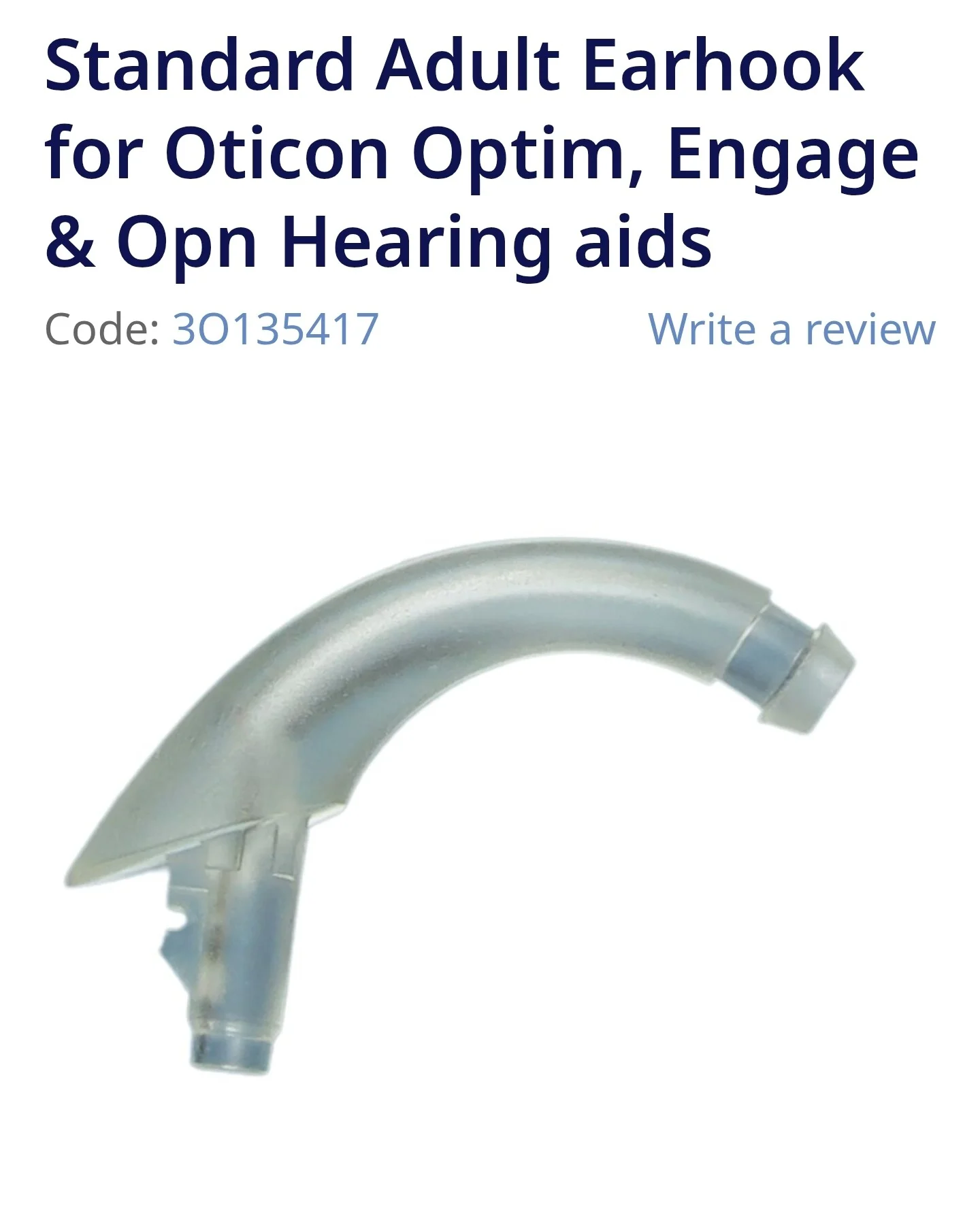
You are most likely showing a small white porous, often called an acoustic damper. It’s located inside a hard plastic fishhook that, in most cases, can be easily replaced by unscrewing and then replacing it with a new hook. The fishhook attachment can cause problems and become defective if moisture enters the hard tubing and collects. Thus, the reason if you wear aids to purchase a good aid dryer that not only dries out the components but also removes any moisture that can collect inside the fishhook.
As I said in my earlier post, I was only considering removing the damper from what are now my ‘spare’ aids as these Oticon Engage are not supported by anyone now as I kept them after having replacements (NHS funded Danalogic Ambio) ) provided by M&S Opticians. I would certainly not tamper with the Danalogics as I can simply go back to M&S with any problems (M&S Opticians and Hearing services is actually Scrivens, a long established Birmingham Opthalmic company).
I would like to know how to remove the sound hook on the Oticon aids to at least check the dampers.
With the Phonak Paradise/Lumiity you just screw the ear hook off. So it’s basically threaded. Personally, I wouldn’t mess with the damper itself and just replace the whole part. Your Audi should be able to give you a few replacement hooks for free.
They are easy to remove, you just pull them straight out, will take a little force, sometimes there’s a tamper proof for children that they have a little pin where the hook connect, nothing to do with screw, do not attempt this as you’ll break it! Removing the damper is very easy as explained.
Thus, the reason if you wear BTE aids to purchase a good aid dryer that not only dries out the components but also removes any moisture that can collect inside the fishhook.
Personally, I have been using a good hearing aid dryer, I believe for well over 14 years, I am on my 3rd dryer in that time… I like to use the ones that also incorporate UV light, to disinfect the aid moulds, I didn’t really know they existed prior to that, until I read about them on the previous iteration of this site, the 20 odd years prior to that, I predominantly used, NHS issued aids, I got them free at point of service, but around 2012, I started buying my aids, this tends to sharpen your mind into looking after your aids, that’s not to say I didn’t look after my NHS aids, but we were never instructed about dryers, or indeed how to look after your aids! Strangely, around 2007, after my “Meniers disease” went into remission, I went back to work, I was trained up on repair, cleaning and maintenance of hearing aids, nothing major, just general stuff, this was with a UK Government Initiative via one of their Social Work teams, called “Deaf Services” part, a small part of our remit was, we held drop in clinics all over the Highlands & Islands for hearing aid repair and maintenance, we also dispensed free batteries, at no point was I ever instructed on dryers! They must have existed? I became quite an expert on changing tubing and ear hooks, it takes me about a minute to change the tubing on each aid, but when you have perhaps a dozen pairs to do each day at a clinic, you soon become fast at it! One thing I would say though, I must emit a fair amount of moisture from my ears, probably because I have no vents whatsoever in my moulds, so the moisture is trapped in the ear hooks, I religiously put my aids in the dryer every evening, it sits by my bedside… This didn’t stop the dampers from swelling though, and completely blocking the ear hooks, so I winged them…


 London

 Scottish Highlands