I have no idea where these hearing aids companies are getting their feedback from.
In this particular case, because Oticon already has done induction charging and has had a smart charger that has a built-in battery inside in their previous models, it’s obvious that they cannot keep these 2 options this time with the Intent due to new requirements that lead to design constraints which can’t realize those 2 things. So it’s not like they need customer feedbacks to tell them that those are the 2 negatives, they already know but still chose to give them up in their design trade-offs consideration.
So it’s not like they need customer feedbacks to tell them that those are the 2 negatives, they already know but still chose to give them up in their design trade-offs consideration.
… which is exactly my point - designing a product that won’t meet the customer’s expectations and needs (a good chunk of us woul like a bit more flexibility). Pretty arrogant behavior, if you ask me. However, similarly to what happened with Oticon in the past and with the Phonak Lumity recently, I expect that at some point they will release a version of the Intent with disposable battery, or at least a more flexible charger. I like my SmartCharger a lot, it is very convenient when I am away from home…
It depends on how big of a deal it is that their trade-off decision is to give up some of the minor negatives in order to gain some of the major positives.
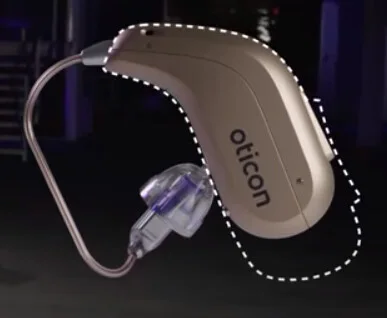
To me, the lack of induction charging is only a very minor negative. As long as they have some kind of a magnetic snap-on design to ensure that the aid always make contact with the contact points (and I heard that they do), then it’s really no big deal whether it’s induction charging or not. Don’t forget the positives from the trade-offs for no induction charging → they now can save off a bit of space at the end there to make the aid shorter than the previous models (see pic below), most likely because they can get rid of the induction coil needed for induction charging now. If they had stuck with induction charging, they probably would have needed a much larger coil in order to be able to keep up with a higher charge rate to accommodate the new size 13 battery, resulting in a bigger hearing aid; let alone being able to reduce the charging time to 33% less than before, and also be able to get a full charge in only 1 hour → faster top up. So if I were given a choice between getting all those trade-off advantages or getting the induction charging, I would gladly give up induction charging in a heart beat.
If I were to bring up a negative trade-off much more worth mentioning, it wouldn’t be the induction charging. It would be the fact that it looks like the battery replacement may not be doable at the ’s office anymore, but might have to be sent back to the factory to get this done.
As for the lack of a portable SmartCharger that has its own built-in battery, it’s possible that they may still make it available later on. When Oticon released the More, they never mentioned any SmartCharger up front. They just waited until it’s available for sale, then they announced it. It’s very possible that they can still make a SmartCharger for the Intent, I wouldn’t rule it out prematurely like this.
Same thing with having a disposable battery version, it may still come later, like it did with the More.
Running out of electricity in a vehicle means you can’t start it. If you’re talking about the rear consumer battery, surely the solar panel would be doing overtime in the types of climate you describe. There’s a couple of genuine concerns with actual camping or something like a raft expedition, but there’s also roll-out solar, bivvy stoves and wind/water generators available.
Imho, the ‘need’ to charge your phone in a given hostile environment would usually mean that you can provision a tiny amount of power for your hearing aids via USB.
When you look at the speech-banana, you will find that 2-3KHz is nearly unnecessary to understand speech.
This is a strange thing to say. You know that the speech banana is a hugely simplified representation of speech sounds, right? There’s a lot of information from 2-3 kHz.
There isn’t any dedicated desktop space. My wife is an Italian and cooks everything from scratch, even when we are out on the road. And yes there are USB ports on both sides of the bed but no place to keep a desktop charger. With my smart charger i put my aids in it an put my charger in my clothes closet without the cable connected. To recharge the charger i can just lay it on the bed. Not a perfect ideal but better than not having any choices. The trailer is small and designed around the kitchen, bathroom, and bed. It is comfortable for the 2 of us as long as be plain our trip out a head of time.
Surely we need all frequency bands - otherwise we wouldn’t have developed an ear for them.
As long as you listen to (one) trained news reporter, you will perfectly get by with the frequencies of the speech banana. When a lot of people talk at once, you will need every cue you can get hold of; especially the overtones that fall into the categories that are not blocked by the other voices.
Therefore i didn’t change the 65db (normal speech level) characteristics but reduced only the high gain within the noise band.
But this is what i had to learn. If for example a singer sings in falsetto (Prince - kiss), he will also shift some formants. Otherwise he would sound like mickey mouse. Then my reduced noise band makes the text and the music no longer recognizable.
So my first try is a useful alternative program - since i have 4 slots in my more1s - but it’s not general purpose. My second try does not reduce anything - just enhances low noise bands.
During the first half of the 20th century, communications engineers at Bell Telephone Laboratories developed the articulation model for predicting speech intelligibility transmitted through different telecommunication devices under varying ...
As always with pubmed the article contains so much information, that even i can’t read it in normal speed. But i will suck out all that’s in it
I have my own “test eqipment”:
A wife with a 42db voice…
she uses her tablet computer also as a TV-set
The radio is constantly on at <50db
The noise from outside ist just perceiveable.
If i sit on the sofa opposite hers, about 4m away, can listen to her tv and can talk to her, and additionally if i clatter around in the kitchen and can listen to the low music, then the configuration could be perfect. If there wasn’t the “constantly rushing faucet” from my right HA.
With my 2-3KHz lowering there is no impact to the low speech and the “normal” loud tv is understandable as well. But the low music is terribly mutilated. There played “Prince-kiss” and i could not recognize what this strange sound is until i approached the speaker.
Same for mostly all other music.
Perhaps i will be able to estimate the impact on speech from lowered 2-3KHz with the formulas.
They are changing the Bernafon branding so it seems I see more like fitted an instrument in terms of environment , also browse the literature notice that the headquarter has moved to Denmark probably dropping the Swiss made branding
I thought that the Encanta is just the newly to-be-released MODEL name for the brand Bernafon, no? Or are you saying that the brand Bernafon now changed to the brand name Encanta? Unlikely.
I think it’s pretty obvious, @billgem , if you go to Bernafon.com2 and you see Bernafon featuring the Encanta as their newly featured hearing aid model. So Bernafon is still the brand name, and Encanta the model name.
not a name change, I notice when you seen the encanta 100 , you notice how they put
this instrument is for quiet, this for group etc. This seems like a new way of communicate
but not saying much about how the instrument really works


 Wales, UK


 Hot Springs Village, Arkansas

 Germany/Bavaria