Longtime sufferers know of my travails. Newbies: I’ve been through the trials of the damned over the last couple of years, including, at one point, in Vero Beach FL, where there’s a hearing aid outfit on every corner (meaning short travel times, my living there at the time), and during which time I visited 4 independent providers, testing 6 different manufacturers’ gear, to no improvement over my Beltone Imagine 17s.
It was only a referral to an hour-away, VERY patient and talented audiologist, which, after about a dozen visits, got me to the ability to reliably understand my wife. Unfortunately, my musicality (auditory and vocal reproduction) never actually made it to my prior hearing-aid-enabled abilities, and as a result I’ve effectively lost a major portion of my life quality.
But I digress. I’m now in NE GA, where providing audiologists are widely spread, and very thinly so, with all but one a minimum of an hour, and most closer to 2 hours, away, so I’m not looking forward to this next round, hoping that the technology has advanced sufficiently to allow me to again understand my wife and regain my in/out music sounds accurately. At this point, we rely on a sender-worn microphone, a kludge at the very best, and a last resort, as it reproduces only the wearer, with my and surrounding sounds nearly gone (I can’t hear anything else than her, nor my own voice unless I’m next to her).
So, the sole local provider is an independent (American Hearing Aid Centers). They sell Audibel and Starkey, as far as I can discern. So, looking for neutral input (no bias to Audibel or Starkey) for a solution which I can’t imagine will be other than:
Full molds.
At the moment, I have all that from Beltone, with high powered receivers. I speculate that the mold might work on whatever Audibel receiver winds up being prescribed, allowing me a faster start while waiting for THEIR full molds to fully and properly assess the Audibel option.
You may very well be a candidate. You may also be a surgical candidate–it wouldn’t resolve your hearing loss but might improve the left ear to a degree that hearing aids work better for you. Maybe you’ve looked into both of these options already.
Unfortunately, even with , equipped places are - at least for the dozen or so we’ve tried within a couple of hours here - not even rare; they aren’t here.
And, of course, if they weren’t a Beltone provider, they wouldn’t have the software to match up to it.
The is very nervous-making, as there’s no going back. But, what sort of surgery?
TIA and currently for your expertise and contributions here.
Yeah, you’re not in the easy-decision zone where one ear is totally useless. Under 60% word recognition usually makes you a candidate these days, but the choice of risking 60% word recognition versus 0% is very different. (Good CI outcomes can ive you 80-90%.) Although, at least in my region, centres that do CI candidacy assessment also do real-ear verification to determine whether the hearing aids are even set up correctly (so that they can say, “you don’t need a CI, you just need a better provider”). So the process alone may be worthwhile.
Possible stapedectomy on the left ear to close up the air-bone gap and at least get it more like the right ear, possibly. I don’t know. I don’t know what the etiology of that conductive component is, but worth asking an . Sometimes that little bit of improvement brings you out of the range where a hearing aid cannot even replace the sounds you need and back into better benefit.
I’m not surprised there are a lot of hearing aid providers on the Florida coasts, what with the elderly retired crowd, snowbirds of a certain age, the employees and enthusiasts of the space programs, aficionados of fast/loud boats, people who go to clubs with loud music, concerts at casinos and such and people who have various hearing challenges independent of noise exposure. It’d be kinda foolish to pass up such numbers of clientele.
It’s too bad it’s such a challenge now to find a variety of nearby audiologists.
we rely on a sender-worn microphone, a kludge at the very best, and a last resort, as it reproduces only the wearer, with my and surrounding sounds nearly gone (I can’t hear anything else than her, nor my own voice unless I’m next to her)
I don’t know about another manufacturer , but in Phonak’s I can set balance between HA mics and external mic.
Just a quickie:
I had a great deal of difficulty finding (none) an with ; I didn’t go to any which might have investigated other stuff, though it may come to that. No local outfit (I don’t now recall if there’s even an ENT in my area; I know that if so, it was a rarity among the very few we found within a 2-hour drive radius) had REM…
I didn’t see Dr. Cliff; got a link?
My app has the ability to affect surroundings and microphone volumes, but my surroundings, even with the mic quite minimized, doesn’t get it, presumably due to the various frequency tweaks which has allowed marginal speech elsewhere. But that reminds me that I might want to ask my Beltone rep, later today, to tweak the surroundings in the PalPro (microphone) portion of HearMax…
My experience with Audibel. They are primarily sales oriented. They have a high turnover of audiologist in my experience.
Audibel hearing aids are locked Starkey.
If you go with one go with Starkey, they are not locked.
I wear the Starkey Edge . It is a very good hearing aid. It performs well in noisy situations if that is important to you.
As you know the trick is finding an audiologist that knows what they are doing.
Once again my experience. That is really hard in an Audibel shop.
Locked?? Whazzat? My MIL, RIP, had one of each in my time in Vero, both from the same provider, who was very skilled, and had a proper endoscope and a variety of dredging tools to remove gunge.
The Beltone lady I’m seeing later to day, to revert to my prior setting (which was very good other than that I had to use the speech clarity tweak in the all-around setting), has an endoscope which goes to her phone, rather than the pro version of the lady in Vero; I have a similar instrument and as noted in an earlier post, regularly inspect my canals and dredge if there’s anything there…
Yes the Audibel aids are locked to Audibel.
A few years ago there was an audiologist who came to this site to see if he could get a pirate copy of an Audibel program.
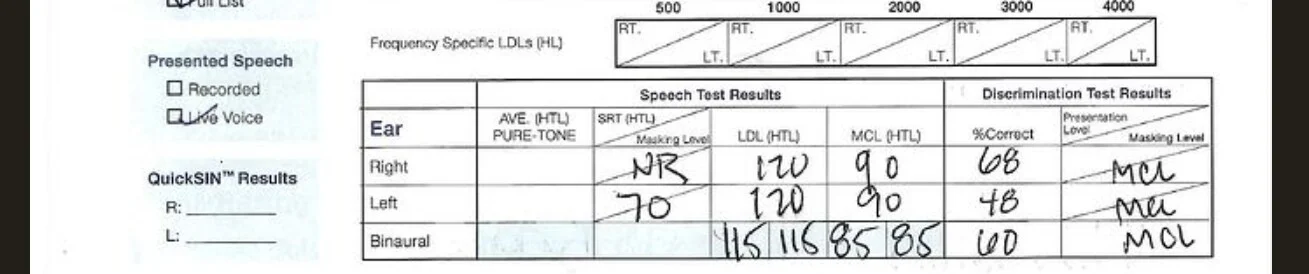
Oh what was I looking at? I saw 68% right and 48% left.
It is a bit hidden:
EDIT: Oh, or maybe it’s 60% binaurally? Hard to recognise if it’s 100 or 60% If the latter, then considering evaluation is definitely recommended option.
However, it was live voice instead of recordings. I would repeat this test but with recorded words before seeking a CI route. Strange to see results lower than with the better ear (60 vs. 68%).
I had a great deal of difficulty finding (none) an ENT with REM
is completely different job. It’s a doctor - physician, who is also a surgeon and examine your ear, nose, throat and possibly laryng if he/she see an indication for it. He could never hear aout , because it isn’t his job area.
REM is done by audiologist or hearing aid specialist - It’s a completely different job, mainly done after ENT appointment.
HearingUp, the new home of Dr. Cliff 's Best Practice Pro Network, is where you will get connected to top-notch local care from experienced hearing professionals.
There is also Dr Cliff Aud channel on YouTube if you have time amd energy to watch it.
Ok, so it’s probably an error margin. So I was right that should be repeat for getting more reliable results, regarding route. Thanks for clarification.
Yup, HUGE error margin on . For the actual candidacy assessment they’re taking lots of things into account, WRS less than 60 is just a gross guide for referral.
Error margin is huge on recorded. On live it’s… Well the test is barely worthwhile. But typically patients will do better on live --clinicians can’t help but help, even just by mildly enhancing enunciation.
So, with apologies (they might be useful as separate posts outside of this thread), I’ll document what’s happening on this round, including (where available; see the page regarding American Hearing Center/Starkey).
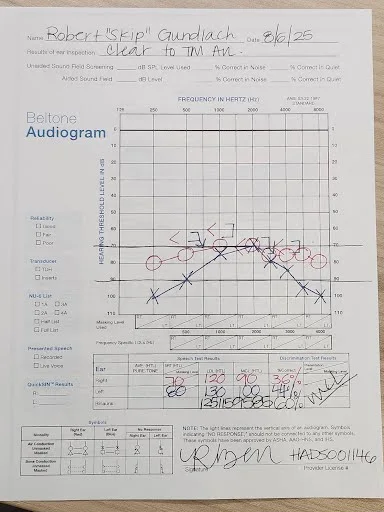
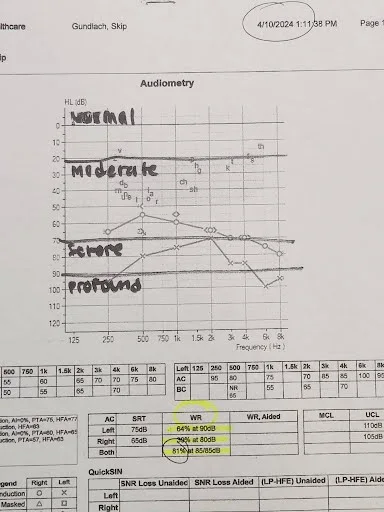
Generally speaking, having gone back through my previous audiograms, however, I’ve seen a steady decline in my acuity. As Neville noted upstream from here, voice testing is fraught, so I don’t know how much veracity to attach to whatever I see, but in general, my right ear seems far worse at word recognition, while being generally better at tone acuity (can hear the test tone). That’s counter-intuitive to me, but I’m a babe in the woods despite my being a wonk about nearly anything (INTJs tend that way, if you happen to be familiar with MBTI you may know that), and anomalies stand out. As well, from one audio tech to another, there are significant differences, which to the orderly mind, raises questions about the reliability of any of them (which, if any, is correct??)…
Patrick Lockett did a test with Lydia reading some words from behind me in open air with my Beltone 17s in their current, ineffective all-around setting; I MAY have gotten one correct.
Testing was a combination of the usual recorded “say the word…” and his own voice. He used over-the-ear non-inclusive (pads sat on my ears) headset, and did not test with bone conduction.
He did some volume testing using his own voice in a conversational mode (blah, blah; is this comfortable?) after each (of 3) several-word recognition tests, presumed slightly more amplified each time. The final one I got all correct.
United Health Care’s program had some gonzo impact on the potential for the recommended Starkey Genesis, a 2-years-into a typical 4-year new-model cycle, with acrylic molded-in receivers; impression to follow in a week, as I was unwilling to commit at that time, because:
It’s a one-and-done deal. No refunds (which is curious in light of what I thought was an industry standard requirement, albeit with potential surrender charges, of a 30-day, money-back trial).
He was unwilling to give me a written quote, and I didn’t record our conversation, so don’t have an exact number, but Lydia and my recollection has it in the neighborhood of $2500, +/- a couple hundred, for the pair.
The system (he sez) is actually dispensed by United Health Care, though any Starkey dealer (he sez) can implement the 3-year warranty should any issues with any part arise in that time; the no-refund part is ostensibly due to UHC (apparently/presumed) taking ownership of the transaction.
Among all the hearing providers I’ve encountered over my journey he was the sole instance of being unwilling to give me a copy of my until I had purchased the (any) hearing aids, using an excuse that I could take it and go to anyone and get whatever-they-sold fitted based on that profile. I found that mysterious and likely inaccurate, though pros here could comment as to its truth/efficacy in reality. But as I’m a wonk, I’d want to have that as a reference point, if for no other reason than to see my progression into the profound loss area.
So, research is needed to compare the Starkey Genesis to others which are presented as the top of the line by other providers, and to see about the assertion that it’s now really an insurance owner, rather than he, which/who will be my source-of-product. But the cost is extremely attractive, unless:
He cautioned us strongly:
Avoid ANY ambient noise (background music, a television playing, etc.). This is problematic in that we are frequently in unavoidable background sound circumstances, such as a restaurant, a group sitting around a table in conversation, with other tables doing the same in the post-church coffee chat, a walk through Walmart or any similar retail situation, and the like.
Do not expect to understand anyone who’s not right in front of you, and facing you. Next room, or any variant on the theme will give marginal results of understanding whomever you’re speaking with.
(To the speaker): get my attention before speaking to me.
While I agree that doing all that is ideal, ideal isn’t the real world.
Overall, the only potential benefit I found against any others so far is that it’s claimed (I have not confirmed) that these are made in Minnesota, and thus not subject to international shenanigans of any sort; during Covid, e.g. with ports tied up, he claimed that he was “business as usual” whereas all the others’ products were locked down in ports.
I’m scheduled (if I decide to pull the trigger here) to return in a week for a mold fitting. The head-end is a bit fatter and shorter than others I’ve seen, which is of no particular concern other than of interest. The only outstanding benefit (of no real concern, but of interest) is a claimed true waterproof system; I could go diving with them on, he sez. On the other hand, Starkey sez:
“Does Starkey make a waterproof hearing aid?
Thanks to our proprietary Pro8 HydraShield™ technology, Starkey rechargeable hearing aids are waterproof up to 1 meter and engineered to withstand sweat, rain, dirt, drops and dunks.”
Given that I’ve forgotten, and dived off the back of the sailboat I used to live on for 15 years, at least once, into salt water, over 10 years ago, in my previous generation Beltone Imagine set, without issue (rinse, blow neutral-temperature air at them including the receivers = worked just fine), I consider that state of the art, not unique, not that I’d go deep diving (or any other swimming!) wearing these.
So, the cost is attractive, but the one-and-done is scary. Furthermore, I want to know why I wasn’t quoted on the Edge, a step up, based on reviews here and elsewhere.
On the positive side, it’s by far the closest provider, at only 20 minutes from my home; the closest other possibles are an hour away, though there’s one which I’ve yet to visit only 40 minutes away…
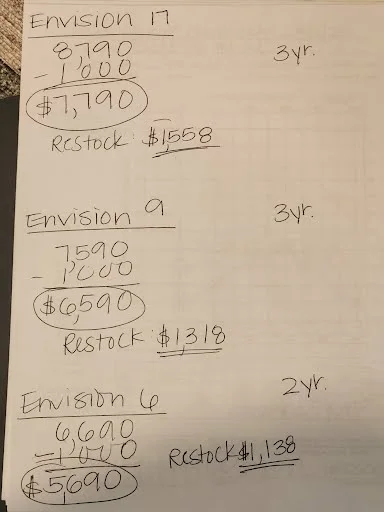
Rachel Bell encouraged me to invest in the Beltone Envision 17…
This is two generations later than my Imagine17s; I learned that there are 3 different levels of programs/channels/whatever in the Beltone lineup: 17, 9 and 6. The Envision is a very recent addition to Beltone, so relatively state of the art.
My current is suspect, in my mind, as it was done in her office which, while it had waffle foam on all the walls and the door (other than the frame around it), the ceiling and floor were hard surfaces. As well, much of the testing was done in her own voice, in open air (vs directly into the ear; in this case it was foam encased ‘receivers’/speaker-pipes, so relatively sound-secure/directed into my ear, for the tone testing and recorded “say the word” series).
Aside from the heart-stopping costs, despite the $1000 deduction (I don’t recall if that’s a discount or a trade-in allowance) the major reasons not to go forward with this (admittedly notable improvement over my current 4-years+ current Imagine 17s) set include:
While there is a mandated 30-day trial privilege, the surrender cost is a 20% restocking fee, which in the case of the 17s, means that I risk $1558 to trial these. That to me, given my historic challenges, is a game stopper. In no prior experience was there ANY cost to withdraw from a trial, including the ones from both Phonak and Miracle Ear which had enclosed in a full acrylic mold, and Sam’s Club in soft molds . As well, no discussion was had regarding molds, so I presume I’d use the ones I have now; she’d suggested getting them remade (same impression, as they fit comfortably) just before the warranty expired, as there’s a bit of splitting where the receiver enters and comes out every time I clean them.
The testing is suspect in my mind, as the verbal acuity is far off others’ analysis of my right ear, as well as the test chamber’s difference from any other I’ve ever been tested in (at least 8, over the time I’ve owned hearing aids, and several times at various encounters before actually buying my first Beltone units); all but one were completely enclosed boxes, with the other being an open bottomed, top-closing door.
While I know there are no high-end hearing aids which aren’t expensive to nearly any normal person’s budget, these (well, I wouldn’t go to the lower 9 or 6 channel versions) are a dime short of $7800. No mention of a trade-in, insurance involvement, or definition of whether I’d just use the same molds that I have now (adequate, though it’s entirely possible that either acrylic, titanium, or some other hard mold might perform better) or have to buy new ones, so the actual cost might be higher.
The closest Beltone office is an hour and change from my home; this and the other 2 closest ones is/are 90 minutes away. Any adjustments needed would be a serious time commitment.
Barring some major changes I can’t imagine, Beltone’s at the bottom of my current (several more providers to check out) list. The audiograms shown are the one done in the prior office just before being sent off to find an ENT with capability, and the most current. It appears that GA doesn’t do that, as our search failed in that regard; calling her office generated conversations which indicated that there might be a better chance at resolution of my issues than had been experienced in my previous office, so, having been summarily dismissed (see above about ENT/REM) by my Beltone office previously used in GA, we decided to give her a shot at my challenges…
The two audiograms shown are from just before my instruction to find an REM with Solus Max (the Beltone programming software), done in Gainesville GA in the typical booth (she identified that there are no Beltone offices in GA which have REM), and this most recent time:
The recorded words on the testing program at my audiologist’s office are a woman’s voice giving information about carrots!
It cracks me up, because it immediately makes me think about Bugs Bunny.

 Toccoa GA 30577


 Poland

 If the latter, then considering evaluation is definitely recommended option.