you are not going to convince anybody in Canada that privatized health care is the way to go.
Apparently his understanding is that the perhaps 40% of people in Canada and the US who don’t pay ANY net income tax, can somehow come up with thousands if only their taxes were reduced. Reminds me of the recent talk of reducing some prices by up to 1500%. Seems like most would settle for a mere 100%.
The Spheres are definitely better for noisy environments. The Intent1 aids are definitely better for quiet environments.
I wonder if Oticon Intent1 with 105 receivers gives more gain in high frequencies compared to the Phonak Audeo Infinio Sphere with UP receiver? I mean from 2000 Hz and above.
The pharmaceutical industry has sued a small company out of business that made a supplement that actually improves my vision. I am scrambling to find replacement .
you are not going to convince anybody in Canada that privatized health care is the way to go
Same for other countries with “socialized medicine” (France, UK, Germany, Spain- almost all European countries). The US is an extreme outlier among the OCEDs, and nobody wants to follow their example in this, with its particularly low life expectancy and inequality, despite huge overall healthcare expenditure.
As for chinese goods- the country is indeed (as was pointed out) the workshop of the world. I just exchanged my american Kindle for a far superior chinese ereader (FYI, an Onyx Boox Go Color 7 Gen II). If my book collection or use is of particular interest for someone in China, so be it. What annoys me tremendously more is US immigration going through my gmails and Facebook stuff would I ever visit that country again. No illusions here that everyone spies, but “I have nothing to declare but my genius”, as Oscar Wilde put it.
Sadly, I do not think that this chinese manufacturing miracle will bring HA prices down, where the major cost components are how they are fitted (the audiologist), customer care and R&D, certainly not the hardware costs.
Sadly, I do not think that this chinese manufacturing miracle will bring HA prices down, where the major cost components are how they are fitted (the audiologist), customer care and R&D, certainly not the hardware costs.
with self-fit/test is likely to be the way the market is going for a significant number of these products with the inherent bad/good = outcomes/price trade off.
I hope you are right. Yes, no reason why cannot be produced and sold far more cheaply from China. With Airpods showing the way, I can easily see something similar costing a fifth or so of Apple’s price. The issue that remains is that OTCs are capped for mild hearing loss only. Similarly, earbuds from China have limited maximum volume, due to legislation in foreign markets. But those with severe hearing loss are a far smaller market…
The issue that remains is that OTCs are capped for mild hearing loss only.
Up to 35dB gain from the current crop with decent (possibly Ai) feedback control. So that will do 80-90dB losses fairly comfortably. 15 de-noising claimed.
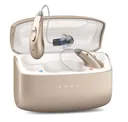
The next gen is already out, trendy little chargers (some with UV sanitation), Ai interpretation running everything. Spousal voice recognition and Ai training likely in the next few versions.
What I think most people don’t understand is that models provide incorrect results at best 24% of the time. Existing manufacturers are using AI to enhance the performance of their existing engineering, but newcomers don’t have access to their existing models to train their new AI in the first place. There will still be large costs involved in developing products that will be competitve with those from existing manufacturers. Then there’s the supply chain, compliance costs everything that comes with this. It is much easier to implement AI in consumer grade products than it is to tackle ones regulated as medical devices.
I don’t believe either model serves the population well. Much of modern “medicine” does more harm than good and the system is designed that way on purpose. Your bodies have been monetized, hence why for example why what was normal blood pressure is now classified hypertension and 1/3 of the population would be recommended anti-hypertensive medication if they had their blood pressure measured. In Canada they’ve even monetized death according to one pro-euthanasia advocate.1
It doesn’t matter whether you pay for it out of pocket or through your taxes. The system is inherently designed to monetize your body and create illnesses using guidelines and unscientific research. This isn’t a political issue in my books. It’s a scientific and social issue.
Hearing aid subsidies actually guarantee manufacturers a lowest market price and reduce competition in the affordable end of the market. Government regulation of markets is needed, but interference with markets has unexpected consequences. Subsidies were tripled in my country and corporate hearing aid clinics simply raised their prices and pocketed the difference when it happened. Without them prices would at least have been honest.
If citizens had control over more of their income they would make better choices than what others spend their money on, because they’d be forced to do the research and make educated spending decisions themselves. When government gets involved in areas involving health and wellbeing, inevitably the cartels end up dominating and determining how the systems run and the taxpayer gets scalped to pay for it. You can substitute insurance companies for government for privately-funded healthcare, because it becomes all about profit. Truly private-funded healthcare means paying out of pocket.
Granted - if it fails to recognise a noise source though, it just stays in the signal which the user isn’t inherently aware of. I’d imagine that training to reecognise feedback would be much easier as the device can internal/external sound source (and inter-mic) comparisons from pretty clear data.
It doesn’t matter where GN and Widex manufacture, there’s been factories in Suzhou/Shenzen for ages, which have reduced due to local wage rises - as long as you get the AI to do the reverse engineering, no current technology can be excluded. So you can feed any piece of kit into the front end, run some directional/noise/speech stimuli and emulate the result. As long as you query the program in enough detail, you can make a working facsimilie. Building it into a small enough package with enough power is another issue: but firms from this part of the world have rarely struggled with miniaturisation.
Much of modern “medicine” does more harm than good and the system is designed that way on purpose. Your bodies have been monetized, hence why for example why what was normal blood pressure is now classified hypertension and 1/3 of the population would be recommended anti-hypertensive medication if they had their blood pressure measured
That’s nonsense. Do you know in what mechanism is hypertension dangerous? Probably not. Explain please, why we have stricter blood pressure standards been adopted only now, and not, for example, 20 years ago? Do you know that anti-hypertensive drugs are very cheap (at least in Europe), but treating hypertension complications may be even more profitable for business because of necessity of expensive interventions and hospitalization?
I do appreciate your knowledge in your audiological field, but in medical issues your post is misinformative and harmful.
I also have a degree in human physiology. I’m not purely an audiologist. Here is a great musical video on pharmaceuticals for treating blood pressure6 (and other widespread conditions) from a pharmacology professor in Canada. The numbers to treat mean for most people the medication is useless and the side effects (aka unwanted effects they don’t want to market to you) affect a greater number of people than those who get the benefits by an order of magnitude.
The reality is that blood pressure isn’t a direct measure of health, and treating it without treating the cause of high blood pressure doesn’t lead to better outcomes, but this is what the medical system does. And now normal blood pressure from 20 years ago is considered dangerous, because its a great source of revenue. There is money to be made and your health has been monetised.
Please don’t accuse other people of being deceptive and harmful when you actually haven’t actually asked why they believe the things they do. Peter C. Gøtzsche, founder of the Cochrane Collaboration has written a book called “Deadly Medicines and Organized Crime.2” I suggest you read it to become better informed on the issues. Prescription medications are the third leading cause of death in the USA. Have you ever asked yourself how it got to become this way?
You do understand that it can emulate speech and music well enough to create an artist with a back catalogue from thin air? Or I can play it a conversation in noise and it can extract the speech? Getting it emulate hearing device functionality is an incredibly basic ask. Making it do that on the fly with 3 volts, slightly harder, but - THE ENGINEERING INFRASTRUCTURE HAS BEEN LEFT IN PLACE - by the big 4/6 moving away from their high labour cost centres in China.
I understand perfectly well what is capable of, but I think there are a lot more unseen variables in designing a system that can optimally manage speech and other sounds across all environments that can also run on a chip inside a hearing aid and deliver all day battery life and natural sound quality. I don’t think it is as basic of a task as you think it to be.

 BC

 Poland


 Geneva, Switzerland
 Wales, UK


 Hot Springs Village, Arkansas
 Doncaster UK