You’re ignoring this member’s posts.
The Walking Dead…..(Big 6/4 manufacturers)
101 replies3k viewsLast reply


@Um_bongo, I agree with you that major changes are on the horizon, but I also think that @Hearing_Potential is correct when he says that it’s not quite that easy to copy or leapfrog the established manufacturers.
The biggest hurdle is the main hearing aid chip. Advanced chip manufacturing technologies are becoming exponentially more expensive, which means that you need ever larger sales volumes to offset the development costs.
Established players have an advantage because they only incur incremental costs for each new chip generation (which still rises exponentially). Plus, they already have a working software stack.
The Chinese market alone is certainly large enough to justify a new chip development, but I don’t think this has happened yet. Tomore (mentioned by @Um_bongo) proudly shows an Onsemi chip with their products:

Nonetheless, IMHO the most compelling argument in favour of gaining market share is indeed . Particularly the idea that gain settings only need to be approximated if AI speech enhancement becomes really really good. That won’t satisfy the audience here (myself included), but it might be very helpful and viable for a large part of the world’s population.
You’re ignoring this member’s posts.

 Wales, UK
In reply to @Hearing_Potential
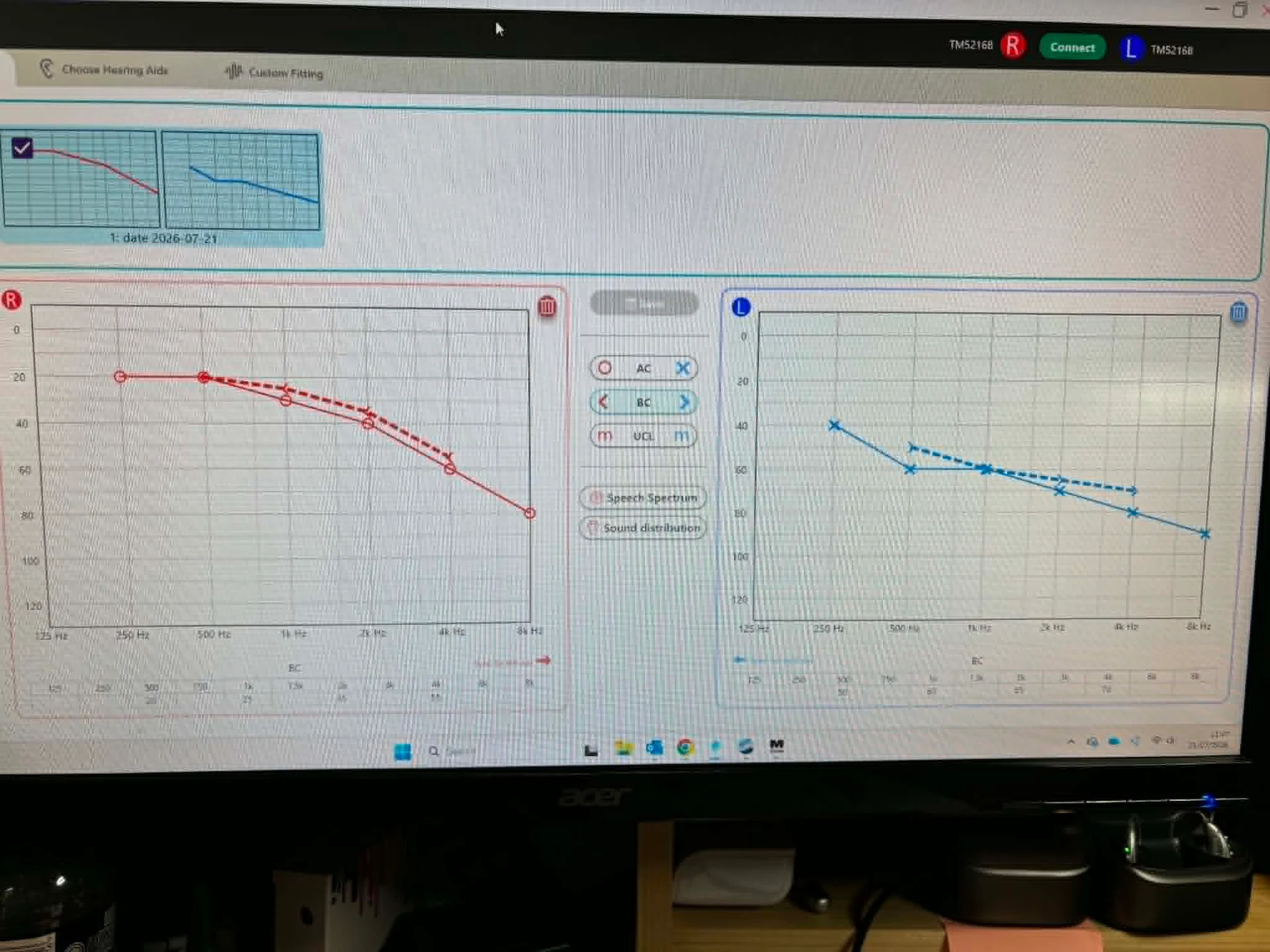
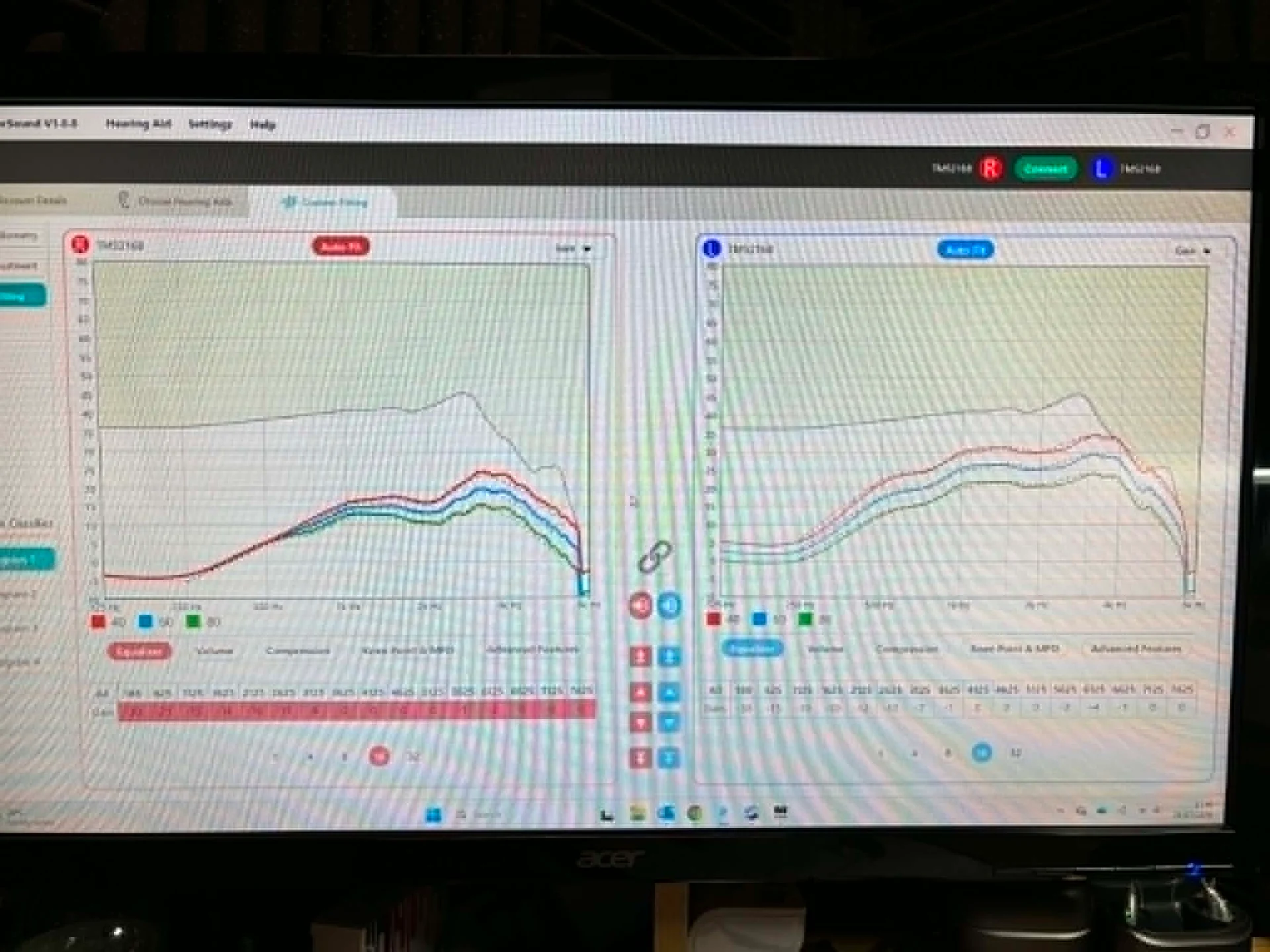
Prescription settings via desktop programming software and also app, connection direct to PC. So and FTF basis. If it quacks like a duck etc. 2 aids and a charger for $100-200 wholesale. The foundations of your castle aren’t quite as solid as you migh believe.
You’re ignoring this member’s posts.
The biggest hurdle is the main hearing aid chip. Advanced chip manufacturing technologies are becoming exponentially more expensive, which means that you need ever larger sales volumes to offset the development costs.
Chip development is driven by volumes - given the barriers to market access (mainly first World prices) how does fully featured product coming in at 10% of current pricing sound? What do you think that does for sales volume.
You’re ignoring this member’s posts.

 Geneva, Switzerland
In reply to @Hearing_Potential
blood pressure isn’t a direct measure of health, and treating it without treating the cause of high blood pressure doesn’t lead to better outcomes, but this is what the medical system does. And now normal blood pressure from 20 years ago is considered dangerous, because its a great source of revenue.
Much of modern “medicine” does more harm than good and the system is designed that way on purpose.
Where to start… High blood pressure, the “silent killer”, is an extremely well-established major risk factor for heart disease, stroke and kidney disease, whatever the underlying cause. Yes, the risk threshold has gone down as large population studies have better defined these, and more aggressive treatments show benefit. No, antihypertensives are a lousy moneymaker for the Pharma industry (in which I spent a career). All these are now off-patent (i.e., sold as very cheap generics) and have negligible side effects. No companies are currently trying to discover new ones.
Benefits/adverse effects for prescription medicines are measured in large Phase III trials and evaluated by independent agencies like the , the EMA and (also looking keenly at costs, and competition) the NHS. They tend to be extremely thorough, often mandating postmarketing studies as well.
You’re ignoring this member’s posts.

Hearing_PotentialProvider
I think you should look at the resources that I’ve linked to. They directly contradict what you’re saying and they’re written by professionals without ties to or funding from the pharmaceutical industry. One shows that the numbers needed to treat are so high that the vast numbers of people taking these medications won’t get any benefit from them, while others are useless. The other shows widespread corruption from academia through publishing, regulatory agencies and NGOs that set guidelines that are followed by medical professionals.
As someone whose career depended upon the pharmaceutical industry I don’t blame you for not wanting to bite the hand that fed you, or wanting to tell yourself a happy story about the good that you’ve done. It is natural for humans to want to believe that they’re the good guys and they’re on the right side of things. But ignorance isn’t bliss and rose tinted glasses don’t take away real consequences.
You’re ignoring this member’s posts.
Hearing_PotentialProvider
So you have insider knowledge. Are you selling these products? How have you found them? Do they have an control? Are they the reason for starting this topic?
If you can share some decent screenshots using the screen clipping tool I’m sure the forum members would appreciate a better look at what the software is capable of.
You’re ignoring this member’s posts.
Hearing_PotentialProvider
I think I’ve read somewhere that Starkey use onsemi in their products. It would be interesting if they could clone their software.
I can see products like this doing well in markets like India where very low cost products meet market conditions. I can see tariffs being applied in the USA and other markets to lift minimum prices to a level where they’re competing with existing manufacturers.
You’re ignoring this member’s posts.
In reply to @Hearing_Potential
So you have insider knowledge. Are you selling these products? How have you found them? Do they have an MPO control? Are they the reason for starting this topic?
Give it rest with the ad hominem. You made a few claims about the technology and said they couldn’t be sold on a presciptive model. I’ve just shown you a couple of shots from the software I’ve seen. As it goes, I’m in communication with a former colleague/engineer from Knowles about bringing his products to market. Also people have derided the use of common chips, but as we know, some of the major players are using the OnSemi product. And like I’ve said; volume is the key to any chip fabrication.
We’re researching other market entrants as part of the process like Shenzen-Sehnrui, Tomore, Mirasing and Bellsing. Those firms aren’t operating within the dominating vertical integration that we’ve seen taking over the conventional market. They are starting to put out new product lines at a fraction of the supply price that we’ve seen elsewhere.
The problem is that due to the ability of the internet to convey knowledge and subsequently goods, the competitive advantage of the big 6/4 is sitting on thin ice and the role of a small scale importer/distributor in each state/area will hit critical mass. Hence the thread title.
I do plan to start selling them once we have confidence in the bulk provision, longevity of the product and the parts logistics sorted out.
You’re ignoring this member’s posts.
Hearing_PotentialProvider
Please note that I was in no way was attacking your character. There is nothing wrong with seeking out affordable products for clients if you think they are a good option and meet their needs.
Your motivation for starting this thread is however your insider knowledge of this product. The information available on their website indicates they are being sold as devices. That they can be programmed as prescription devices (albeit using an outdated formula) is insider knowledge. I wish you all the best with your venture and look forward to seeing how you do.
I do however think that the thread title is a little hyperbolic and a little premature. I hope you can appreciate my scepticism and lower enthusiam.
You’re ignoring this member’s posts.

For those of us who struggle in connecting the dots (me) and without holding you to anything, you’re predicting that within 1? 2? 3? years, we’ll be seeing devices comparable to current hearing aids, retailing for 500 <> 1000 dollars (?), are programmable by the user, available from AliExpress? audiologists? and suitable for those with greater than moderate hearing loss?
You’re ignoring this member’s posts.
Hearing_PotentialProvider
You can purchase these from Alibaba.com5 right now. Looking at the more expensive model, it doesn’t seem to have any processing as indicated in the thread title, but it is software programmable unlike the cheaper option. They’re priced at US$600 according to their official website.
You’re ignoring this member’s posts.
In reply to @Hearing_Potential
That they can be programmed as prescription devices (albeit using an outdated formula) is insider knowledge.
If I couple that to Live Speech Mapping on the Med-Rx system, I circumvent the need to have a prescriptive model like NAL3 at all. When the Chinese work out how to integrate an autoREM function (established on an LSM propotionality model) into their post fit/feeback manager step, then everbody is stuffed.
You’re ignoring this member’s posts.
you’re predicting that within 1? 2? 3? years, we’ll be seeing devices comparable to current hearing aids, retailing for 500 <> 1000 dollars (?), are programmable by the user, available from AliExpress? audiologists?
Now to 18months, yes to all the rest, probably a couple of hundred for for an in person fitting. Ceiling on power might be decided by your local legislature in respect of unprescribed models.
You’re ignoring this member’s posts.
Hearing_PotentialProvider
Are you saying that you circumvent the need to have a more broadly available prescription formula on the device because you’re verifying their targets, or that you’ll be using the FIG6 model instead?
You’re ignoring this member’s posts.
Do they use FIG6 to avoid licensing fees knowing it can be bypassed with ?
“FIG6: Developed by Denis Byrne in the 1970s, FIG6 offered a tabulated set of gain recommendations based on audiometric thresholds. It represented one of the first attempts to formalise fitting rules in a clinically applicable way.” Understanding the NAL-NL3 Prescription System: a new era of personalised hearing aid fitting | ENT & Audiology News8
You’re ignoring this member’s posts.
Hearing_PotentialProvider
They probably use FIG6 because it doesn’t require paid licensing as the patents have likely expired.
You’re ignoring this member’s posts.
You’re ignoring this member’s posts.
In reply to @Hearing_Potential
Fitting in house would be verified using my Avant , so there’s no need to get a prescriptive target via the manufacturer software. FWIW, I don’t really use them anyway (other than as a starting point) as they’re based on a lot of assumptions about average coupling/canal volume/tymp impedance/venting that can’t be proved.
Almost always better to fit ‘blind’ on the LSM and use speech noise to get a basis, then tweak with live voice over a background noise/restaurant track.
You’re ignoring this member’s posts.
You’re ignoring this member’s posts.
Log in to reply to this topic.
Related discussions
Hearing Aids174 replies
Hearing Aids16 replies
Hearing Aids175 replies
Hearing Aid Self-Fitting (DIY)80 replies
Fitting Software Requests1.1k replies